
Negative Cash Conversion Cycle: A DTC Growth Playbook
By Arthur Falcone · Founder of Arlo
Your Shopify dashboard says you’re growing. Orders are coming in. Meta spend is live. ROAS looks respectable. Then you open your bank account and feel sick.
That gap is where a lot of DTC brands get trapped.
You can grow revenue and still choke on cash flow because revenue doesn’t pay suppliers, freight bills, and ad invoices on the day they hit. Timing does. If you buy inventory too early, get paid too slowly, or pay vendors too fast, growth becomes expensive. The faster you scale, the more painful it gets.
I’ve seen founders obsess over acquisition while ignoring the operating engine underneath it. That’s backwards. A store with a strong negative cash conversion cycle can fund more of its own growth. A store with a weak one ends up borrowing, delaying, or cutting back right when demand shows up.
This is why the negative cash conversion cycle matters. Not as an accounting concept. As a growth weapon.
#Table of Contents
- Why Your Growing Store Feels Cash-Strapped
- What Is a Negative Cash Conversion Cycle?
- The Strategic Advantage of Getting Paid to Grow
- How Amazon and Gymshark Mastered Negative CCC
- Your Tactical Playbook for a Negative CCC
- How to Measure and Track Your CCC in Shopify
- Turn Your Cash Cycle Into a Growth Engine
#Why Your Growing Store Feels Cash-Strapped
The usual story goes like this. Sales climb for a few months, your team finally finds a few winning products, and paid social starts behaving. You assume the hard part is over.
Then inventory reorders hit. Your 3PL invoice lands. Creative retainers are due. The card processor settles on its own timing. Suddenly, you’re doing real volume and feeling poorer than when you were smaller.
That’s not a sales problem. It’s a working capital problem.
A lot of Shopify brands operate with a hidden drain. They pay for stock before the stock sells, then wait for the full cash impact of those sales to settle, while vendors still expect to be paid on fixed terms. The business can look healthy in Shopify and fragile in the bank at the same time.
#Growth can increase pressure, not relieve it
More demand often means more cash tied up ahead of demand. If you place bigger purchase orders, hold more safety stock, and expand SKU count before your cash cycle improves, growth becomes a financing burden.
Cash flow stress usually shows up right after a “good month.”
That’s why founders get confused. They think the answer is more sales. Sometimes the answer is better timing.
#The real issue is when cash moves
You don’t need a finance degree to understand this. You need to answer three operational questions:
- How long inventory sits before it turns into a sale
- How fast customers pay after the sale happens
- How long you wait to pay suppliers after inventory is received
If those three things work against you, growth eats cash. If they work for you, growth creates cash.
That’s the shift. Stop treating cash flow as a back-office report. Treat it like a growth lever that sits right beside pricing, merchandising, and media buying.
#What Is a Negative Cash Conversion Cycle?
You pay your supplier on net 45. Your customer pays at checkout today. If the product sells before that invoice comes due, the order funds itself.
That is a negative cash conversion cycle.
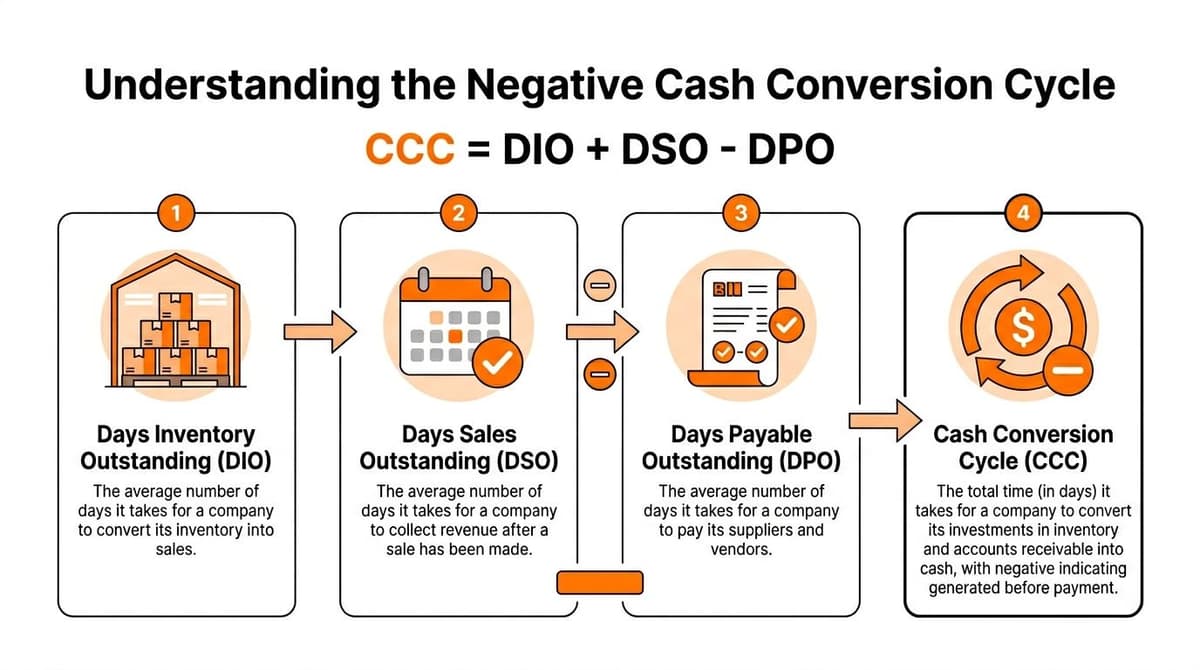
The formula is simple: CCC = DIO + DSO - DPO. For a Shopify brand, you get a negative result when the time inventory sits plus the time it takes to collect cash is shorter than the time you take to pay suppliers.
#The formula in plain English
Here’s the operator version:
- DIO is Days Inventory Outstanding. How long your units sit before they sell.
- DSO is Days Sales Outstanding. How long it takes to collect cash after the sale.
- DPO is Days Payable Outstanding. How long you have before you pay the supplier.
For most Shopify brands, DSO is already strong because customers pay upfront. Your real control points are inventory speed and supplier terms. That’s why this topic matters far more to growth than to accounting.
A founder chasing efficient customer acquisition can still run out of cash if inventory turns slowly and vendor bills hit too early. The brands that win connect demand generation with working capital discipline. That is the same mindset behind focusing on durable customer economics instead of just acquisition volume.
#What "Negative" Means
Negative does not mean bad. It means timing is in your favor.
You collect cash before cash leaves the business. That gap gives you room to reorder winners, fund ads, cover payroll, and stay aggressive without constantly pulling on a credit line.
A simple example makes it clear. Say inventory sits for 25 days, customer cash lands in 2 days, and your supplier gives you 45 days to pay. Your CCC is 25 + 2 - 45 = -18 days. You have an 18-day cash float.
That float is fuel. Use it well.
#The founder takeaway
Do not treat negative CCC like a finance trophy. Treat it like an operating system.
The objective is straightforward. Sell through inventory faster, collect cash with less delay, and push supplier payments out without damaging the relationship. If you do those three things, growth gets easier to finance from inside the business instead of from your own pocket.
#The Strategic Advantage of Getting Paid to Grow
The best reason to build a negative cash conversion cycle is simple. It gives you a chance to grow without begging a lender, thinning out your margins with financing, or giving away equity too early.
If you collect cash before your bills come due, every new order can help finance the next one. That changes how aggressively you can reorder winners, restock fast movers, and press on channels that are working.
#Why this matters more than ROAS screenshots
ROAS is useful, but it’s incomplete. A campaign can look profitable while your operating model imperceptibly destroys liquidity.
A founder who only tracks channel performance misses the bigger picture. You don’t scale on ad efficiency alone. You scale on ad efficiency plus inventory discipline plus payment timing. That’s why cash-aware operators care more about contribution and working capital than dashboard vanity.
If your team is already focused on customer acquisition, this is the missing second half of the equation. Growth only counts when the business can hold onto the benefit. That’s also why I’d rather look at real economics than celebrate top-line spikes, the same logic behind thinking past acquisition volume and toward durable customer economics.
#Where founders screw it up
Some founders hear “stretch payables” and turn into terrible partners. That’s a mistake.
A negative cash conversion cycle works when suppliers trust you. It breaks when you act unpredictable, pay late without warning, or squeeze terms without giving anything in return. If a vendor starts limiting production, asking for deposits, or prioritizing another buyer, your clever cash strategy just blew up your supply chain.
Use this advantage. Don’t abuse it.
- Protect credibility: Pay on agreed terms, not whenever you feel like it.
- Trade value for terms: Offer clearer forecasts, larger commitments, or cleaner ordering behavior.
- Keep a cash buffer: Don’t spend every dollar of float as if it’s permanent.
The extra cash is working capital, not found money.
#How Amazon and Gymshark Mastered Negative CCC
A founder takes a big week of sales as proof the business is healthy. Then payroll hits, the next PO needs funding, and the bank balance says otherwise. The brands that break out of that trap build operations that collect cash first and pay later.
#Amazon turned payment timing into an operating advantage
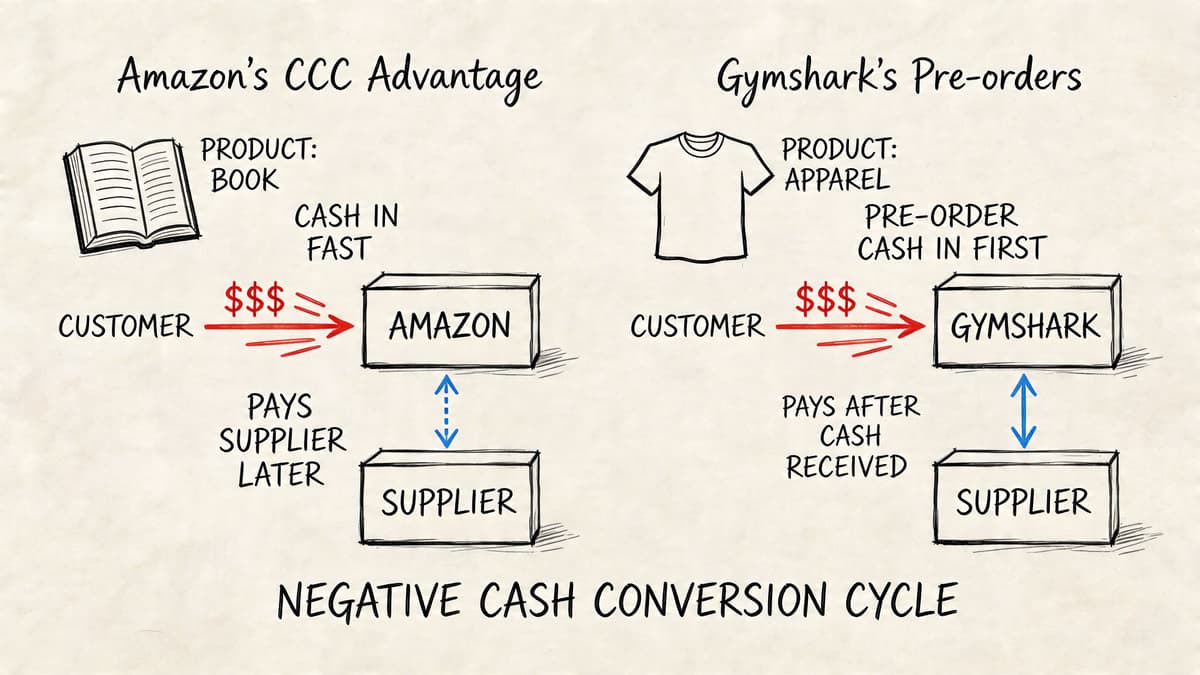
Amazon built a system that got paid at checkout and delayed cash going out to suppliers. According to Relay’s explanation of Amazon’s negative CCC model, Amazon kept DSO near zero and pushed supplier terms out far enough to create a negative cash conversion cycle of roughly -20 to -37 days.
That matters because growth gets funded inside the business. More orders bring in more cash before the related bills come due. That gives management room to buy inventory, improve fulfillment, and press harder on growth without needing outside money every time revenue climbs.
Shopify founders should copy the mechanics, not the scale.
- Collect cash immediately: Checkout should stay prepaid and clean. Any delay between order and cash receipt weakens the model.
- Prioritize inventory velocity: A SKU that sells through fast is more useful than one with a nice margin and slow turnover.
- Earn better terms over time: Vendors extend payment windows to buyers who forecast well, order consistently, and pay exactly as promised.
That operating discipline is what turns working capital into a real e-commerce growth strategy for scaling profitably.
#Gymshark proved the model works in founder-led DTC
Amazon is a giant. Gymshark is the better reference point for most Shopify operators because it scaled as a consumer brand with real inventory constraints.
The key lesson is simple. You do not need perfect inventory turns to run a negative cash conversion cycle. You need enough control over stock, enough demand to get paid upfront, and enough supplier trust to secure long terms.
Gymshark did exactly that. Its inventory still took time to move, but the payables side gave it breathing room. That created space to reinvest customer cash back into growth instead of constantly plugging working capital gaps.
For a founder, that is the key takeaway. Negative CCC is not a finance trick. It is an operating model. If your store gets paid before inventory bills come due, growth stops draining cash and starts producing it.
#Your Tactical Playbook for a Negative CCC
A lot of Shopify founders hit the same wall. Sales are up, ad spend is working, orders keep coming in, and the bank balance still feels tight. That happens when cash is trapped in the wrong places. The fix is operational. You need to control how fast inventory moves, how quickly money comes in, and how long cash stays with you before suppliers get paid.
As noted earlier, brands like Gymshark proved the model. The useful takeaway is not the exact number. It is the operating sequence. Get paid first, keep inventory turning, and earn supplier terms that match your sell-through.
#Cut DIO first because inventory is usually the real problem
Inventory is where cash goes to die.
A founder will call it buffer stock. A buyer will call it planning ahead. Your bank account calls it money you cannot use for ads, payroll, or the next PO.
Start with a SKU-level review inside Shopify and sort products by sell-through, weeks of cover, and gross margin dollars. Then make decisions.
- Kill or fix slow SKUs: If a product does not sell and does not serve a clear strategic role, clear it out. Do not keep funding mediocre inventory because you already bought it.
- Buy tighter: Smaller, more frequent purchase orders reduce forecasting mistakes and force discipline.
- Use pre-orders on proven demand: If customers are willing to wait, collect the cash now and line up production around it.
- Rank SKUs by cash efficiency: Fast-turning products often deserve more attention than higher-margin products with slow movement.
- Bundle to free trapped stock: Pair a winner with stale inventory and turn dead units into cash.
The goal is simple. Stop treating inventory planning like a merchandising exercise and start treating it like cash allocation.
#Keep DSO close to zero
For many Shopify brands, DSO should barely exist because customers pay at checkout. If it starts creeping up, you created friction somewhere.
The usual culprits are operational, not theoretical:
- Wholesale invoices go out late. Send them the same day the order is confirmed.
- Retail accounts stretch terms because no one follows up. Put one owner on collections and make aging reports part of the weekly routine.
- Checkout exceptions slow cash capture. Failed payments, manual fraud holds, and draft orders all create lag.
- You offer informal credit. Stop doing favors that turn into receivables.
Subscriptions, prepaid bundles, and replenishment products help because they pull cash forward automatically. If that model fits your category, use it.
#Push DPO up the right way
This is the lever that changes the model fastest for a growing brand. It also exposes weak operators fast.
Suppliers do not extend better terms because you ask nicely. They extend terms when you look organized, predictable, and worth backing. Show clean forecasts. Order consistently. Pay on time. Then ask for terms that fit your sales cycle.
Use this framework:
| CCC Lever | Objective | Key Tactics for Shopify Stores |
|---|---|---|
| DIO | Sell inventory faster | Cull slow SKUs, tighten forecasting, use pre-orders, buy narrower and more often |
| DSO | Collect cash faster | Keep checkout prepaid, invoice wholesale accounts immediately, reduce payment friction |
| DPO | Pay suppliers later | Negotiate net terms, phase deposits, trade better forecasts for flexibility, consolidate order volume |
A practical script:
“We’re increasing order volume and want to build a more stable purchasing plan with you. To support that growth, we want payment terms that line up with our sell-through cycle. In return, we’ll give you better forecasts and more consistent ordering.”
That is a serious conversation. “Cash is tight” is not.
Test these moves:
- Ask for staged payments: Deposit now, balance after production or after shipment.
- Consolidate spend with fewer suppliers: Bigger and more predictable volume gives you more negotiating power.
- Bring forecast data to the call: Suppliers respond to planning, not stories.
- Negotiate before the next large PO: Terms discussions land better when future volume is on the table.
- Protect trust once you get terms: One late payment can erase months of credibility.
If you want the broader operating side, not just the finance math, read this guide to scaling an e-commerce growth strategy profitably.
#Sequence the work correctly
Do not try to improve every part of CCC at once. That is how teams stay busy and cash stays stuck.
Start with inventory because it usually holds the most cash. Then tighten receivables if you have wholesale or invoice-based sales. Negotiate supplier terms last, after your ordering process is clean enough to make the ask credible.
That order matters. Clean operators get better terms. Messy operators get shorter ones.
#How to Measure and Track Your CCC in Shopify
If you don’t calculate this every month, you’re guessing. Founders love instincts until cash gets tight. Then everyone wants a number.
Here are the formulas that matter:
- DIO = Average Inventory / Cost of Goods Sold × 365
- DSO = Accounts Receivable / Credit Sales × 365
- DPO = Accounts Payable / Cost of Goods Sold × 365
- CCC = DIO + DSO - DPO

#The simple formulas that matter
You don’t need a fancy finance stack to start. You need clean inputs.
Pull average inventory from your inventory and accounting records. Pull cost of goods sold from your P&L. Pull accounts receivable only if you sell on credit. For many Shopify-first brands, DSO is low because checkout is prepaid, but wholesale and retail accounts can change that quickly. Pull accounts payable from your accounting software and line it up against COGS.
Then calculate each component separately. Don’t just look at the final CCC number. A single bad reorder decision can spike DIO even if DSO and DPO stay stable.
#Build a monthly scoreboard
One snapshot is interesting. A trend line is useful.
According to Alpha Bridge’s DTC cash conversion cycle benchmarks, elite DTC brands maintain CCC between -15 and -30 days, while laggards often sit around +45 days. The same analysis suggests practical targets such as DIO below 25 days, DSO below 10, and DPO above 50, and notes that at $1M in revenue, that structure can create $50K+ monthly cash float for reinvestment.
That’s why this deserves a recurring dashboard, not an annual finance review.
Track these every month:
- Overall CCC trend: Is your cycle moving toward zero or deeper into positive territory?
- DIO by category: Apparel basics may behave differently from seasonal drops or bundles.
- DSO by channel: DTC checkout, wholesale, and marketplace sales should not be blended blindly.
- DPO by supplier: One difficult vendor can wreck the whole equation.
Operator’s rule: Track the trend, then investigate the component that moved. Don’t stare at the final number and call it analysis.
If you’re still judging performance mostly by ad metrics, you’re missing the operating side of the business. That’s the same mistake behind confusing media efficiency with actual business returns, which is why this comparison of ROAS vs ROI for e-commerce operators is worth your time.
#Turn Your Cash Cycle Into a Growth Engine
A negative cash conversion cycle is one of the few finance ideas that directly changes how hard you can push growth.
The playbook is straightforward. Sell inventory faster. Collect cash immediately. Pay suppliers later, on agreed terms. Do those three things well and your business becomes more self-funding.
This is not abstract. It affects how much inventory you can reorder, how confidently you can scale paid media, and how often you’ll need emergency capital to bridge a good month. Founders who understand this stop treating cash as an afterthought and start managing timing with the same seriousness they bring to CAC and AOV.
You don’t need a perfect model to benefit. You need a disciplined one.
Start with your last full month. Calculate DIO, DSO, DPO, and your full cash conversion cycle. Then identify the one lever you can improve first. Usually it’s excess inventory. Sometimes it’s loose wholesale collections. Sometimes it’s supplier terms you should have renegotiated months ago.
Whatever the answer is, fix that before chasing another growth spike.
Arlo helps Shopify operators make decisions like this without living in spreadsheets. Its AI-powered analyst turns your store data into a plain-English weekly brief that explains what changed, why it matters, and what to do next across sales, traffic, products, and customer behavior. If you want clearer priorities and faster action, take a look at Arlo.