ROAS vs ROI on Shopify: Why a 4x ROAS Can Still Lose Money
By Arthur Falcone · Founder of Arlo
TL;DR: ROAS measures ad campaign efficiency, and ROI measures overall business profitability. If you're a Shopify founder, use ROAS = Revenue from Ads ÷ Cost of Ads for daily ad decisions, but trust ROI = Net Profit ÷ Total Investment × 100 for budget decisions, because a 5:1 ROAS can still produce 0% ROI once COGS, shipping, and fees are included, and 4:1 ROAS is generally considered very good for ad efficiency while not guaranteeing profit (Hustle Marketers on ROAS vs ROI).
Your ad dashboard says things are fine. Your bank account says something else.
That gap is where most founder frustration lives. Meta shows a healthy return. Google Ads looks respectable. Your agency sends a clean report with green arrows. Meanwhile, cash feels tight, inventory decisions feel riskier, and every new ad dollar feels heavier than it should.
ROAS and ROI answer different questions. If you mix them up, you can grow yourself into a cash flow problem.
#Table of Contents
- The Uncomfortable Truth About Your Ad Spend
- ROAS vs ROI The Definitions That Actually Matter
- The ROAS Trap How a Good Ad Metric Can Kill a Business
- A Founder's Decision Framework When to Use Each Metric
- From Metrics to Money A Worked Shopify Store Example
- Your New Measurement Workflow Stop Guessing Start Growing
#The Uncomfortable Truth About Your Ad Spend
A founder checks Shopify in the morning, then Meta Ads before the second coffee. Sales are coming in. ROAS looks decent. The team says the account is stable. But payroll is still looming, cash conversion feels slow, and the next inventory payment isn't getting any less real.
That's the uncomfortable truth in roas vs roi. A good ad account can coexist with a stressed business.
I've seen this happen when the ad team focuses on the easiest number to defend. ROAS is clean, fast, and native to every ad platform. It gives people a quick answer. It does not tell you whether the business is profitable.
You don't pay suppliers with ROAS. You pay them with profit.
Founders usually sense the problem before they can explain it. They feel it in the month-end close, in shipping costs that keep biting, in returns, in discounting, and in the way revenue growth doesn't create breathing room.
#The symptoms are usually obvious
- Cash gets tighter as spend rises: Revenue goes up, but the business doesn't feel stronger.
- Reports look cleaner than reality: The ad dashboard celebrates efficiency while finance sees pressure.
- Scaling feels dangerous: You want to push harder, but something in your gut says the unit economics aren't ready.
The issue isn't that ROAS is bad. It's that founders often use it for the wrong job.
ROAS tells you whether your ads are generating revenue efficiently. ROI tells you whether the business kept any of that money after actual costs hit. If you only look at the first number, you'll optimize the ad account while starving the company.
A lot of Shopify operators don't need another definition. They need a filter for deciding which metric belongs in which conversation. That's what matters when cash is tight and every budget choice has consequences.
#ROAS vs ROI The Definitions That Actually Matter
To stop mixing these up, give each metric one job and keep it there.
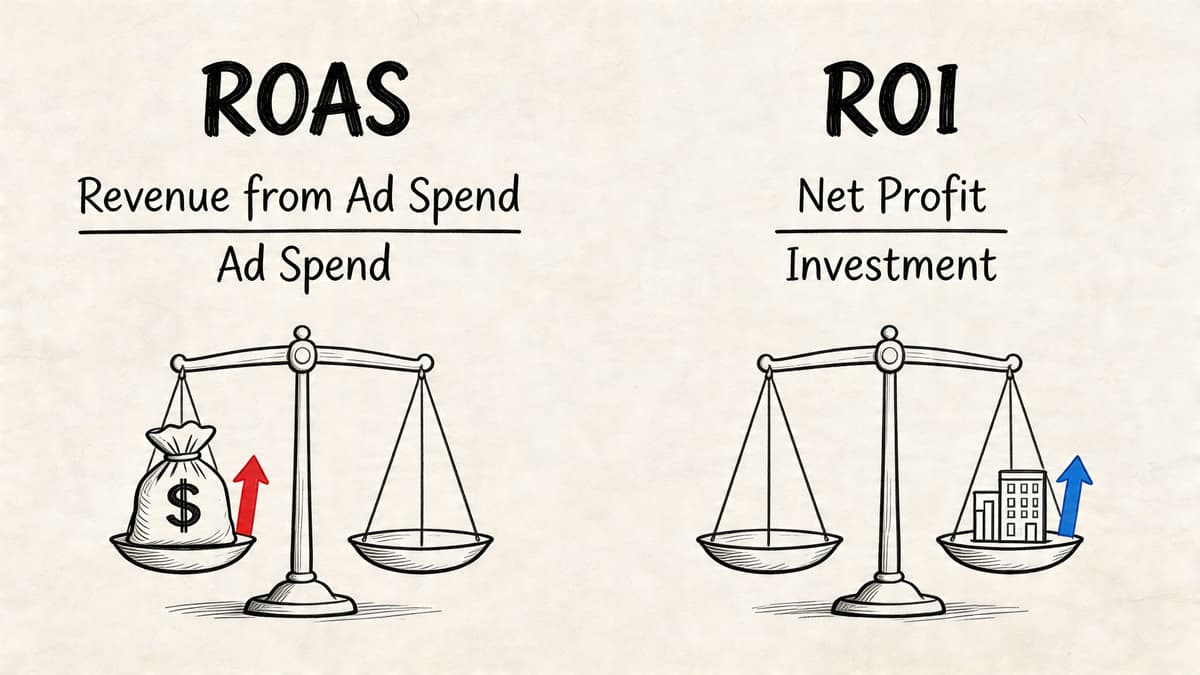
ROAS measures ad efficiency. ROI measures whether the business kept any money.
That distinction sounds simple. It saves founders from bad budget decisions.
| Metric | Formula | What it measures | Best use | What it ignores |
|---|---|---|---|---|
| ROAS | Revenue from Ads ÷ Cost of Ads | How efficiently ads generate revenue | Daily and weekly campaign decisions | COGS, shipping, fees, operational costs |
| ROI | (Net Profit ÷ Total Investment) × 100 | Whether the business made money | Monthly and quarterly budget decisions | It doesn't give fast, in-platform ad feedback |
#What ROAS tells you
ROAS is simple. Revenue from Ads ÷ Cost of Ads.
Spend $4,000 on ads and bring in $20,000 in tracked revenue, and your ROAS is 5:1. Useful number. Incomplete number.
ROAS helps you answer execution questions inside the ad account:
- Which creative should we pause
- Which campaign deserves more budget
- Which channel is driving stronger direct revenue right now
Use ROAS when speed matters and you need a fast read on media performance. That is why it lives inside Meta and Google. It is a tactical metric, not a profit metric. If your team needs a sharper explanation of why platform ROAS can drift from business reality, read this breakdown on why Meta Ads ROAS can mislead Shopify brands.
#What ROI tells you
ROI asks the founder question. Did we make money after costs showed up?
The formula is ROI = (Net Profit ÷ Total Investment) × 100. Total investment includes ad spend, but it also includes the costs that hit your bank account, like product cost, shipping, payment fees, discounts, agency fees, and returns if they are material to the decision.
Go back to the same campaign. $20,000 in revenue on $4,000 in ad spend can still be a bad outcome if the rest of the cost stack eats the margin. A strong ad result does not guarantee a healthy business result.
Practical rule: If a metric ignores costs you pay every month, it cannot be the number you use to scale spend.
Here is the clean way to divide the work.
ROAS belongs with the media buyer. ROI belongs with the founder, finance lead, or anyone deciding how much cash the business can afford to put back into growth.
If someone says, "We should increase budget because ROAS looks good," ask one follow-up question. What happens to contribution margin after fulfillment, fees, and returns? If nobody can answer that, the business is flying with half the dashboard missing.
#The ROAS Trap How a Good Ad Metric Can Kill a Business
Monday morning. Your agency says the account looks strong. ROAS is up, revenue is up, and they want more budget.
By Thursday, you're reviewing cash, pushing a supplier payment, and wondering how a "winning" month created more stress, not less.
That is the ROAS trap.
ROAS is useful because it is fast. It tells you whether paid traffic is generating revenue efficiently inside the ad account. It does not tell you whether that revenue leaves enough money after product cost, shipping, fees, discounts, and returns. A founder who scales spend on ROAS alone can grow sales and tighten cash at the same time.

#Why this trap is expensive
The problem gets worse in low-margin categories, heavy-discount brands, and stores with high return rates. In those businesses, a campaign can look strong in Meta or Google and still be a bad use of cash.
Here is the simple version. If your gross margin is thin, your required breakeven ROAS rises fast. A result that looks good on a dashboard can still leave nothing in the bank after the full cost stack hits.
For a Shopify founder, that has real consequences:
- You reorder inventory based on revenue that did not produce enough margin
- You increase budget because the ad account looks healthy
- You find out too late that fulfillment, fees, and returns ate the gain
- You create a cash problem disguised as growth
That is why I do not let founders treat ROAS as a green light by itself.
#What to trust instead
Use ROAS as a traffic efficiency signal. Pair it with breakeven math before you scale anything.
Three numbers matter here:
- ROAS tells you whether the ad generated revenue
- Breakeven ROAS tells you the minimum performance required to avoid losing money
- Contribution margin after ad spend tells you whether growth is helping the business
That middle number is the one many teams skip. It is also the one that saves you from expensive optimism.
If your media buyer says a campaign is at 3.2x ROAS, your next question should be simple. Is that above our breakeven ROAS after product cost, shipping, payment fees, discounts, and returns? If nobody knows, do not scale it. If you want the math done for you, the free should I kill this ad calculator takes five inputs and returns a kill, wait, or scale verdict against your breakeven.
If you're dealing with shaky attribution or inflated in-platform numbers, read why Meta Ads ROAS can mislead Shopify brands. You do not need to abandon ROAS. You need to stop confusing platform efficiency with business health. And if that problem has you shopping for an attribution stack, start with our Triple Whale pricing and fit comparison before you commit to one.
#The weekly filter I recommend
For weekly decisions, add one quick filter before approving more spend. Check whether the campaign clears your margin-adjusted hurdle, not just your platform target.
In plain English, ask whether this campaign is producing enough gross profit to cover ad spend and still leave room for the rest of the business. That keeps the speed of ROAS, but adds the founder lens.
Stop asking, "Did this campaign hit target ROAS?" Ask, "Did this campaign clear the ROAS this business needs to stay alive?"
That question changes behavior fast.
You stop praising channels that print pretty screenshots. You start backing the campaigns that protect contribution margin, preserve cash, and earn the right to scale. An AI analyst can help here by tying ad account performance to your Shopify margins automatically, so you are not making budget calls with half the picture missing.
#A Founder's Decision Framework When to Use Each Metric
The issue often isn't a measurement problem. It's a decision problem.
They bring ROAS into conversations where only ROI belongs. Then they bring ROI into moments where the team needs speed, not accounting. That confusion slows decisions and creates fake confidence.
Here's the clean split.
#The fastest way to stop metric confusion
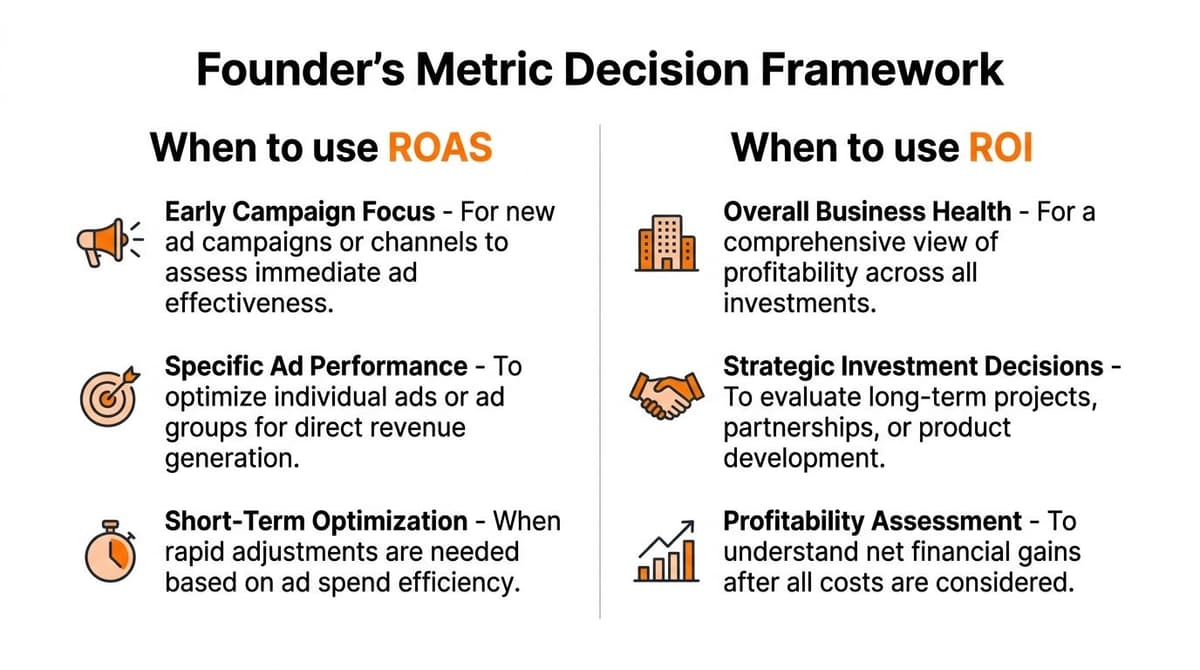
Use ROAS when the question is tactical. Use ROI when the question is financial.
A useful benchmark from Upwork's guide to measuring ROI versus ROAS makes this clear. ROAS became a core ad platform metric in the 2010s for short-term decisions, including killing weak campaigns such as a Facebook campaign sitting at 1.8:1 ROAS. ROI is the older business metric for long-term profitability, and a campaign can show $40,000 in revenue with $38,000 in total costs and still produce only 5.3% ROI.
That is the split in one paragraph. Tactical versus strategic.
#The operating cadence I recommend
Use this framework inside a Shopify business:
| Meeting or decision | Metric to lead with | Why |
|---|---|---|
| Creative review | ROAS | You need quick feedback on what is driving revenue |
| Channel budget shifts | ROAS first, ROI second | Start with efficiency, then confirm the profit story |
| Monthly marketing review | ROI | This is where profitability matters more than platform optics |
| Scaling plan | ROI | Scaling without profit discipline gets expensive fast |
| Pausing losers in ad accounts | ROAS | Speed matters more than full finance reconciliation |
| Founder cash planning | ROI | Cash flow doesn't care about ad dashboard wins |
I like a simple rule set:
- Daily decisions belong to ROAS. Pause weak creatives. Reallocate spend. Protect what is working.
- Weekly decisions need a profitability check. Margin-adjusted thinking demonstrates its worth.
- Monthly and quarterly decisions belong to ROI. Budgeting, hiring, and scaling need the full cost picture.
If the question is "Which ad?", use ROAS. If the question is "Should we keep funding this?", use ROI.
Founders get into trouble when they let the ad team define success for the whole company. The ad team should own efficiency. You should own profitable growth.
That doesn't mean you need to become a media buyer. It means you need one rule: nobody gets to call a channel successful unless it survives an ROI conversation.
#From Metrics to Money A Worked Shopify Store Example
It is Monday morning. Shopify says sales were strong this weekend. Meta says the campaign crushed it. Your cash balance says otherwise.
That gap is the whole ROAS vs ROI problem.
Take a fictional brand, Urban Totes. The founder spends $10,000 on Facebook ads and gets $50,000 back in tracked revenue. The ad account shows a 5:1 ROAS. Any media buyer would call that a win. A founder should pause and ask one harder question. How much of that revenue became profit after product costs, fulfillment, and everything else required to serve those orders?
If the business runs on thin margins, a 5:1 ROAS can still be a bad outcome. That is the part founders miss when they stare at ad dashboards too long. Revenue can rise while cash stays tight.
Here is the simple model.
#Urban Totes Profitability Analysis
| Metric | Calculation | Value |
|---|---|---|
| Ad spend | Given | $10,000 |
| Revenue from ads | Given | $50,000 |
| ROAS | Revenue from ads ÷ ad spend | 5:1 |
| Margin assumption | Example scenario | 15% |
| ROI outcome | Margin-adjusted result | Negative |
| Breakeven ROAS target | Higher than current ROAS | Above 5:1 |
That table matters because it forces the essential conversation. A strong ROAS only tells you the ads produced revenue efficiently. It does not tell you whether the business kept enough of that revenue to make scaling smart.
Now add the messier part. Store performance is rarely uniform across traffic.
Urban Totes gets a lot of mobile traffic. The ads still drive purchases, but mobile shoppers convert worse, buy smaller baskets, and drop off more often in checkout. The ad account still reports revenue. The store economics get weaker after the click. That is how founders end up with a campaign that looks healthy in-platform and feels painful in the bank account.
This is why I do not want founders using ROAS as a permission slip to increase budget. I want them pressure-testing the path from click to contribution margin.
If your sales reports and your cash position keep telling different stories, run a store-level check before you blame the channel. A practical place to start is this guide on how to diagnose a revenue drop by connecting channel data to store behavior.
Use this filter on any campaign that looks great in ads manager and disappointing in real life:
- Check contribution margin first. If margins are thin, your required ROAS is higher than your team wants to admit.
- Break out mobile performance. Do not let blended conversion rates hide a weak mobile experience.
- Review AOV by device and channel. Cheap traffic with smaller baskets can wreck profitability.
- Model the next spend level before you scale. A campaign that works at $10,000 can fail badly at $30,000.
- Compare reported platform revenue to cash impact. If revenue is up and cash is flat, you have an efficiency story, not a profit story.
The lesson is simple. Good ads can still fund bad economics. Founders who understand that stop chasing pretty ROAS screenshots and start making budget decisions that protect cash.
#Your New Measurement Workflow Stop Guessing Start Growing
Monday morning. Ads manager says revenue is up. Your bank balance says growth feels tighter than it should. That gap is where bad decisions get made.
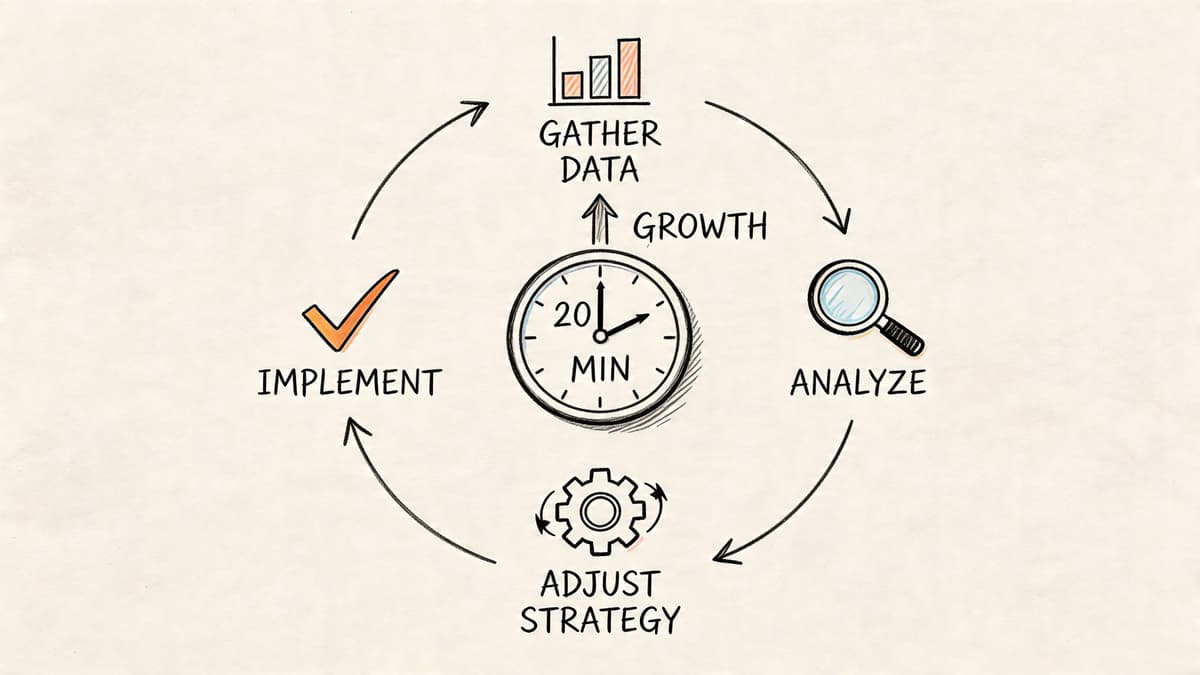
You do not need more charts. You need a weekly operating rhythm that forces one question: should we spend more, hold, or cut back?
#A simple weekly workflow
Use this every week. No exceptions.
-
Start with paid media
Check ROAS by campaign, ad set, and creative. Your job here is simple: cut waste fast, protect the few assets producing efficient demand, and stop letting blended account averages hide weak spend.
-
Translate ad performance into store profit
Take the campaigns that look strong in-platform and run them through your real economics. Include gross margin, shipping, discounts, and any cost that changes the answer. If you cannot tell whether a campaign puts cash in the business, you are not ready to scale it.
-
Audit the path after the click
Review landing pages, product pages, checkout, and device-level conversion gaps. A campaign can win the click and still lose you money if the store turns paid traffic into low-margin orders or weak conversion sessions.
-
Choose two actions only
Pick one acquisition move and one retention move for the week. That constraint matters. Founders get stuck when every metric becomes a project. Sometimes the best ROI move isn't a new ad. It's fixing your welcome flow, improving checkout completion, or pushing average order value higher.
If you want this to become a standing habit, use a weekly growth review for Shopify founders that turns numbers into actions.
Good operators review metrics every week. Great operators make one budget decision and one profit decision from them.
#Why CLV changes the budget call
First-order efficiency is not the whole story for a repeat-purchase brand.
A campaign with average first-order ROAS can still deserve budget if those customers come back, buy full price, and stick. A campaign with strong first-order ROAS can still be a bad bet if it brings in one-and-done buyers who only convert on discounts.
That is the practical rule:
- Use ROAS to manage media
- Use ROI to decide whether spend deserves to grow
- Use CLV to judge whether the customer you bought was worth the cost
Measuring CLV properly usually means cohort LTV tooling. Lifetimely is the established name in that lane, and our comparison covers its pricing and where it fits.
This is how a founder should run the system. Weekly. With discipline. ROAS tells you what is happening inside the ad account. ROI tells you whether the business can afford more of it. CLV keeps you from underinvesting in valuable customers or overpaying for cheap ones who never return.
Arlo helps Shopify founders run this process without living in spreadsheets. Its AI analyst turns your store, traffic, product, and customer data into a plain-English weekly report that explains what changed, why it matters, and what to do next. If you want fewer dashboards and better growth decisions, take a look at Arlo.
Generated with Outrank