DTC E-commerce Growth Strategy: 2026 Framework
By Arthur Falcone · Founder of Arlo
Your store isn’t failing because you haven’t found the next clever tactic. It’s stalling because you’re trying to grow through noise.
You check Shopify. Then GA4. Then Meta Ads. Then Klaviyo. One dashboard says traffic is up. Another says conversion is down. Your agency wants more spend. Your retention tool wants more flows. Your designer wants a new PDP. Cash feels tighter than it should, and every decision starts to feel expensive.
That’s a brutal place to operate from.
A real e-commerce growth strategy isn’t a stack of disconnected ideas. It’s a way to identify the single biggest constraint on revenue, estimate what fixing it is worth, and ignore everything else until that job is done. That matters even more in a market where global e-commerce sales are projected to reach $7.4 trillion in 2025, and mobile commerce is forecasted to represent 44% of U.S. e-commerce sales by 2025, according to Enhencer’s e-commerce projections.
Most founders don’t need more tactics. They need a diagnostic process.
#Table of Contents
- Why Most Growth Strategies Feel Like Guesswork
- The Four Levers That Actually Control Your Revenue
- How to Diagnose Your Biggest Growth Bottleneck
- A Prioritized Menu of High-ROI Growth Tactics
- How to Rank Your Actions by Dollar Impact
- Your First 30-60-90 Day Growth Action Plan
- From One-Off Tactics to a Consistent Growth System
#Why Most Growth Strategies Feel Like Guesswork
Most growth advice is useless because it treats every store like it has the same problem.
It doesn’t. One brand needs better mobile conversion. Another needs stronger repeat purchase behavior. Another is buying low-quality traffic and calling it scale. If you apply the same playbook to all three, you waste time and money.
Founders fall into this trap because the internet rewards activity. Publish more content. Launch more ads. Add SMS. Start TikTok. Expand channels. Redesign the homepage. None of that is strategy. That’s motion without diagnosis.
Most stores don’t have a tactic shortage. They have a prioritization problem.
The pain gets worse once revenue plateaus. When you were smaller, sloppy decisions didn’t show up immediately. Now they do. A weak mobile experience, a leaky checkout, bad traffic quality, or lazy retention work can undermine the whole business. The problem is that these issues rarely scream. They blend into normal operating noise.
What feels like uncertainty is usually one of two things:
- Too many disconnected metrics: You’re seeing data, but not the chain of cause and effect.
- Too many competing recommendations: Agencies, freelancers, apps, and content creators are all selling a fix before anyone has diagnosed the bottleneck.
That’s why most founder-led brands feel like they’re guessing. They are.
A useful e-commerce growth strategy starts with one blunt question: what is the main thing limiting revenue right now? Not this quarter in theory. Right now, in your actual store, with your current traffic, offers, and customer behavior.
Once you answer that, the fog lifts. You stop trying to “do more marketing” and start fixing the part of the machine that’s dragging down the result.
#The Four Levers That Actually Control Your Revenue
Revenue in e-commerce is simpler than it's often made to sound. You have four main levers:
Revenue = Visitors × Conversion Rate × Average Order Value × Purchase Frequency
If you remember nothing else, remember that equation.
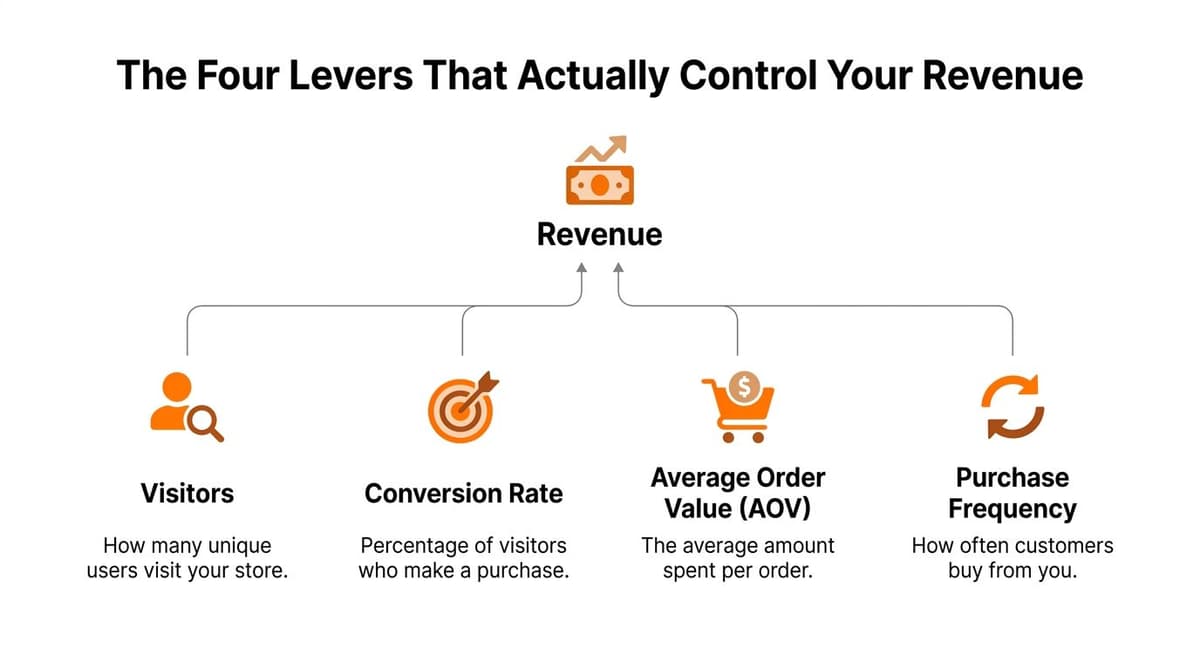
Treat your store like a machine with four dials. If revenue is soft, one or more of those dials is underperforming. Your job is to find the weak one first.
#Visitors
This is the number of people who land on your store.
Think of it as foot traffic. If the right people never show up, nothing else matters. But more traffic isn’t automatically better. Cheap, low-intent traffic can make your dashboards look busy while your cash flow gets worse.
#Conversion Rate
This is the percentage of visitors who buy.
This lever tells you whether the store experience does its job. Product pages, pricing clarity, mobile UX, checkout flow, trust signals, and load speed all show up here. If people arrive and don’t buy, the issue usually sits in this dial.
#Average Order Value
This is how much customers spend per order.
You improve AOV by getting buyers to add one more item, choose a bundle, upgrade to a better option, or cross the threshold for an offer that makes sense. Strong brands don’t leave basket size to chance.
#Purchase Frequency
This is how often customers come back and buy again.
A lot of founders obsess over acquisition while ignoring the customers they already paid to acquire. That’s backwards. In a maturing market where U.S. e-commerce growth slowed to 5.4% in 2025, the smarter move is retention and basket expansion. The same source notes that attracting a new customer can cost five times more than retaining an existing one, according to Ship to the Moon’s U.S. e-commerce analysis.
Practical rule: If you can’t say which of these four levers is weakest in your store, you don’t have a strategy yet.
Here’s the point most operators miss. Tactics map to levers.
| Lever | What it controls | Typical examples |
|---|---|---|
| Visitors | Reach and traffic quality | Meta ads, Google Shopping, SEO, creators, marketplaces |
| Conversion Rate | Store efficiency | PDP copy, mobile UX, checkout fixes, reviews, offer clarity |
| Average Order Value | Basket size | Bundles, upsells, quantity breaks, cart offers |
| Purchase Frequency | Repeat buying | Email flows, subscriptions, replenishment, loyalty, win-back campaigns |
Once you know the lever, tactics become obvious. Before that, tactics are just shopping.
#How to Diagnose Your Biggest Growth Bottleneck
Most brands skip the audit because it feels less exciting than launching something new. That’s a mistake. Most growth strategies fail because they skip the foundational audit, especially when stores have hidden issues like mobile-desktop gaps or friction buried in sales and traffic signals, as noted in JoinBrands’ take on foundational audits.
Start with the diagnosis.

#Start with symptoms, not opinions
Don’t begin with “we should run more ads” or “the site needs a redesign.” Those are opinions. Start with symptoms.
Ask:
- What changed first: Did sessions drop, did conversion slip, did AOV soften, or did repeat purchase behavior weaken?
- Where is the problem concentrated: One channel, one device type, one landing page set, one product category, or one customer segment?
- Is this a quality problem or a volume problem: Are fewer people arriving, or are the same number arriving and buying less often?
If you’ve had a recent dip, review a practical walkthrough for how to diagnose a revenue drop in Shopify. The point isn’t to panic. It’s to isolate the leak.
#Run a four-part store health check
Use Shopify Analytics, GA4, your ad platform reports, and your email platform. Keep it simple. You’re not building a board deck. You’re finding the constraint. If someone on your team is pitching a custom dashboard build instead, weigh Polar Analytics pricing against what a diagnosis actually requires. Most stores need the answer, not another reporting layer.
#Acquisition check
Look at Shopify sessions, GA4 traffic acquisition, and your ad dashboards.
Ask:
- Are your main traffic sources stable or falling
- Are paid channels bringing buyers or just clicks
- Are branded and non-branded traffic behaving differently
A common founder mistake is celebrating traffic growth while conversion quality deteriorates. If one channel is pumping visitors who bounce fast and don’t initiate checkout, that isn’t scale.
#Conversion check
Look at device split, landing pages, product pages, and checkout funnel behavior.
Ask:
- What’s your mobile conversion rate versus desktop
- Where do users drop between product page, cart, checkout, and purchase
- Which top landing pages attract traffic but fail to produce revenue
Weak UX issues become apparent here. Slow mobile pages, confusing offer structure, unclear shipping, and poor product education all show up here. If mobile underperforms sharply, fix that before buying more traffic.
A short video can help your team align on what good diagnosis looks like in practice:
#AOV check
Look at average items per order, cart contents, and product pairings.
Ask:
- Do customers buy one item when they should be buying a set
- Are your highest-traffic products leading to low-value baskets
- Do carts suggest obvious bundling or cross-sell opportunities
If a hero SKU drives volume but suppresses basket size, the problem isn’t demand. It’s offer architecture.
#Retention check
Look at repeat customer behavior in Shopify and flows in your email platform.
Ask:
- Are first-time buyers coming back
- Are post-purchase, replenishment, and win-back flows live
- Which products naturally lend themselves to a second order
A lot of stores talk about loyalty while sending generic campaigns and weak post-purchase messaging. That’s not retention. That’s hoping.
When you finish this audit, you should be able to write one sentence: “Our biggest bottleneck is ___ because ___.” If you can’t, keep digging.
If you’d rather not run the audit by hand, the free Shopify store health score grades the same territory across eight metrics and ranks your top three leaks by dollar impact in about 20 minutes.
#A Prioritized Menu of High-ROI Growth Tactics
Once you know the bottleneck, you don’t need a giant ideas list. You need a short menu tied to the weak lever.
One of the most overlooked plays is channel diversification. 72% of Instagram users have purchased a product after seeing it on the platform, yet 80% of businesses fail to effectively use channels like Facebook Shops and Instagram shoppable posts, according to Zest Logic’s review of underrated e-commerce channels. If your current acquisition mix is stale, that matters.
#If traffic is the problem
Not all traffic tactics deserve equal attention.
- Tighten paid traffic quality: Cut ad sets, keywords, or audiences that bring cheap clicks without downstream purchase intent. For single-ad calls, the free should I kill this ad calculator turns five numbers into a kill, wait, or scale verdict.
- Expand into shoppable social placements: If your brand is visual and impulse-friendly, Instagram shopping surfaces can add qualified discovery.
- Improve landing page match: Align ad creative, offer, and landing page message. A click without message continuity burns spend.
#If conversion is the problem
It offers most founder-led stores the fastest path to revenue.
- Fix mobile product pages: Simplify image stacks, tighten copy, surface social proof, and make the add-to-cart path obvious.
- Reduce checkout hesitation: Clarify shipping, returns, delivery timing, and payment options before buyers hit checkout.
- Rewrite PDP hierarchy: Lead with the buying reason, not brand fluff.
Good conversion work doesn’t look flashy. It removes doubt.
#If AOV or retention is the problem
These are usually easier wins than forcing more top-of-funnel spend.
- Build bundles around buying behavior: Don’t bundle randomly. Use products customers already buy together.
- Add cart and post-purchase upsells: Present one logical add-on, not a cluttered menu.
- Launch a real win-back flow: Segment lapsed customers and give them a reason to return that fits the original purchase context.
- Strengthen post-purchase education: Help customers use the product well so they buy again.
Here’s a practical shortlist.
| Growth Lever | Tactic | Estimated Effort | Potential Impact |
|---|---|---|---|
| Visitors | Cut low-quality paid traffic and reallocate budget to higher-intent campaigns | Medium | High |
| Visitors | Add Instagram shoppable posts or storefront integrations | Medium | Medium to High |
| Visitors | Improve ad-to-landing-page message match | Low | Medium |
| Conversion Rate | Audit mobile PDPs and simplify the path to cart | Medium | High |
| Conversion Rate | Clarify shipping, returns, and delivery expectations sitewide | Low | Medium |
| Conversion Rate | Improve checkout trust and reduce friction | Medium | High |
| Average Order Value | Create bundles for natural product combinations | Medium | High |
| Average Order Value | Add cart upsells tied to hero SKUs | Low to Medium | Medium |
| Purchase Frequency | Launch or repair post-purchase and win-back email flows | Medium | High |
| Purchase Frequency | Build replenishment reminders for repeat-friendly products | Medium | High |
Don’t run this table like a buffet. Pick the tactic that matches the diagnosed problem.
A few hard rules help:
- If mobile conversion is weak, don’t pour more money into acquisition yet.
- If AOV is low, don’t default to discounting. Fix offer structure first.
- If repeat rate is soft, don’t call yourself a retention brand because you send campaigns twice a week.
- If one paid channel dominates revenue, build a second source before performance turns against you.
Most “growth hacks” often fail. They aren’t wrong. They’re just out of order.
#How to Rank Your Actions by Dollar Impact
A task isn’t important because it sounds strategic. It’s important because it can produce a meaningful financial result with acceptable effort.
That’s the filter.
#Use a simple impact estimate
You don’t need a complex forecast model. Use directional math.
Estimate impact with one of these approaches:
- Conversion opportunity: monthly sessions × expected change in conversion rate × AOV
- AOV opportunity: monthly orders × expected lift in AOV
- Retention opportunity: number of lapsed or first-time customers × expected reactivation or repeat behavior × AOV
You don’t need fake precision. You need a reasonable estimate that helps you compare options.
For example, compare two ideas:
| Action | Lever | Confidence | Effort | Likely value |
|---|---|---|---|---|
| Fix mobile PDP friction on best-selling collection | Conversion Rate | High | Medium | Strong |
| Start a new awareness channel from scratch | Visitors | Low | High | Unclear |
The first one usually wins because the path from problem to outcome is shorter.
This is also where personalization deserves attention. The brands that do it well aren’t running smarter algorithms. They’re working from cleaner data, so recommendations, offers, and flows actually match what a customer is likely to buy next. The practical lesson isn’t “buy more AI.” It’s this: when you can rank likely actions by expected return, you stop confusing activity with progress.
If you’re weighing paid efficiency, contribution, and true business return, read this comparison of ROAS vs ROI for e-commerce operators. Founders get in trouble when they optimize for dashboard vanity instead of profit.
#Then filter through effort and urgency
After you estimate value, rank each action through two more lenses:
- Effort: How hard is this to implement across design, dev, creative, and ops?
- Urgency: Is this fixing a live leak or chasing a future improvement?
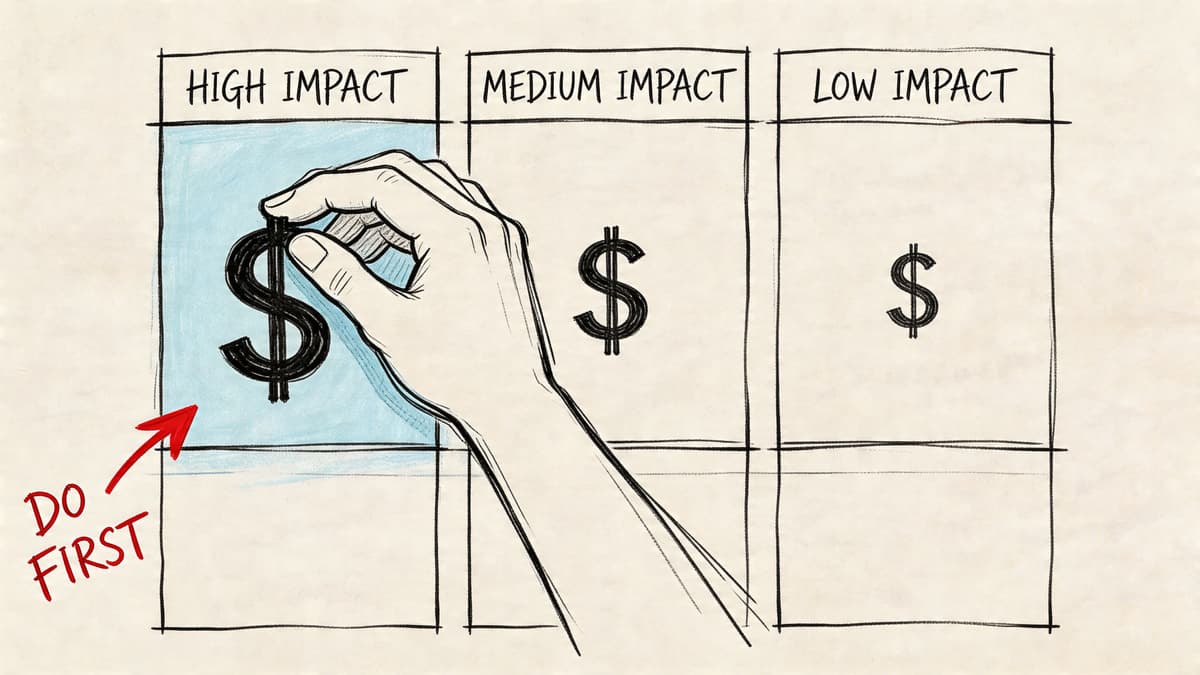
Use a simple mental matrix:
- High impact, low effort: Do now.
- High impact, high effort: Schedule as the main project.
- Low impact, low effort: Batch later.
- Low impact, high effort: Ignore.
Operator’s view: A boring fix with clear impact beats an exciting project with fuzzy upside.
Your roadmap should never contain ten “top priorities.” It should contain one main move, one supporting move, and a short list of things you’ve consciously decided not to do yet.
That discipline is what turns an e-commerce growth strategy into something useful.
#Your First 30-60-90 Day Growth Action Plan
You don’t need a twelve-month transformation deck. You need a sane operating cadence.
#Days 1 to 30
This phase is for clarity and quick wins.
- Audit the four levers: Pull your core data from Shopify, GA4, ad platforms, and email. Write down the single biggest bottleneck in one sentence.
- Find one obvious leak: Examples include poor mobile PDP experience, broken email flow logic, weak product page clarity, or bad paid traffic quality.
- Implement one low-effort fix: Keep it practical. Improve product page hierarchy, tighten shipping messaging, repair a post-purchase flow, or cut wasteful campaigns.
- Create a weekly review habit: Same day, same time, same scorecard.
Don’t start three initiatives. Start one and finish it.
#Days 31 to 60
This phase is for the main build.
- Choose one core project tied to the bottleneck: If conversion is weak, run a mobile UX and checkout improvement sprint. If retention is weak, rebuild lifecycle messaging and customer segmentation.
- Assign one owner: Founders can stay involved, but someone needs to own execution.
- Measure before and after: Track the specific lever you’re trying to change, not every metric in the business.
- Protect what already works: Don’t break top-performing campaigns, pages, or products while fixing the weak area.
A lot of teams sabotage themselves here by changing too many variables at once. Don’t.
#Days 61 to 90
This phase is for systemizing what you learned.
- Review the result: Did the main project improve the target lever? If yes, keep building. If not, reassess the diagnosis.
- Document the playbook: Save screenshots, copy changes, offer logic, and lessons learned so you’re not starting from zero next quarter.
- Pick the next lever: Once one bottleneck improves, another becomes the new limit.
- Build a repeating operating rhythm: Weekly reviews, monthly lever checks, quarterly priority resets.
A simple version looks like this:
| Timeframe | Primary focus | What matters most |
|---|---|---|
| First 30 days | Diagnose and stop the bleed | Clarity and quick fixes |
| Days 31 to 60 | Fix the biggest bottleneck | One main project |
| Days 61 to 90 | Lock in process | Repeatability and accountability |
This is how a founder gets out of reactive mode. Not with more hustle. With a better sequence.
#From One-Off Tactics to a Consistent Growth System
The stores that grow consistently don’t operate on random bursts of effort. They run a loop.
Diagnose. Prioritize. Act. Review. Repeat.
That’s the system.
You don’t need a huge team to do this well. You need a short list of metrics tied to the four revenue levers, a willingness to face the bottleneck, and the discipline to work on the highest-value problem before chasing new ideas.
Block time every week. Review what changed. Ask which lever is constraining growth right now. Choose one action with a clear reason behind it. Then execute.
If your current routine is “check dashboards, feel stressed, try something,” replace it with a weekly operating cadence. This guide to a weekly growth review for Shopify brands is the kind of discipline most founders need more than another tactic list.
Sustainable growth comes from repeated good decisions, not occasional bursts of inspiration.
That is the core e-commerce growth strategy. Not hacks. Not noise. A repeatable diagnostic habit that tells you what to do next.
If you want that weekly discipline without living inside five dashboards, Arlo gives Shopify brands a concise AI-powered “20 Minute CMO” report that explains what changed, why it matters, and what to do next. It ranks actions by urgency and dollar impact, flags issues like broken flows or mobile-desktop gaps, and helps founder-led teams focus on the next move that can grow revenue.