New Account Acquisition: A DTC Founder's Guide for 2026
By Arthur Falcone · Founder of Arlo
Traffic is up. Your ad dashboard looks busy. Shopify says sessions are healthy. But the cash in the bank doesn’t match the story.
That’s the trap a lot of founders are in with new account acquisition. They think they have an acquisition problem when they really have a profitability problem. More visitors won’t save a store that pays too much for low-value customers, sends them to weak landing pages, and then celebrates blended metrics that hide the damage.
If you’re running a founder-led DTC brand, you don’t need more tactics thrown at you. You need a system. One that tells you which channels deserve budget, which customers are worth buying, and what to fix every single week before waste compounds.
#Table of Contents
- What New Account Acquisition Really Means for DTC
- The Only Acquisition Metrics That Matter
- Prioritizing Your Acquisition Channels
- Strategies to Convert Traffic into Accounts
- Building Your Weekly Acquisition Rhythm
- Conclusion From Tactics to a Growth Engine
#What New Account Acquisition Really Means for DTC
A lot of founders define new account acquisition too narrowly. They treat it as the moment someone makes a first purchase or creates an account. That definition is too cheap, and in most cases it leads to expensive decisions.
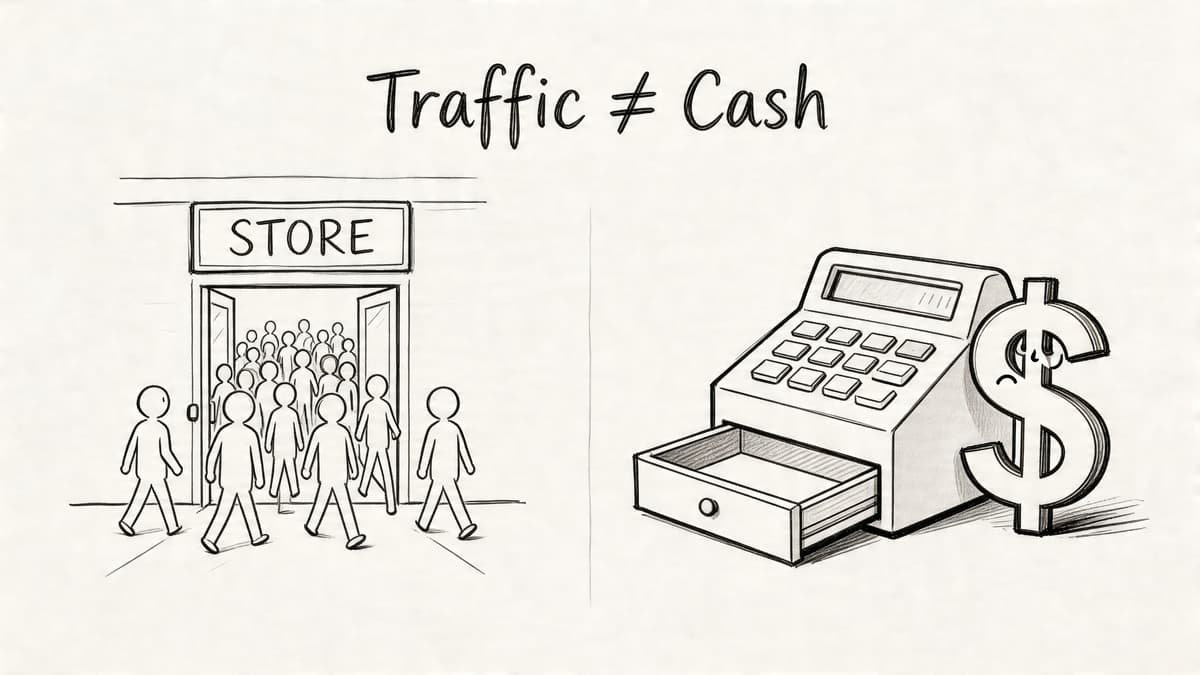
In DTC, new account acquisition means buying a profitable customer relationship, not just buying a transaction. If your store pays aggressively to get a first order from people who never come back, you didn’t build growth. You rented revenue.
Between 2023 and 2025, customer acquisition costs surged by 40–60% across major markets, driven by competition, privacy rules, and weaker attribution, according to Phoenix Strategy’s CAC benchmarks by channel for 2025. That changes the standard. The old playbook of forcing spend into the top of funnel and hoping efficiency shows up later doesn’t work when every bad customer costs more to acquire.
#Profit first, not first purchase first
Founders get in trouble when they ask the wrong opening question. They ask, “How do I get more customers?” The better question is, “How do I get more profitable customers without losing control of CAC?”
That small shift changes everything:
- You stop chasing cheap clicks. Cheap traffic that doesn’t convert or retain is still expensive.
- You stop overvaluing volume. A spike in new customers can still hurt the business if those customers discount-hop and disappear.
- You start caring about customer quality. The first order matters, but the second order usually tells the truth.
Practical rule: If a channel brings in new accounts that don’t fit your product, price point, or reorder behavior, it isn’t helping. It’s leaking margin.
#What a good new account actually looks like
A strong new account isn’t just someone who checked out. It’s someone who arrived through the right channel, understood the product quickly, converted without heavy friction, and has a real chance of buying again.
For most Shopify brands, that means your acquisition strategy should connect four things that founders often separate:
- Channel quality
- On-site conversion
- Offer fit
- Retention potential
If one of those breaks, your acquisition numbers get noisy fast. Meta might look efficient for a week. Google might bring high-intent traffic. Email capture might look strong. None of it matters if the customer you buy can’t support what you paid to get them.
You don’t need more new accounts. You need more new accounts that make the rest of the P&L work.
That’s the frame for 2026. New account acquisition is not a traffic problem. It’s an operating system for profitable growth.
#The Only Acquisition Metrics That Matter
Most founders track too many numbers and trust the wrong ones. They stare at blended ROAS, click-through rates, and dashboard screenshots from ad platforms that are grading their own homework. That’s how waste survives for months.
If you want a clean read on acquisition health, focus on three numbers: CAC, LTV:CAC, and payback period.
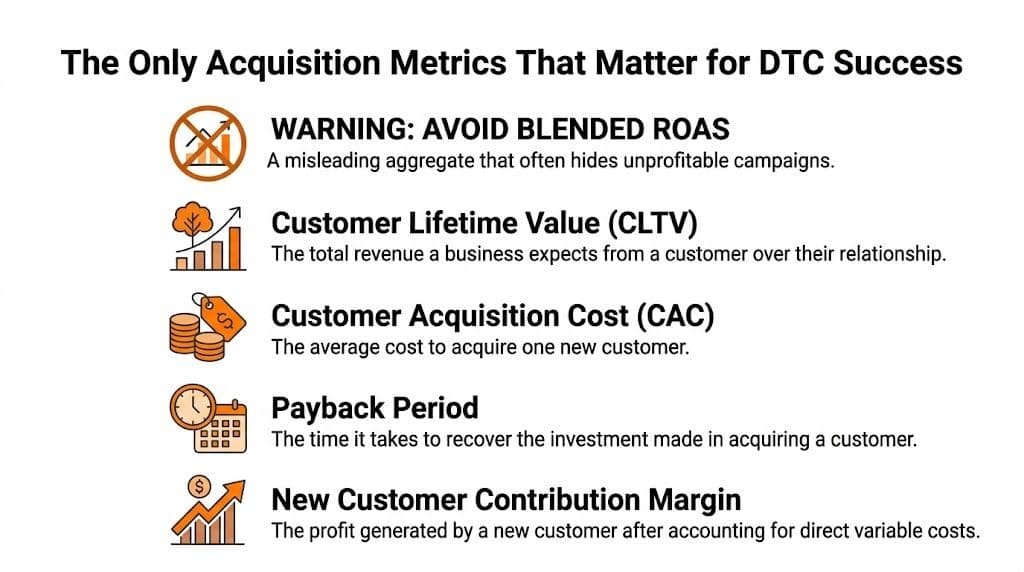
If you still lean on ROAS as the main decision-maker, read why ROAS and ROI are not the same thing. It’s one of the fastest ways to spot why “good” campaigns can still hurt the business.
#CAC tells you what you paid
Customer acquisition cost is the cost to acquire one new customer. That’s it. No fluff.
The simple formula is:
CAC = total acquisition spend / number of new customers acquired
If you spend on Meta Ads, Google Ads, agency fees, creative, or sales support tied to acquisition, those costs belong in the bucket. Don’t sanitize the number to make yourself feel better. A fake CAC is worse than a high CAC because it leads to bad scaling decisions.
Use CAC at the channel level first. Blended CAC has a place, but only after you understand what each channel is doing. If Meta is your lowest cost per new account, great. Keep it under review weekly and move budget based on actual performance, not habit.
#LTV to CAC tells you if growth is worth it
CAC only answers what you paid. It doesn’t answer whether the spend made sense.
That’s why LTV:CAC matters more. According to Lotame’s guide to acquiring new customers with data, an LTV:CAC ratio of 3:1 or higher is the benchmark for efficient, profitable growth, and a ratio below 1:1 signals a loss on each new customer.
Here’s the plain-English version:
- If you spend too much to acquire a customer who barely buys, growth is fake.
- If you acquire a customer cheaply but they never return, growth is fragile.
- If the customer’s lifetime value clearly outweighs what you paid to get them, now you have something you can scale.
A founder should know which channels produce customers with the strongest LTV:CAC, not just the lowest front-end CAC. Those aren’t always the same thing.
The cheapest customer is not always the best customer. The best customer is the one who repays acquisition fast and keeps buying.
#Payback period keeps you honest
Payback period is the least glamorous metric in the room, which is exactly why more founders should care about it. It tells you how quickly the contribution from a new customer pays back what you spent to acquire them.
A campaign can look exciting on day one and still create a cash problem if the customer takes too long to repay CAC. This matters even more if you carry inventory, finance purchase orders tightly, or run a lean team.
Here’s how to use payback period in practice:
- Look at first-order margin, not just revenue. Revenue doesn’t pay your bills. Margin does.
- Review by cohort. Customers acquired in one period often behave differently than customers acquired in another.
- Watch offer quality. If a deep discount pulls in weak customers, your payback gets slower even if conversion rises.
A founder doesn’t need a finance team to do this well. You need a clean weekly habit and the discipline to stop defending channels that aren’t producing healthy cohorts.
#Prioritizing Your Acquisition Channels
A lot of acquisition advice is useless because it treats every channel like it deserves equal attention. It doesn’t. Some channels are your foundation. Others are pressure valves. A few are side quests dressed up as strategy.
If you’re serious about new account acquisition, build your channel mix in layers.
#Start with your foundation channels
For many DTC brands, Meta Ads earns its place as a foundation channel because it often delivers the lowest cost per new account when creative, offer, and landing page are aligned. That doesn’t mean you blindly spend more every week. It means you treat Meta like a machine that needs constant pressure testing.
If performance slips, vary budget based on that week’s results. That’s operator behavior. Not loyalty to a platform.
Google Ads deserves a different role. It usually captures existing intent better than Meta does. That makes it useful for branded search defense, high-intent category terms, and shopping traffic where buyers are already comparing options. But don’t confuse intent capture with acquisition strategy. Google often harvests demand your brand already created elsewhere.
If you’re over-relying on Meta’s dashboard to judge success, read why Meta Ads ROAS can be misleading. It’s a good reminder that platform reporting is not the same thing as business truth.
#Add growth accelerators before you need them
Most founders wait too long to diversify. They keep spending into Meta and Google until CAC gets ugly, then scramble for alternatives. That’s backwards. You should build secondary channels while the core engine is still working.
One overlooked path is diversification into co-registration and pay-per-call. According to RexDirect’s analysis of little-known B2C acquisition strategies, these channels can slash CAC by 30-50% for DTC acquisition, and emerging 2025-2026 data in that same source says diversified media delivered 2x ROAS, with Shopify apps integrating co-reg reporting 25% CAC drops in Q1 2026 trials.
That doesn’t mean every brand should rush into co-reg tomorrow. It means you should stop acting like Facebook and Google are the whole internet.
A few practical filters help:
- Use co-reg when your offer is easy to understand. If your product needs too much education, lead quality can degrade.
- Use pay-per-call when human guidance closes the sale. This can fit higher-consideration products better than low-ticket impulse buys.
- Use niche creators and ambassador-style programs when trust matters more than scale. These channels often help quality even when they’re harder to systematize.
Founders who diversify early buy themselves leverage later. Founders who wait usually diversify under pressure.
#DTC Acquisition Channel Comparison
| Channel | Typical CAC Range | Time to See Results | Management Effort |
|---|---|---|---|
| Meta Ads | Varies by brand and creative quality | Usually fast once campaigns have enough signal | High |
| Google Ads | Varies by intent and competition | Often fast for existing demand capture | Medium to high |
| SEO | Usually lower over time than paid media when executed well | Slower | High |
| Email capture and welcome flows | Usually efficient when list quality is strong | Fast to moderate | Medium |
| Co-registration | Can be lower than major ad platforms for the right offer | Moderate | Medium |
| Pay-per-call | Depends on product complexity and close rate | Moderate | Medium to high |
| Influencer and ambassador programs | Varies widely by fit and structure | Moderate | High |
This table is intentionally qualitative on most rows. That’s because channel selection shouldn’t start with made-up benchmarks. It should start with your own store economics, your product’s buying behavior, and whether the channel produces customers who can support your CAC.
A smart channel mix usually looks like this:
- One primary paid engine you understand thoroughly.
- One intent-capture channel that harvests demand.
- One owned channel that converts and re-converts traffic you’ve already paid for.
- One experimental channel that reduces dependency and teaches you something.
That mix protects the business. It also keeps you from mistaking channel convenience for channel quality.
#Strategies to Convert Traffic into Accounts
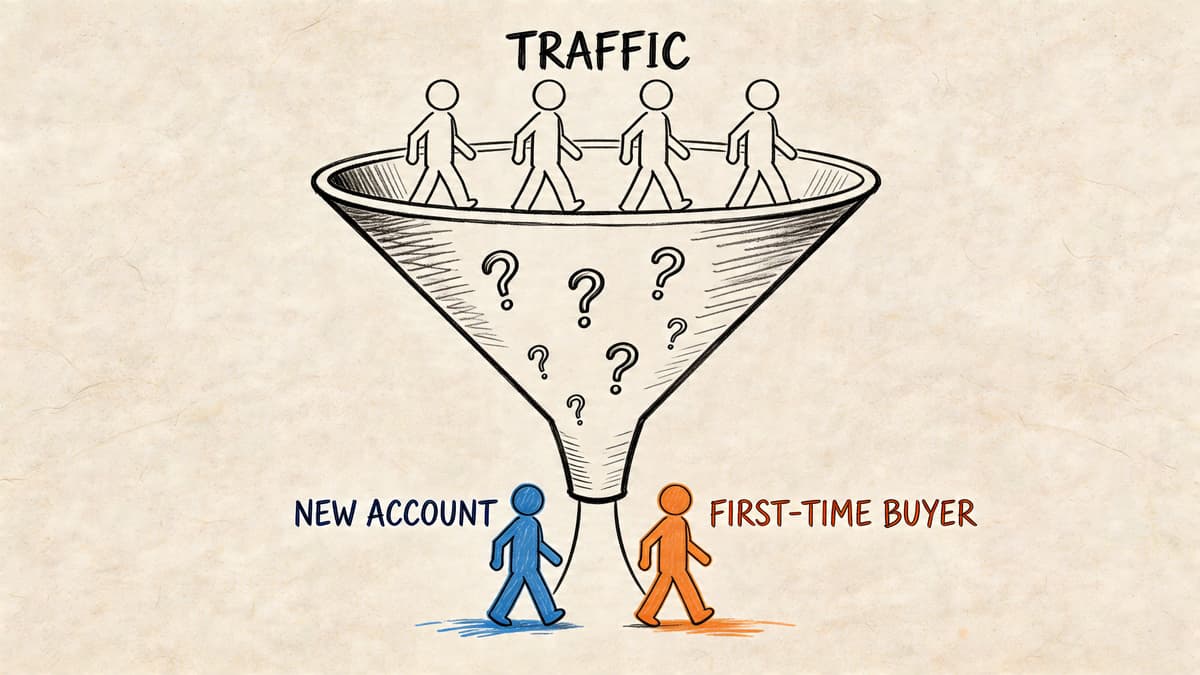
Buying traffic without fixing conversion is one of the most common ways founders torch margin. If visitors hit your site and don’t know what to do next, your acquisition cost goes up even when ad performance stays flat.
The fastest wins usually happen on-site.
#Use quizzes to earn the next click
Quizzes work because they reduce decision fatigue. They also give you first-party data you can use.
A one-question quiz in an email pop-up can increase email submissions because it gives the visitor a tiny action to take instead of a passive ask. A longer-form quiz can do a different job. It can qualify the shopper, narrow the product set, and make the store feel more guided.
That matters for new account acquisition because most first-time visitors don’t want to browse your whole catalog. They want help getting to the right product faster.
Use quizzes in two places:
- At the top of funnel pop-ups for quick segmentation and email capture.
- On landing pages or dedicated quiz pages when product selection is a real barrier to purchase.
Make the payoff obvious. If you ask questions, return something useful. Better product recommendations, a customized bundle, a starter routine, or a sharper welcome offer.
#Build landing pages for one job
Most DTC landing pages try to do too much. They explain the brand, tell the story, show the catalog, push social proof, sell the founder, and ask for the conversion all at once. That’s lazy page strategy.
A landing page tied to an ad should do one job. Continue the conversation the ad started.
Keep it tight:
- Match the promise. If the ad talks about a problem, the page should open on that problem.
- Trim navigation when focus matters. Fewer escape routes often help.
- Lead with the product fit. Not your entire brand manifesto.
- Make account creation feel useful. Save quiz results, provide reorder convenience, track preferences, or store a personalized recommendation.
Here’s a useful gut check. If someone lands on the page and can’t explain what to do next within a few seconds, the page is underperforming.
Later in the funnel, this walkthrough is worth watching if you want fresh ideas on turning traffic into action:
#Trigger follow-up based on intent
Not every visitor deserves the same follow-up. Treating all traffic equally is how brands end up spamming low-intent people while missing the ones ready to buy.
According to SEO Inc’s write-up on customer acquisition and predictive scoring, AI-powered predictive scoring can use behavioral data such as scroll depth, time on page, and content sequence to identify high-intent prospects, and for Shopify DTC founders this can trigger personalized journeys like abandoned cart flows or targeted offers that yield 15-25% faster acquisition cycles.
That points to a practical operating move. Build flows around signals, not just around email collection.
Examples:
- Cart abandoners should get product-specific reminders, not generic brand emails.
- Quiz completers should enter customized welcome sequences tied to their answers.
- Repeat product viewers should see stronger proof, clearer objections handling, or a small nudge to create an account and save preferences.
If a shopper shows intent, respond with relevance. If they don’t, don’t force the sale with discounts you’ll regret.
The founders who improve acquisition fastest usually aren’t the ones buying the most traffic. They’re the ones doing a better job with the traffic they already paid for.
#Building Your Weekly Acquisition Rhythm
Founders get into trouble when acquisition becomes emotional. One bad day on Meta and they panic. One strong day and they overspend. That isn’t a strategy. It’s mood-based media buying.
You need a weekly rhythm that’s boring enough to repeat and sharp enough to protect cash.
#The weekly check-in that keeps you in control
Set aside one recurring block each week. Keep it short. Keep it consistent. If you want a template, this weekly growth review guide is a useful starting point.
Your review should cover only the numbers and questions that lead to action:
- CAC by channel Look for movement, not just snapshots. If Meta worsened, ask why before you cut spend.
- LTV:CAC by recent cohorts You want to know whether the customers you bought recently look healthy, not whether last year’s customers were great.
- Landing page and quiz performance If traffic is steady but account creation drops, the problem may be on-site, not in the ad account.
- Offer quality If conversion improved because you used a heavier discount, check whether customer quality slipped.
Don’t turn this into dashboard tourism. If a metric doesn’t change a decision, it doesn’t belong in the meeting.
#Questions worth asking every week
The best founders aren’t asking more questions. They’re asking better ones.
Try these:
- Which channel delivered the lowest cost per new account this week, and did those customers look healthy after purchase?
- Did a creative change, audience shift, or landing page update move CAC in either direction?
- Are quiz starts, completions, or email submissions drifting?
- Which campaign should lose budget right now, not next month?
- Where did mobile and desktop behavior split enough to justify a fix?
According to Zoomd’s review of user acquisition trends defining 2025, apps and digital businesses adopting AI-powered user acquisition strategies achieved 143% higher user growth compared to traditional methods. For Shopify merchants, the useful takeaway isn’t “AI is hot.” It’s that founders need systems that turn store data into prioritized actions without requiring deep manual analysis.
That’s the key win of a weekly acquisition rhythm. You stop reacting to noise. You start making controlled adjustments based on what changed, why it changed, and whether the customer quality still supports the spend.
Review weekly. Adjust decisively. Don’t let underperforming campaigns linger because they used to work.
#Conclusion From Tactics to a Growth Engine
New account acquisition isn’t a channel list. It’s not a pile of hacks. It’s not “run more ads” and hope the spreadsheet works itself out later.
The brands that win build a system.
First, they measure what matters. CAC tells them what they paid. LTV:CAC tells them whether the customer is worth buying. Payback period tells them whether the business can carry the spend without choking cash flow.
Second, they diversify with intent. They keep a primary engine running, but they don’t let the whole business depend on one platform. They test other channels before they’re desperate, not after performance falls apart.
Third, they optimize every week. They review channel performance, on-site conversion, customer quality, and funnel behavior on a steady rhythm. That keeps small problems from turning into expensive habits.
This is the shift I’d push any founder to make. Stop asking for more tactics. Start building a profitable acquisition machine that you can actually operate.
If your store traffic is up but profit isn’t, the answer probably isn’t more spend. It’s better discipline. Better measurement. Better conversion. Better weekly decisions.
That’s how new account acquisition becomes a growth engine instead of a recurring fire drill.
If you want that weekly discipline without living in five dashboards, Arlo is built for exactly this job. It gives Shopify merchants a plain-English “20 Minute CMO” report that turns store data into prioritized actions, explains what changed, and highlights where to pause waste, improve conversion, and protect revenue. For founder-led brands that need clarity more than more charts, it’s a practical way to run acquisition with control.