Run Profitable Ads on TikTok for Shopify
By Arthur Falcone · Founder of Arlo
You’re probably looking at ads on TikTok from two angles at once.
One angle is hype. You’ve seen brands swear the channel prints demand, creators turn basic product demos into sales machines, and competitors show up in your feed over and over. The other angle is fear. You know short-form video can eat budget fast, and you don’t want another ad account that looks active while your Shopify margin gets thinner.
That tension is healthy. Founders lose money on TikTok when they chase motion instead of profit. Views are cheap. Traffic is easy to buy. Bankable growth is harder. The brands that win on TikTok treat it like a system tied directly to store economics, not a creative playground detached from the P&L.
#Table of Contents
- Why Ads on TikTok Are Your Next Growth Channel
- Decoding TikTok Ad Formats and Creative Specs
- Setting Up Your TikTok Ads Manager and Shopify Pixel
- How to Make TikTok Ad Creative That Sells
- Structuring Campaigns and Budgets for Profit
- How to Track and Optimize TikTok Ad ROI
#Why Ads on TikTok Are Your Next Growth Channel
You launch Meta campaigns, search campaigns, and email flows. Sales plateau anyway because you are still fighting over demand that already exists. TikTok solves a different problem. It creates demand at the moment a shopper sees the product, understands it, and wants it.
For a Shopify brand, that is the key opportunity.
TikTok is already operating at serious scale. According to Marketing LTB’s TikTok ads statistics roundup, the platform’s global ad revenue is projected to reach US$33.1 billion in 2025, representing 11% of global social media ad spend, with a potential ad audience of nearly 1.59 billion users. Native creative can also deliver 1.5x higher visibility than competing platforms, which is exactly why strong product stories travel fast there.
That matters if your growth problem is customer acquisition, not just conversion rate optimization on traffic you already have.
TikTok is a discovery channel. People are not typing your brand name into a search bar. They are seeing a product demo, a creator explanation, a before-and-after, or a sharp problem-solution video and deciding to buy earlier than they planned. If your product wins on demonstration, social proof, or impulse, ads on TikTok deserve budget.
#Profit matters more than platform hype
A common mistake is to ask, “Can TikTok work for us?” Ask a harder question. “Can TikTok bring in new customers at a CAC our store can support after discounts, shipping, and contribution margin?”
That is the filter that keeps founders from burning cash.
Judge TikTok against the levers that affect profit:
- Gross margin. Low-margin products leave little room for weak creative, bad attribution, or inflated CPMs.
- Offer quality. TikTok can scale a product with a clear hook. It will not fix an offer nobody cares about.
- Message match from ad to PDP. If the ad sells one promise and the product page delivers another, you pay for clicks that never become profitable orders.
- Repeat purchase behavior. A store with solid reorder rates can afford a higher first-order CAC than the ad dashboard suggests.
Use TikTok to acquire the first order. Use Shopify economics to decide whether that order deserves more spend.
If you want a smarter way to evaluate paid traffic through contribution margin and customer quality, read Arlo’s guide to new account acquisition. It frames growth the right way for this channel.
#Decoding TikTok Ad Formats and Creative Specs
Before you spend a dollar, fix the easy mistakes. TikTok punishes sloppy setup faster than most founders expect.
Success on the platform is tied to technical compliance. Ads need a 9:16 aspect ratio, at least 720p resolution, and must stay under 60 seconds. Properly formatted Spark Ads can deliver 30% higher completion rates and 142% higher engagement, while misaligned creative can underperform by 3x, based on Cometly’s TikTok advertising specs breakdown.
#Pick the format based on your goal
A lot of brands overcomplicate this. You don’t need every format. You need the right one for the job.
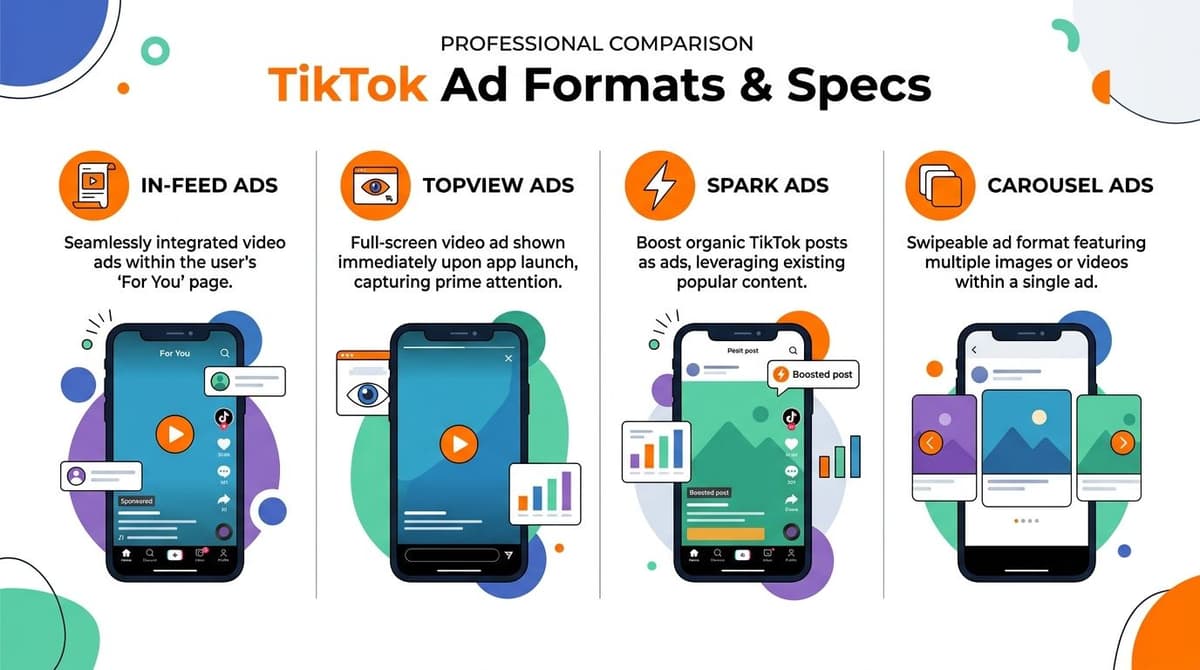
In-Feed Ads are the default direct-response workhorse. They sit inside the For You feed and should feel like native content. If you’re trying to drive product page visits, add-to-cart actions, and purchases, start here.
Spark Ads are the smartest choice when you already have organic posts or creator content that looks natural on-platform. They preserve the native feel, which is exactly why they often outperform stiffer brand-made assets. If a creator made a believable product demo, amplify that instead of rebuilding it in a studio.
TopView is for reach and attention. It’s a louder placement, better suited to bigger launches, seasonal pushes, or brands with enough budget to pay for prime visibility. Most smaller Shopify brands should not start here.
Carousel Ads can help when you need multiple frames or product angles, but for most DTC teams, short native video will still be the center of gravity.
Practical rule: Start with In-Feed and Spark. Earn the right to test broader placements after you can convert traffic consistently.
You can also keep a more detailed reference open in this TikTok ad specs guide while briefing your creative team.
#Use this spec table before you launch
Technical mistakes are boring, but expensive. Use this as a pre-launch check.
| Ad Format | Aspect Ratio | Resolution | Video Length | Best For |
|---|---|---|---|---|
| In-Feed Ads | 9:16 | ≥720x1280px | 5 to 60 seconds | Direct response and product testing |
| TopView Ads | 9:16 | ≥720x1280px | 5 to 60 seconds | Broad visibility and launch moments |
| Spark Ads | 9:16 | ≥720x1280px | 5 to 60 seconds | Amplifying organic or creator content |
| Collection Ads | 9:16 | ≥720x1280px | 5 to 60 seconds | Product discovery tied to catalog-style browsing |
A few rules are mandatory:
- Shoot vertical first. Don’t crop horizontal footage and hope for the best.
- Keep the file clean. Low-resolution uploads make the brand look cheap.
- Front-load the payoff. Put the product, problem, or result early.
- Use sound intentionally. TikTok is a sound-on environment, especially for stronger immersive placements.
Founders waste money when they treat creative specs like admin work. They aren’t admin work. They are the first filter between your ad, the algorithm, and the customer.
#Setting Up Your TikTok Ads Manager and Shopify Pixel
Bad data makes smart founders do dumb things.
The most dangerous version of ads on TikTok is not an expensive campaign. It’s an account with broken tracking that tells you a losing campaign is working, or a winning campaign is weak. That’s how brands scale the wrong thing and pause the right thing.
A significant hurdle for DTC brands is faulty TikTok and Shopify integration. 68% of Shopify merchants using TikTok ads report attribution mismatches, and the average ROAS drop is 25% when data flow is poor, according to the referenced integration summary.
#Build the account correctly
Keep the account structure simple.
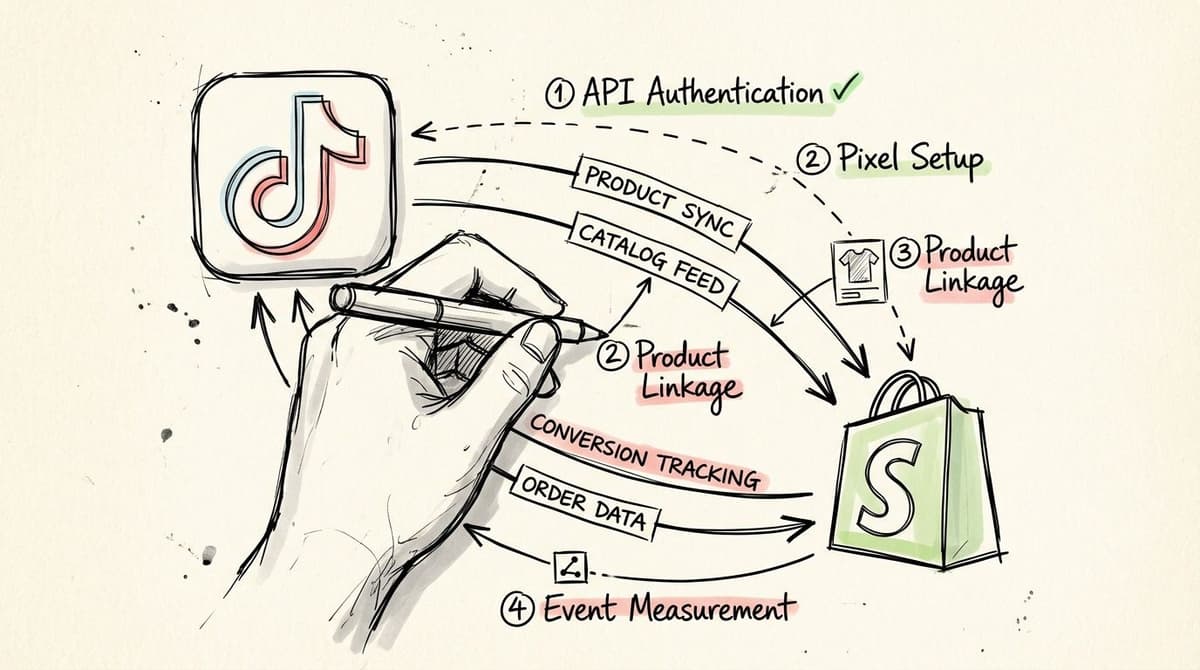
First, create your TikTok for Business setup and make sure the ad account is owned by the business, not buried inside a freelancer’s login. Founders regret messy access later.
Then do these basics in order:
- Connect the right Shopify store. Sounds obvious, but brands with multiple storefronts trip over this constantly.
- Install the official TikTok app in Shopify. Don’t get clever on day one.
- Set up the pixel through the integration flow. Keep naming conventions clear so you know which store and market the pixel belongs to.
- Confirm the ad account and pixel are linked before any campaign goes live.
This part is operational, not strategic. Still, it matters because weak account hygiene becomes a reporting problem later.
#Verify the Shopify data path
The actual work starts after installation.
You need to confirm that the events you care about fire in the journey a customer takes. For most Shopify brands, the essential checks are product view, add to cart, checkout initiation, and purchase completion.
Run through your own store like a customer would. Click from product page to cart, into checkout, then complete a test order if your setup allows it. Compare what Shopify records against what TikTok receives. If those don’t line up, don’t launch.
Use this checklist before spending:
- Check event firing. Make sure key commerce events trigger on the correct pages and steps.
- Review duplicate signals. Multiple apps can create conflicting data.
- Test after theme changes. A store redesign can lead to broken tracking.
- Audit inventory sync. If catalog or availability data is stale, campaigns can push products that can’t convert.
- Compare platform data with Shopify orders. Don’t trust one dashboard in isolation.
If you can’t explain why TikTok says one thing and Shopify says another, pause spending until you can.
This is also where one analytics layer outside ad platforms helps. Tools like GA4 can support cross-checking, and platforms such as Arlo can interpret TikTok, Shopify, sales, traffic, and product signals together so you can spot mismatches without living in dashboards all week.
#How to Make TikTok Ad Creative That Sells
Creative is the lever. Not targeting. Not bid tweaks. Creative.
Most losing TikTok ads come from brands making ads that look like ads. They open with logos, polished product beauty shots, scripted voiceovers, and carefully lit footage that screams “brand team.” People scroll past because it doesn’t belong in their feed.
#Stop making polished brand ads
The founder version of this mistake is easy to spot.
A skincare brand opens with a clean white background, product lineup, slow zoom, and a line about “redefining modern skincare.” It looks expensive. It also looks ignorable.
The better version starts with a creator holding one product and saying something blunt like, “I bought this because my skin kept looking flat by noon.” Then the creator shows texture, routine, result, and reason to care. That feels like TikTok.
The same pattern works across categories:
- Home goods win when someone shows the product solving an annoying daily problem.
- Apparel works better when a person tries it on, comments on fit, and reacts naturally.
- Beauty does better with demonstration, use context, and visible outcome.
- Food and supplements need taste, routine, or convenience, not polished claims.
Native beats polished because native earns attention before it asks for action.
#A simple creative structure that converts
You don’t need a giant production calendar. You need a repeatable format for testing angles.
Use this five-part structure:
-
Hook immediately
Start with the problem, result, or objection. The first moment should create tension. Think “why I switched,” “what surprised me,” or “the mistake I kept making.” -
Show the product early
Don’t hide the item until halfway through. People need context fast. -
Demonstrate, don’t describe
A founder talking about craftsmanship is weaker than a user showing the product in use. -
Add on-screen text
Most strong ads on TikTok use text to reinforce the point, frame the benefit, or clarify the offer. -
Close with a natural CTA
“Grab yours,” “I linked it,” or “this is the one I kept” works better than stiff direct-response language.
Here’s a useful creative review prompt: if you muted the video and watched only the visuals and text, would the story still make sense? If not, it’s probably too vague.
A good creative team also makes variations, not one “hero ad.” Change the hook. Change the speaker. Change the use case. Keep the offer and landing page aligned.
This breakdown is worth watching before your next batch of briefs:
#Build creative from your store reality
Your best hooks usually come from customer language, not brainstorm sessions.
Pull from:
- Reviews that describe the before and after
- Support tickets that reveal objections
- Post-purchase surveys that explain why people bought
- Founder stories that make the product feel specific
- Creator whitelisting or UGC that feels lived-in, not manufactured
The point isn’t to be entertaining for entertainment’s sake. The point is to be watchable enough to sell.
#Structuring Campaigns and Budgets for Profit
TikTok Ads Manager gives you options. Most of them are distractions for a Shopify brand trying to sell products.
If your store’s goal is revenue, your default objective should be Conversions. Not traffic. Not vanity reach. Traffic campaigns can buy cheap sessions that never had real purchase intent. That’s not efficient growth. That’s rented activity.
#Use fewer campaign types
A simple campaign structure beats a clever one.
Start with one conversions campaign using Campaign Budget Optimization. Inside it, test a small set of ad groups and put most of your variation into creative, not endless audience slicing. TikTok’s system needs room to learn, and founders often choke performance by over-segmenting too early.
A clean structure looks like this:
- One campaign focused on purchases
- A few ad groups that separate broad targeting from any high-intent or existing audience logic you want to test
- Multiple creatives per ad group, each built from different hooks, creators, or offers
- Lowest cost bidding unless you have a clear reason to constrain delivery
That setup does two useful things. It gives the algorithm enough data concentration to learn, and it gives you clearer readouts on which creative themes deserve more budget.
#Judge performance with sane benchmarks
Founders need context or they panic too early.
A good TikTok CTR often falls between 0.58% and 0.73%, and average engagement rates are often around 3.85% to 4.90%, according to WebFX’s TikTok benchmarks summary. That same source notes that 83% of users expect ads to be entertaining, which explains why polished, non-native creative tends to drag performance down.
Use those numbers as a rough orientation point, not a religion.
If CTR is weak, ask:
- Is the hook boring?
- Does the ad feel too branded?
- Is the message mismatched to the audience?
- Does the first screen make the product obvious?
If engagement is healthy but purchases lag, ask a different set of questions:
- Is the landing page carrying the same promise as the ad?
- Is the offer clear enough?
- Is mobile checkout friction killing intent?
- Are you driving curiosity instead of buying behavior?
High engagement with weak sales usually means the creative entertained people who were never likely to buy.
Budget-wise, stay conservative until the store path is proven. Don’t scale because one creative had a good day. Scale when multiple creatives show believable demand and Shopify revenue supports the move.
#How to Track and Optimize TikTok Ad ROI
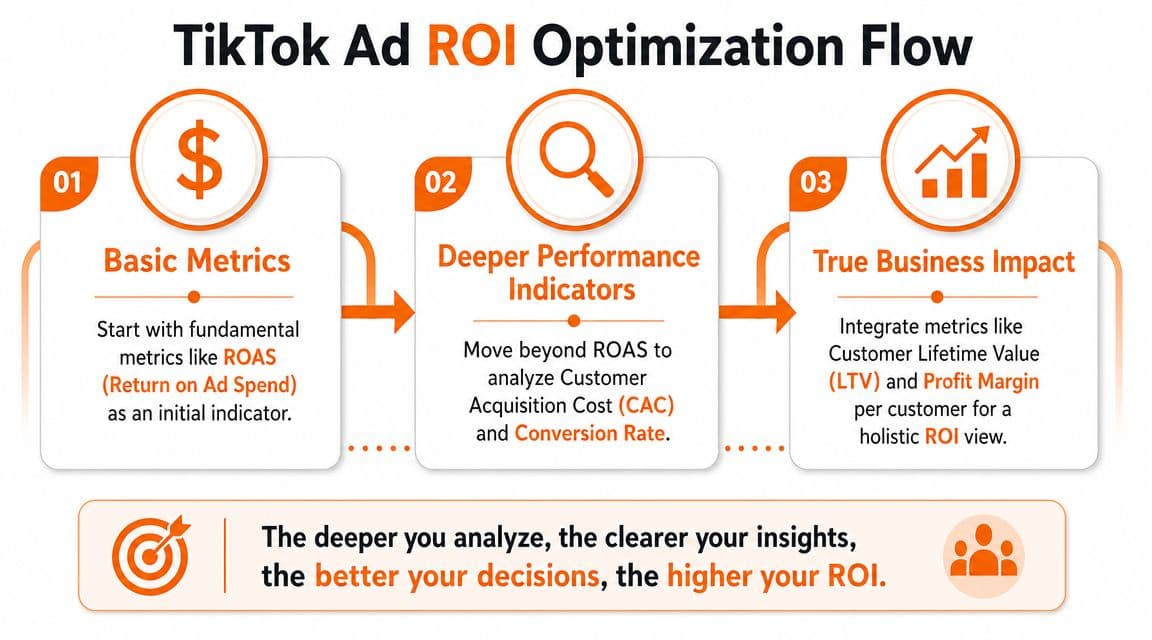
Most founders stop at platform ROAS. That’s a mistake.
TikTok can look strong inside Ads Manager and still be mediocre for the business. It can also look noisy in-platform and still be valuable if it’s bringing in new customers who reorder later. The only way to run profitable ads on TikTok is to judge the channel through more than one lens.
Top-performing DTC brands look beyond immediate ROAS. 72% of e-commerce managers can’t link TikTok traffic to LTV or AOV uplift, which is exactly why so many teams misread the channel, according to the AdsInc summary on TikTok and long-term value.
#Use three measurement lenses
You need three views of performance. One alone will lie to you.
Platform view
Use TikTok Ads Manager for immediate readouts on spend, conversion volume, creative response, and directional ROAS. It’s useful for tactical decisions. It is not enough for final budget decisions.
Blended business view
Look at total store revenue against total paid spend across channels. This helps you see whether TikTok is adding incremental demand or just taking credit for revenue that would have happened anyway.
Cohort value view
Track customers acquired from TikTok inside Shopify over time. Do they reorder? Do they buy different products? Do they become subscription customers? This is the difference between “campaign profitable today” and “channel profitable over time.”
If you want a cleaner framework for separating ad platform reporting from actual business impact, read Arlo’s explanation of ROAS vs ROI.
#Run a weekly profit review
Don’t optimize TikTok every hour. Review it weekly with discipline.
Use a standing checklist:
-
Check creative fatigue
Are winners still pulling attention, or has response softened? If the ad feels old in the feed, performance usually tells you. -
Compare ad promise to landing page reality
If one angle gets clicks but not checkouts, the handoff is probably broken. -
Review new customer quality
Look at what TikTok-acquired customers do after the first order. Cheap first purchases can still be expensive customers if they never return. -
Pause what creates noise, not just what looks expensive
A campaign that muddies attribution or brings low-intent traffic costs more than its media spend. -
Scale only proven themes
Move budget into creative concepts that keep working across more than one asset, not one lucky video.
A profitable TikTok account is usually boring behind the scenes. Strong tracking, clear creative patterns, disciplined pauses, and steady scaling beat constant tinkering.
The founder’s job isn’t to admire dashboard spikes. It’s to protect cash and compound what works.
If you want a simpler way to see whether TikTok is helping or hurting your Shopify store, Arlo gives merchants a weekly plain-English report that interprets sales, traffic, customer, and product data, flags wasteful spend, and ranks what to do next by urgency and dollar impact.