TikTok Ad Specs 2026: A Guide for E-commerce Brands
By Arthur Falcone · Founder of Arlo
You exported the ad, uploaded it to TikTok Ads Manager, hit publish, and then watched the platform either reject it or spend money without producing sales. That usually isn't a product problem. It's an execution problem.
Most founders treat tiktok ad specs like admin work. That mistake gets expensive fast. Wrong aspect ratio hurts immersion. Weak opening frames kill clicks. Low-resolution exports make good products look cheap. Then the team blames the offer, the audience, or the platform.
TikTok can absolutely work for DTC. The platform delivers an average revenue return of $2 for every $1 spent, and e-commerce conversion rates sit between 1.1% and 2.5% according to Teleprompter's TikTok marketing statistics. But you don't achieve that upside by guessing. You achieve it by getting the creative specs right, then matching them to a real acquisition strategy. If your broader paid and owned media plan is shaky, fix that too with a tighter e-commerce growth strategy.
#Table of Contents
- Why Your TikTok Ads Aren't Profitable
- TikTok Ad Specs Quick Reference Table 2026
- Choosing the Right TikTok Ad Format for Your Goal
- Detailed In-Feed Ad Specs Video and Image
- Specs for Spark Ads TopView and Brand Takeover
- Creative Best Practices for Higher ROAS
- Your E-commerce Creative QA Checklist
- Managing Ad Fatigue and Creative Rotation
- Frequently Asked Questions About TikTok Ads
#Why Your TikTok Ads Aren't Profitable
If your TikTok campaigns aren't profitable, start with the obvious truth. The platform is strict, and bad creative setup burns money before optimization even has a chance.
Founders waste time obsessing over targeting while shipping ads that were doomed at export. The video is horizontal. The text gets covered by the UI. The first seconds say nothing useful. The landing page doesn't match the promise in the ad. Then spend starts, clicks stay weak, and CAC climbs.
This is why tiktok ad specs matter. They're not a compliance box. They're the gate between a creative that feels native and a creative that looks like an ad someone should skip.
Practical rule: If your ad doesn't look like it belongs in the feed, TikTok users won't reward you with attention.
Profit on TikTok comes from stacking small advantages. Native orientation helps stop the scroll. Clean exports avoid quality rejection. Shorter direct-response edits make it easier to land the offer before attention disappears. Those details don't feel glamorous, but they shape the metrics founders care about: CTR, conversion rate, and ROAS.
The painful part is that many losing ads aren't conceptually bad. They're just packaged badly. A strong product demo in the wrong format still loses. A credible UGC clip with clumsy framing still underperforms. A solid offer hidden after the opening seconds still gets ignored.
#TikTok Ad Specs Quick Reference Table 2026
If you're busy, use this as your pre-flight check. Confirm the format, export properly, and only then worry about bidding, audiences, or scale.
Some TikTok ad specs are shared across formats, but not all. That's where teams get sloppy. They assume one export works everywhere, and then wonder why performance is uneven.
| Ad Format | Aspect Ratio | Resolution (px) | Duration | Max File Size |
|---|---|---|---|---|
| In-Feed Video Ads | 9:16 preferred. 1:1 and 16:9 supported | Minimum 540x960 for 9:16, 640x640 for 1:1, 960x540 for 16:9. Recommended 720x1280 or 1080x1920 | 5-60 seconds, with best performance at 9-15 seconds | 500MB |
| In-Feed Image Ads | Not verified in the provided data | Not verified in the provided data | Not verified in the provided data | Not verified in the provided data |
| Spark Ads | Same as original post format | Same as original post format | Inherits original post length | Not verified in the provided data |
| TopView | 9:16 | Recommended 720x1280 or 1080x1920 quality standards align with TikTok video ad guidance in the verified data | Up to 60 seconds | 500MB |
One opinion. Default to vertical full-screen unless you have a very good reason not to. Most brands don't.
#Choosing the Right TikTok Ad Format for Your Goal
TikTok doesn't have one ad format. It has several, and founders lose money when they use the wrong one for the job.
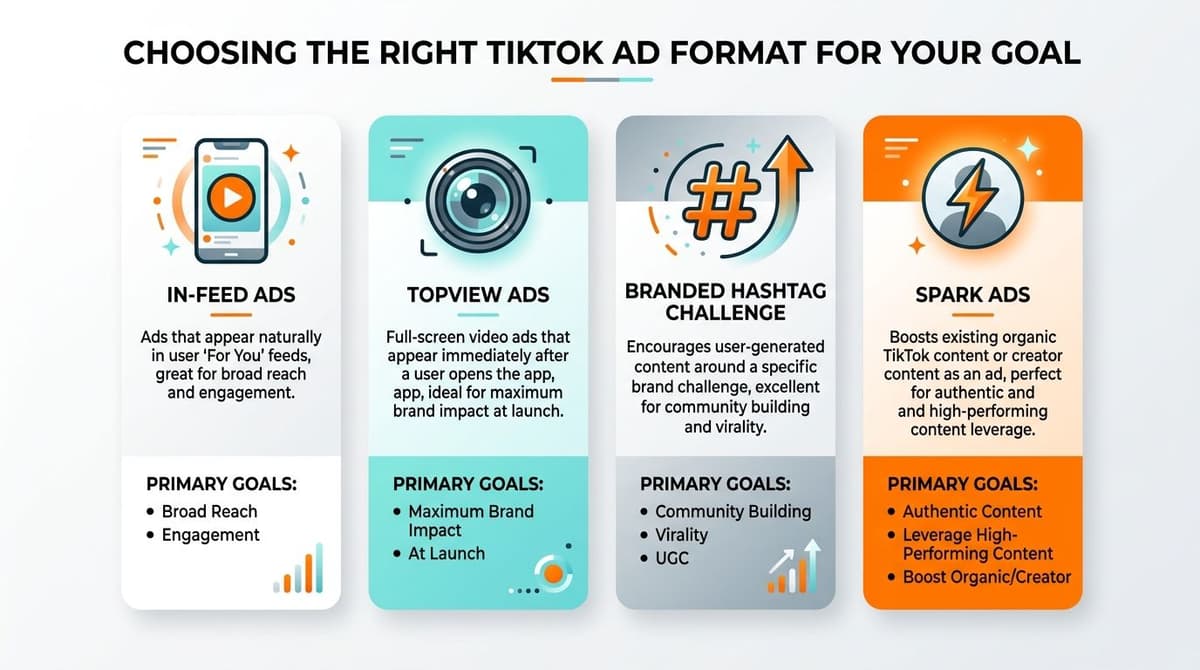
If you're trying to acquire customers profitably, tie the format to the business outcome. Don't choose based on what looks flashy in Ads Manager. Choose based on whether you need direct response, social proof, or broad awareness. If customer growth is the priority, this sits inside a larger new account acquisition system.
#In-Feed Ads for day-to-day direct response
For most Shopify brands, In-Feed is the workhorse. It appears where users already scroll, which gives you a real chance to blend in, earn the click, and convert traffic without screaming "advertisement."
In this context, most DTC testing should happen first. Product education, offer framing, founder-led demos, problem-solution edits, creator clips, and retargeting all fit here cleanly.
#Spark Ads for trust and social proof
Spark Ads are what you use when the organic post already feels believable. That's their edge. They preserve the creator or brand-post feel instead of forcing a cold, overproduced ad into the feed.
Use Spark when comments, creator presence, social proof, or a post's native momentum matter. If you have good UGC, don't strip away the thing that made it persuasive in the first place.
Spark is often the better choice when the audience needs to believe the person before they believe the product.
#TopView and Brand Takeover for launches
TopView and Brand Takeover are not everyday performance formats for most founder-led brands. They're impact placements. You buy them when you want immediate attention around a launch, major promotion, retail moment, or category statement.
That doesn't make them bad. It makes them specialized. The problem is that small brands sometimes buy awareness-style real estate when what they need is conversion-tested creative and tighter economics.
A simple decision filter works well:
- Use In-Feed when you need scalable acquisition and routine testing.
- Use Spark Ads when creators, comments, and authenticity strengthen conversion.
- Use TopView or Brand Takeover when attention itself is the objective.
- Skip premium formats if your store still hasn't proven message-market fit in ordinary feed placements.
#Detailed In-Feed Ad Specs Video and Image
You launch a new creative test, spend for two days, and CTR stays weak. The offer is solid. The landing page converts. The problem is often the ad file itself. Wrong framing, soft resolution, cluttered composition, or slow first seconds will drag down feed performance before your product gets a fair shot.
For most DTC brands, In-Feed is where CAC gets fixed or inflated.
The point of specs is not compliance for its own sake. Each one affects how fast a shopper understands the product, how credible the ad feels, and whether TikTok can deliver it cleanly in the feed. Better fit usually means better thumb-stop rate, stronger click intent, and lower wasted spend.
#In-Feed video specs that affect performance
Use these as your operating standard:
- Aspect ratio: Prioritize 9:16. TikTok also supports 1:1 and 16:9, but vertical fills the screen and usually holds attention better.
- Resolution: Minimum is 540x960 for vertical. Export at 720x1280 or 1080x1920 whenever possible to keep the product sharp.
- File formats: MP4 and MOV are the safest choices. TikTok also supports formats such as MPEG, 3GP, and AVI.
- Length: TikTok allows 5 to 60 seconds. For direct-response creative, shorter usually wins because the product claim lands faster.
- File size: Keep files under 500MB.
- Codec and bitrate: Use H.264 and maintain enough bitrate to avoid visible compression, especially on product close-ups and text overlays.
Here is what those specs mean in money terms.
A 9:16 video takes over the screen. That improves feed fit and gives your hook a better chance of earning the next second. A blurry export makes skincare texture, fabric quality, and product details look cheap. That hurts trust, and trust is a conversion variable. Long edits often delay the payoff, which means you pay for impressions from people who never even understand what you sell.
#Image specs matter too
If you run image-based In-Feed ads, treat layout as a performance decision, not a design exercise.
- Use high-resolution images sized for vertical viewing.
- Keep the product and primary claim in the center-safe area.
- Avoid placing pricing, offers, or key benefit text near the edges where TikTok UI elements can cover them.
- Check contrast on mobile. If the text blends into the image, your click-through rate will suffer.
Static creative can still work for DTC, especially for before-and-after visuals, bundles, founder offers, and straightforward promos. But the image has to communicate the product and outcome immediately. If a shopper has to study it, you already lost the auction.
#Expensive mistakes founders keep repeating
| Mistake | Business impact |
|---|---|
| Repurposing landscape footage without re-editing for vertical | Lower feed fit, weaker watch time, higher CPC |
| Uploading soft or compressed files | Lower trust, weaker product perception, lower CVR |
| Trying to tell the full brand story in one ad | Slower hook, weaker CTR, wasted spend |
| Waiting too long to show the product | More scrolls before intent forms |
| Placing text too close to the edges | Covered messaging, confused offer, lower click intent |
One more rule. Show the product early. If the viewer cannot identify what you sell in the first moments, the ad is doing branding work at performance prices.
Good tiktok ad specs support strong creative. Bad specs quietly raise CAC.
A practical QA pass before launch:
- Build the ad in 9:16 first.
- Export at 1080x1920 if your source footage allows it.
- Make the product visible immediately.
- Keep one claim, one angle, and one action.
- Preview on an actual phone before you spend anything.
That last step saves money. Desktop review misses cropped text, weak readability, and compression problems that show up instantly on mobile.
#Specs for Spark Ads TopView and Brand Takeover
You approve a bigger TikTok budget, buy a premium placement, and traffic spikes for a day. CAC gets worse. ROAS stays flat. That happens when brands treat format selection like a visibility decision instead of a profit decision.
Spark Ads, TopView, and Brand Takeover do different jobs. Pick the wrong one and you pay for reach that your creative, offer, or landing page cannot convert.
#Spark Ads for conversion efficiency
Spark Ads use an existing TikTok post as the ad. That matters because the post keeps its native social proof, creator identity, and platform fit. For DTC brands, that often translates into stronger click-through rate and lower resistance at the click.
Use Spark Ads when the post already does three things well. It shows the product fast, demonstrates the outcome clearly, and sounds like a real person instead of an ad team. If the original post is vague, over-edited, or weak in the first seconds, Spark will scale the problem.
Good Spark candidates usually include:
- Creator demos that show the product in use
- Organic brand posts with credible comments and engagement
- UGC that handles one objection clearly
- Posts that already drive product-page visits or strong add-to-cart behavior
This is the format DTC brands should test aggressively before paying for broader awareness. Native creative usually gives you a cleaner read on whether the message can convert. That matters if you're trying to judge the difference between platform ROAS and actual business profitability, not just cheap impressions.
#TopView and Brand Takeover for reach, not rescue
TopView and Brand Takeover are premium placements. They buy attention at the top of the app. They do not fix weak economics.
According to TikTok's Brand Takeover ad specs and placement overview, Brand Takeover appears when a user opens the app and can direct traffic to an internal or external destination. That placement gives you immediate visibility, but the business case only works if your offer is already proven and your site can convert paid traffic without friction.
Use TopView for launches, tentpole promos, retail moments, or broad product awareness when you already know the creative angle works in cheaper placements.
Use Brand Takeover for short, high-impact campaigns where share of attention matters more than efficient testing.
Skip both if you're still figuring out hooks, product-market message fit, or landing page conversion problems. Premium inventory amplifies whatever is already true. If the ad is strong, you get scale. If the ad is weak, you get expensive waste.
#What to check before you spend on premium placements
Founders get in trouble here because they focus on placement prestige and ignore conversion readiness. Run this QA pass first:
| Format | Best use case | Main risk | What to verify before launch |
|---|---|---|---|
| Spark Ads | Scaling proven native posts | Boosting weak organic content | Clear product demo, credible creator fit, comments support trust |
| TopView | Major launch or broad awareness push | Paying for attention without click intent | Strong first frame, obvious offer, landing page matches ad promise |
| Brand Takeover | Short burst visibility campaign | High spend with weak downstream conversion | Clean CTA, fast mobile page load, campaign economics already proven |
My recommendation is simple. Start with Spark if you care about efficient acquisition. Move to TopView or Brand Takeover only after your hook, offer, and post-click experience are already producing acceptable CAC in lower-cost placements. That is how you use specs to improve revenue, not just satisfy platform requirements.
#Creative Best Practices for Higher ROAS
Technical compliance gets the ad accepted. Creative quality determines whether the ad earns its keep.
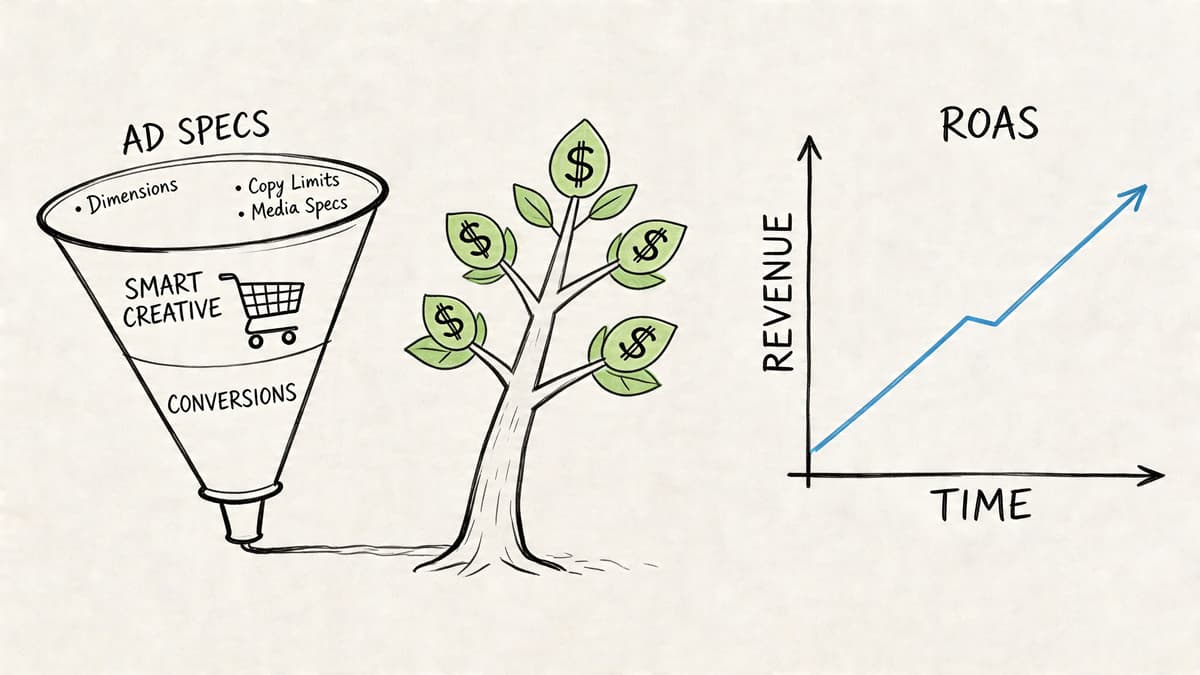
Too many brands stop at "it fits the specs." That's lazy thinking. Plenty of ads meet the format rules and still lose money. If you're trying to judge paid social properly, understand the difference between ROAS vs ROI, because a campaign can look acceptable in-platform and still be a bad business decision.
#Hooks decide whether you pay for attention or earn it
Your hook has to land in the first 3 seconds to counter a 50%+ viewer drop-off rate, and exporting at 1080x1920px with native-feel creative can lift CTR by 20-30% according to Soona's TikTok image size and specs guide.
That means your opening can't be cinematic throat-clearing. No logo animation. No slow pan. No "hey guys." Show the pain, the result, the product use, or the claim immediately.
Founders should pressure-test every ad with one question. Would a stranger know what's being sold and why it matters before the first few seconds are over?
Try hooks like:
- Show the product solving the problem immediately
- Lead with a visible result
- Open on a strong objection
- Use a creator line that sounds spoken, not scripted
If the first seconds don't create curiosity or recognition, the rest of the ad doesn't matter.
Here's a useful walkthrough on tightening creative decisions in practice:
#Lo-fi usually beats polished brand video
TikTok rewards ads that feel like they belong on TikTok. That's why lo-fi, creator-led, phone-shot creative often beats expensive agency work.
This doesn't mean "make ugly ads." It means make credible ads. Clean audio, clear framing, visible product use, readable on-screen text, and direct language beat glossy nonsense every time.
A practical creative stack for DTC brands:
- UGC demo with product in hand.
- Problem-solution cut with fast pacing.
- Founder face ad explaining why the product exists.
- Social proof edit built from creator clips or comments.
- Offer-led retargeting ad with direct CTA.
Don't chase polish. Chase clarity, credibility, and speed.
#Your E-commerce Creative QA Checklist
This is the part many advertisers skip because it feels boring. Then they spend money to discover mistakes that were visible before launch.
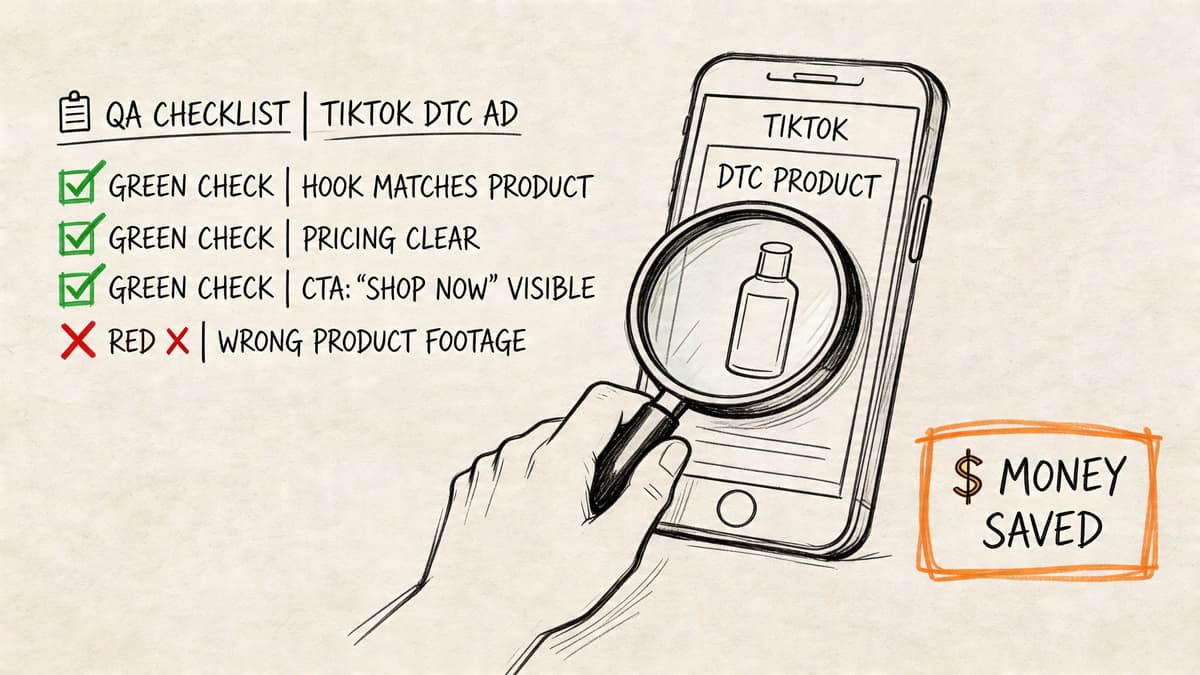
Run this checklist every time. Not when you remember. Every time.
#Pre-launch checks inside your creative file
- Aspect ratio check: Is the ad built in 9:16 unless you have a deliberate reason to use another format?
- Resolution check: Did you export at 720x1280 or preferably 1080x1920?
- Length check: Is the edit tight enough to earn attention quickly, especially for direct response?
- Opening check: Is the product, problem, or result visible immediately?
- Safe zone check: Are captions, offer text, logos, and product details away from crowded screen edges?
- File compliance check: Are you using a supported video type and staying under the file-size limit?
- Audio check: Is dialogue understandable without forcing users to strain?
#Checks outside the ad file
A technically correct ad can still fail if the rest of the funnel is sloppy.
| QA item | What to verify |
|---|---|
| Landing page match | The page reflects the product, message, and offer shown in the ad |
| Mobile experience | Product page loads cleanly, reads well, and makes checkout easy on mobile |
| CTA clarity | The ad and destination agree on what the user should do next |
| Tracking setup | Your measurement stack is firing so you can judge performance properly |
| Product availability | The item is in stock and the variant path isn't broken |
Launching without QA is not speed. It's rework with ad spend attached.
If you run a team, assign one owner for final sign-off. Shared responsibility usually means nobody checks the obvious.
#Managing Ad Fatigue and Creative Rotation
Your first TikTok ad finally hits. CTR looks healthy, CPA is tolerable, and you start thinking scale will solve the rest. Then a week later, spend is still going out, click quality drops, and CAC starts climbing because you're feeding the same audience the same creative.
That pattern is predictable. Metric Mosaic's TikTok ad specs analysis notes that performance often starts to decay after 7-10 days. Specs matter at launch. Rotation discipline protects ROAS after launch.
#Fatigue is a performance problem, not a creative mystery
Ad fatigue means the market has seen enough of that angle, that hook, or that delivery. Your ad can still meet every technical requirement and still stop producing profitable traffic. Founders miss this because they treat compliance as the finish line. It isn't. Compliance gets the ad live. Fresh creative keeps it efficient.
Late reactions are expensive.
If you wait until results are obviously bad, you force the account to absorb weak traffic while the team rushes replacements. That usually shows up as lower CTR, weaker CVR, and wasted spend on ads that already lost their edge.
Watch for these signs:
- CTR starts sliding while delivery stays stable
- Comment quality turns repetitive, skeptical, or dismissive
- Traffic volume holds, but conversion rate weakens
- Previous winners keep spending but stop driving efficient purchases
#Use a rotation system, not a winner-and-pray strategy
One winning ad is not a strategy. It's a temporary asset.
Run multiple concepts at the same time so your account is never dependent on one piece of creative. Rotate new hooks, offers, use cases, and proof points before the current winner burns out. A minor edit won't rescue a dead angle. A new message might.
Use a simple operating rhythm:
- Keep 3 to 5 distinct concepts in testing or live rotation.
- Replace angles before results fully break down.
- Change one major variable at a time so you know what improved performance.
- Queue the next round of concepts as soon as a winner appears.
- Pause tired ads fast. Nostalgia is expensive.
#Rotate based on business signals
Do not rotate because you're bored with the ad. Rotate because unit economics are getting worse.
If CTR drops first, your hook is wearing out. If CTR holds but CVR falls, the click is getting less qualified or the promise is losing credibility. If both fall, the concept is spent. That diagnosis matters because it tells your team what to make next, not just that you need "new creative."
One useful open question remains. Existing guidance does not clearly show whether fatigue behaves differently across 9:16, 1:1, and 16:9 over time. Until better evidence exists, keep vertical-native creative as your default, test other formats with intent, and judge them by business outcomes, not novelty.
#Frequently Asked Questions About TikTok Ads
#What's the minimum budget for TikTok ads
Plan around TikTok's platform minimums, then budget above them if you want decisions you can trust. A tiny spend does not buy efficiency. It buys noisy data, weak delivery, and false confidence.
For most DTC brands, the primary question is not "Can I launch?" It's "Can I afford enough spend to find a winning hook before CAC gets out of control?"
#What file types should I use
Use MP4 or MOV.
They are the safest options for fast exports, clean uploads, and fewer avoidable production problems. That matters because every delay between concept approval and launch slows testing velocity, and slow testing hurts ROAS.
#How long should my ad be
Keep direct-response ads short enough to make the sale before the swipe.
TikTok allows longer videos, but permission is not a performance strategy. For e-commerce, concise usually wins because it gets to the problem, product, proof, and offer faster. Faster message delivery usually improves thumb-stop rate and protects conversion intent.
#Do I need 9 by 16 every time
Use 9:16 as your default.
It fills the screen, looks native in-feed, and gives your product the best chance to hold attention. Other aspect ratios can work, but they often feel repurposed. Repurposed creative tends to lower CTR because it looks like an ad before the user even processes the message.
#Can I use polished brand video
Yes, but do not make it your first bet.
Polished brand footage often looks expensive and converts cheap. Creator-style, testimonial-led, and lo-fi product demos usually earn more trust on TikTok because they feel closer to how people already consume content on the platform. Start with native-looking concepts. Add polish only if it improves clarity, proof, or product understanding.
#What about ad copy and CTA setup
Keep copy blunt and useful.
Name the product. State the benefit. Give one reason to believe. Then tell the viewer what to do next. Clear copy improves click quality, and better click quality gives you a better shot at stronger CVR after the tap.
#Should I worry about music rights
Yes.
If you use audio you cannot legally run in paid ads, you create approval risk, replacement work, and wasted creative time. Use ad-safe audio from the start so your team is not rebuilding winners after they should already be scaling.
#What's the fastest way to QA a TikTok ad before launch
Run a quick DTC check before anything goes live:
- Is the hook clear in the first seconds?
- Does the video fit 9:16 without awkward crops?
- Is the product visible early?
- Is the value prop obvious without sound?
- Does the CTA match the landing page?
- Does the creative look native enough to earn the click?
Miss two or three of those, and performance usually suffers somewhere downstream. CTR drops. CVR weakens. ROAS follows.
If you're running a Shopify brand and you're tired of digging through dashboards to figure out why paid traffic isn't converting, Arlo is worth a look. It turns your store data into a concise weekly report that tells you what changed, why it matters, and what to do next, including where ads, conversion, and retention need attention before they drain profit.