Advertising in E Commerce: A Founder's Guide for 2026
By Arthur Falcone · Founder of Arlo
You're probably in one of two places right now.
Either you've been boosting posts, running a few Meta campaigns, maybe testing Google, and you can't tell what's driving profit. Or you've avoided going harder on ads because you're worried you'll light money on fire the second you scale.
That anxiety is rational. Advertising in e commerce is crowded, expensive, and full of bad advice. Most content treats it like a menu of channels. Try Meta. Try Google. Try TikTok. Try influencers. That's not strategy. That's a shopping list.
The primary task is both simpler and more difficult. You need to know where buyer intent lives for your brand, what kind of creative earns attention, how to measure performance without lying to yourself, and when to push harder versus when to stop spending. That matters because global digital ad spending is projected to surpass $700 billion by 2025, accounting for over 65% of total ad spend worldwide according to digital advertising market projections. If you run a DTC brand without a clear ad strategy, you're basically closing your doors in the busiest shopping district on earth.
That doesn't mean you need to be everywhere.
It means you need a framework. A way to decide what deserves your first dollar, your next dollar, and your attention this week. That's what founders usually lack. Not effort. Not ambition. Judgment.
#Table of Contents
- Introduction Beyond Boosting Posts
- Mapping the E-commerce Advertising Universe
- Choosing Your First Profitable Ad Channels
- Principles of High-Converting Creative and Targeting
- How to Budget and Scale Your Ad Spend Smartly
- Measuring What Matters in a Privacy-First World
- Your Immediate E-commerce Advertising Checklist
#Introduction Beyond Boosting Posts
Founders get trapped by fake progress. You launch a few campaigns, watch traffic rise, see a handful of orders come through, and assume the machine is working. Then you check the bank account, inventory position, and repeat purchase rate. Suddenly the excitement disappears.
This is the core problem with advertising in e commerce. Advertisers frequently optimize for activity instead of business health. They obsess over click-through rates, campaign names, audience hacks, and whatever some platform rep told them last week. Meanwhile, they ignore the boring questions that decide whether ads help or hurt the company.
Questions like these:
- Can this product win cold traffic, or does it need warm demand first?
- Do people already search for what we sell, or do we need to create desire from scratch?
- Is our site good enough to convert paid traffic on mobile?
- Are we buying new customers, or just paying to re-acquire the same people?
If you don't answer those, your ad account becomes a leak, not a growth engine.
Practical rule: Don't ask, “Which channel should I use?” Ask, “Where can I buy the highest-intent attention for this product right now?”
A founder with limited time doesn't need a bigger media plan. You need a pecking order. Search when intent exists. Social when the product is visual and discovery-driven. Retargeting when traffic is already there. Retention when you've earned a first purchase and don't want to pay for that customer twice.
The good operators I know don't think like media buyers first. They think like investors. They put money into the part of the funnel that is most likely to produce profitable behavior, then they protect what works.
#Mapping the E-commerce Advertising Universe
Advertising in e commerce gets easier when you stop seeing channels as random options and start seeing them as roles in the same system.
#Five buckets that matter
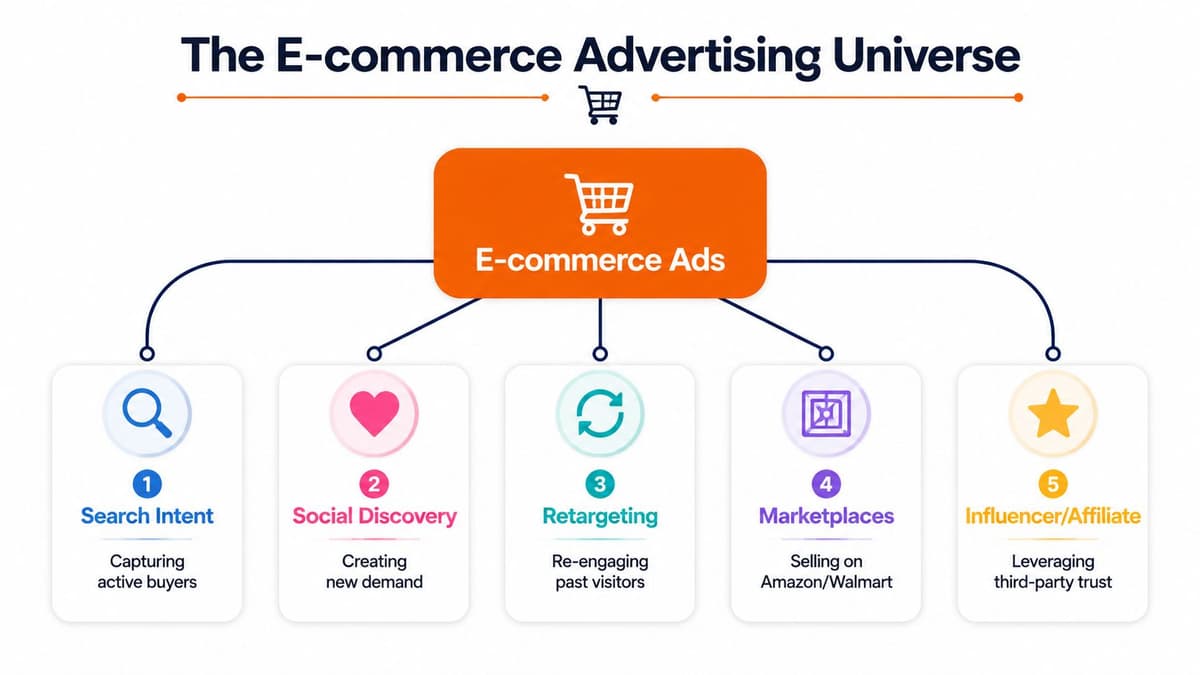
I would categorize the environment into five buckets.
Search intent sits closest to revenue. This is Google Search and Google Shopping. These channels capture people who already want something and are actively looking for it. If you sell a product people know how to name, search is often the cleanest place to start.
Social discovery is different. Meta and TikTok are where people aren't searching for your SKU. They're browsing, scrolling, and noticing. These channels are strong when the product is visually obvious, emotionally appealing, or easy to understand in a few seconds.
Retargeting is your second chance machine. Someone visited, looked, maybe added to cart, then left. Retargeting brings them back with a tighter message, better timing, and higher intent.
Marketplaces matter if the customer already shops inside Amazon or Walmart and trusts the platform more than an unfamiliar brand site. If you're trying to think through channel tradeoffs there, this breakdown of a marketplace advertising strategy for 2026 is worth reading because it frames the actual platform choice founders face.
Influencer and affiliate sits in a different lane. You're borrowing trust from a person or publisher instead of buying pure platform distribution. If your category benefits from demonstration, social proof, or creator-style storytelling, learning from current 2026 influencer marketing strategies can help you avoid treating creators like just another ad placement.
#How these channels work together
Most brands fail because they expect one channel to do everything.
Search doesn't usually create brand desire from nothing. Social doesn't always convert high-consideration buyers on the first click. Influencers can spark attention, but they won't fix a weak offer. Retargeting can recover demand, but only if you generated demand in the first place.
That's why it helps to think in flows:
- Discovery creates awareness
- Intent captures demand
- Retargeting recovers lost buyers
- Retention monetizes the customer again
A good ad system doesn't force every channel to close the sale. It gives each channel a clear job.
If your current setup feels messy, it's probably because you've mixed jobs. You're using prospecting campaigns to do retention work, or expecting retargeting to save an offer nobody wanted.
Clean that up first.
#Choosing Your First Profitable Ad Channels
If you're early, don't launch five channels. That's how founders create five blurry data sets and zero useful answers.
Pick one acquisition channel and one retention channel. That's enough to learn fast without drowning in noise.
#Start with the buying behavior, not the platform hype
You should choose channels based on how people buy your product.
If customers already know what it is and search for it by name or use case, lean toward Google. If your product wins on visual appeal, impulse, before-and-after, or demonstration, social is usually the better opening move. If you already have traffic and email subscribers, retention channels often beat both on profit.
That last point gets ignored far too often. Email marketing delivers an average of $40 ROI for every dollar spent, while SMS marketing boasts 98% open rates, according to U.S. e-commerce sales and channel performance data. Founders love chasing new traffic because it feels like growth. Sometimes the better move is to convert the audience you already paid to attract.
#E-commerce ad channel comparison
| Channel | Best For | Customer Intent | Typical Cost | Complexity |
|---|---|---|---|---|
| Google Search | Products with clear demand and problem-aware buyers | High | Can get expensive in competitive categories | Medium |
| Google Shopping | Visual products with existing search demand | High | Spend rises with competition and feed quality matters | Medium |
| Meta Ads | Visually compelling products and broad consumer categories | Low to medium | Flexible, but creative burn happens fast | Medium |
| TikTok Ads | Products that benefit from creator-style demos and native video | Low to medium | Testing can be efficient, but creative demands are high | High |
| Existing subscribers, abandoned carts, post-purchase follow-up | High from owned audience | Low compared with paid media | Low to medium | |
| SMS | Time-sensitive offers, restocks, cart recovery, VIP buyers | High from owned audience | Low to moderate | Medium |
A few blunt recommendations:
- Start with Google Shopping if people already search for your product category and you have a decent product feed.
- Start with Meta if your product is easy to grasp visually and can be sold with strong hooks, UGC, or simple demonstrations.
- Use TikTok carefully if you can produce creative that feels native to the platform. If you can't, read this guide on TikTok ads for Shopify brands before spending.
- Turn on email and SMS early because these are not side channels. They're profit protection.
#Simple channel picks for real founders
Here's the short version I'd give over coffee.
New store, low budget, searchable product
Go with Google Shopping plus email capture. You want intent first, then a way to follow up if they don't buy.
New store, visual impulse product
Go with Meta plus email. You need creative volume and fast testing. Don't add TikTok unless you can make native-looking video consistently.
Established store with decent traffic but weak returns
Don't add more top-of-funnel spend yet. Fix retargeting, cart recovery, welcome flows, and product-page conversion first.
Brand selling on Amazon or Walmart already
Treat marketplace ads as a separate operating system. The customer behavior, economics, and competition are different from DTC site traffic.
If you can't explain why a channel matches your product and buyer behavior, don't spend there yet.
One more rule. Don't choose a channel because somebody else in your Slack group says it's hot. Their product, margins, offer, and customer journey aren't yours.
#Principles of High-Converting Creative and Targeting
Founders often think ad performance is about secret targeting tricks. It isn't. Most of the time, the creative is carrying the account or killing it.
#Creative has one job
Creative needs to move a stranger from “I don't care” to “I need to know more.”
The old AIDA framework still works because buyer psychology hasn't changed.
- Attention: Stop the scroll with a sharp visual, bold problem statement, or surprising product use.
- Interest: Show the product in context. Make the benefit obvious fast.
- Desire: Remove doubt with proof, outcomes, comparison, or demonstration.
- Action: Tell them what to do next, clearly.
That structure works whether you're running a static image, carousel, or UGC-style video. The format matters less than clarity. If the first few seconds are vague, you lose.
A practical creative mix for most Shopify brands looks like this:
- UGC video: Best when the product needs demonstration or trust.
- Static image: Best when the product is visually simple and the offer is strong.
- Carousel: Best when you need to show multiple use cases, colors, features, or steps.
If you're producing video, the mechanical side still matters. Wrong aspect ratios, cropped text, and poor formatting tank good ideas. Keep this TikTok ad specs reference nearby so your team doesn't sabotage creative with preventable execution mistakes.
#Targeting should get narrower as intent gets stronger
You don't need a thousand audiences. You need clean audience logic.
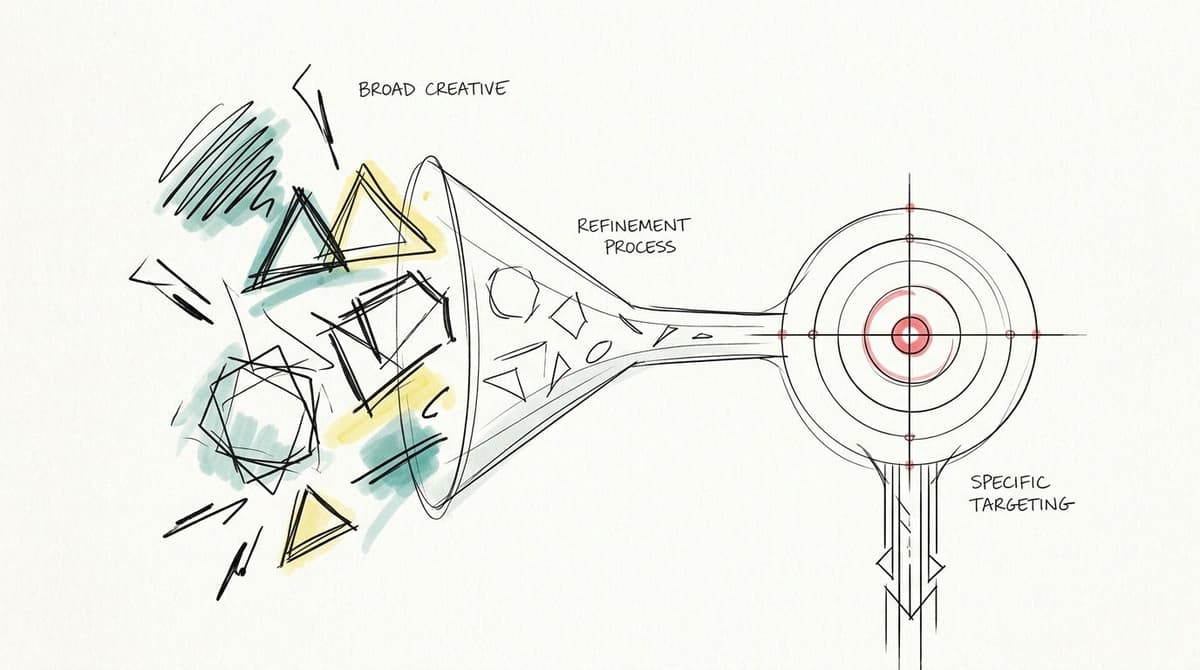
Start broad at the top. Let creative do the heavy lifting in prospecting. Use interest-based or lookalike-style audiences when you need some qualification. Then use behavioral retargeting when a shopper has shown specific intent.
A simple three-layer model works well:
-
Prospecting
Broad or lightly qualified audiences. The goal is to find new buyers. -
Consideration
People who engaged, watched, clicked, or visited. These users need stronger proof and more specific messaging. -
Conversion
Cart abandoners, product viewers, and checkout starters. This audience needs urgency, reassurance, or a reason to finish.
Weak creative with precise targeting still loses. Strong creative with sensible targeting usually finds buyers.
Don't overcomplicate the audience map. Make sure the message changes as intent changes. A cold prospect shouldn't see the same ad as someone who abandoned checkout.
#How to Budget and Scale Your Ad Spend Smartly
Most founders ask the wrong budget question.
They ask, “How much should I spend?” The better question is, “How much can I spend while staying inside a sane acquisition model for this business?”
#Stop using platform ROAS as your north star
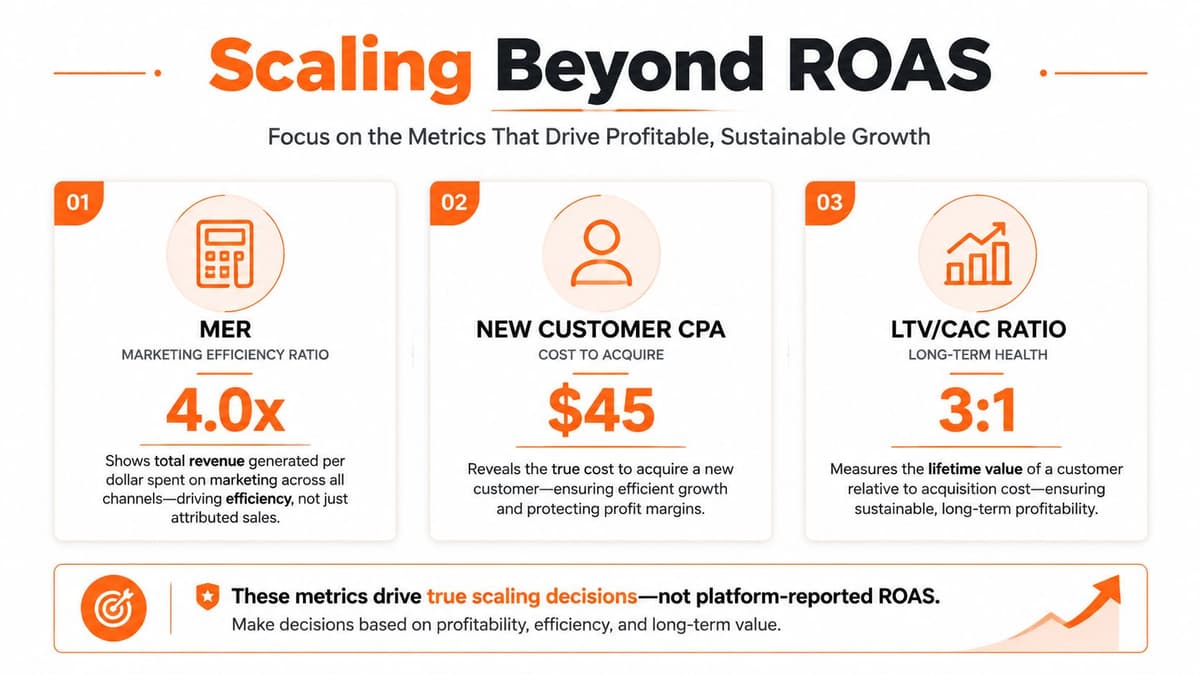
In-platform ROAS is useful, but it's not the truth. It's one version of the truth. Platforms want credit. Your store, bank account, and repeat purchase behavior matter more.
Look at the business through a few lenses:
- Blended efficiency: Total revenue compared with total marketing spend
- New customer acquisition cost: What you paid to bring in someone new
- Customer quality: Whether these buyers come back, buy again, and support margin
If those numbers get worse while platform ROAS still looks pretty, you're not scaling. You're borrowing revenue from the future.
A lot of founders get this backwards. They raise budgets because one campaign dashboard looks healthy, then realize later that the customers weren't good enough or the business couldn't support the payback period.
This explainer is useful if you want the finance side framed visually.
#Where scaling usually works
If you want one of the clearest areas to scale profitably, start with warm audiences. Retargeting ads deliver 5 to 10 times higher ROAS than cold traffic campaigns, and brands that effectively retarget abandoned carts can increase overall revenue by an average of 27%, according to e-commerce retargeting performance benchmarks.
That doesn't mean retargeting replaces prospecting. It means you should stop neglecting the part of the funnel most likely to convert.
A simple order of operations:
-
Fix broken conversion paths first
Product pages, checkout friction, mobile usability, and shipping clarity come before scaling spend. -
Fund retargeting before you over-expand prospecting
Recover the buyers who already raised their hand. -
Scale proven creative, not just proven audiences
Audience fatigue is real, but creative fatigue hits faster.
#A sane way to increase spend
Scaling should feel boring. That's a good sign.
Use rules like these:
- Increase slowly: Raise budgets in small steps after a channel is producing acceptable customer acquisition economics.
- Don't stack changes: Don't change budget, creative, offer, and landing page all at once.
- Watch store-level outcomes: Spend more only when overall revenue quality supports it.
- Protect cash flow: Don't let ad accounts outrun inventory, support capacity, or fulfillment.
Spend follows proof. It should never follow hope.
If you're early-stage, your first budget is a testing budget. Its job is to buy information. Once a channel proves it can acquire customers on terms your business can live with, then you can talk about scale.
#Measuring What Matters in a Privacy-First World
This is the part founders hate because it feels like the data should be cleaner than it is.
It isn't.
#Why your numbers don't match anymore
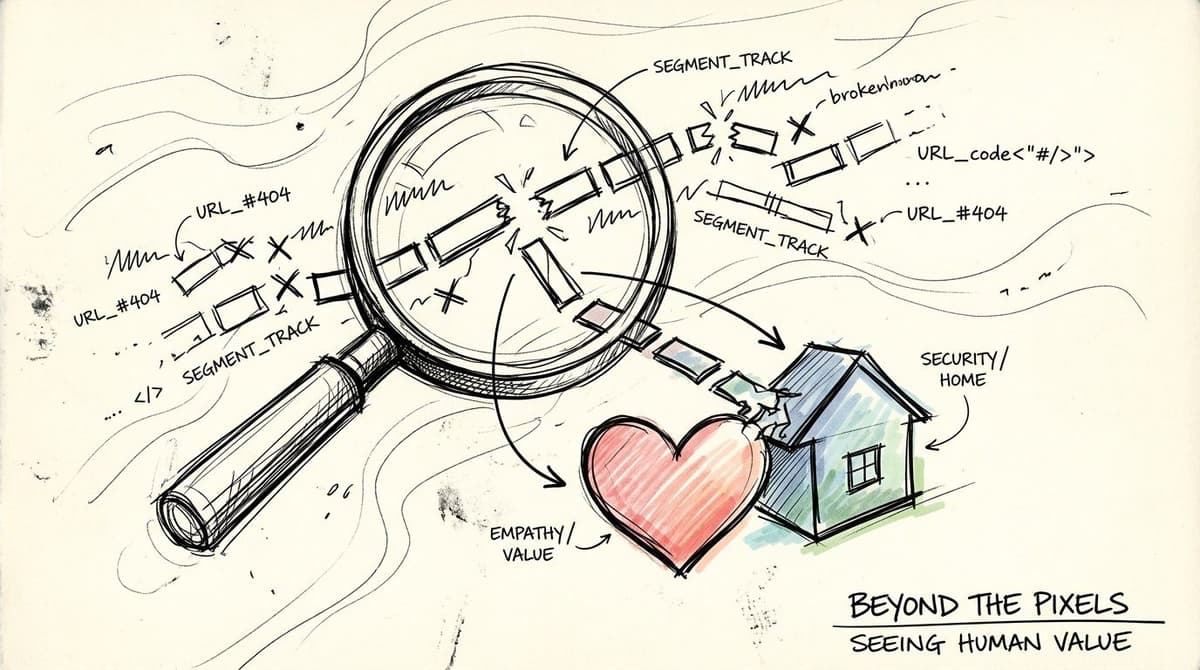
Privacy changes broke the old fantasy that every sale could be perfectly tracked back to one ad click. Platform dashboards miss things. Analytics tools disagree. Shopify shows one version, Meta shows another, Google shows another.
That confusion is now a real operating issue. With privacy changes reducing pixel data, 68% of Shopify merchants report analytics overload, and AI-powered analytics tools that interpret store data into prioritized action items can help non-marketers boost ROI by 20-30% by plugging data gaps and pausing wasteful spend, according to Shopify analytics overload research.
The point isn't that you need more dashboards. You need fewer dashboards and better interpretation.
#What to trust instead
Use a hierarchy.
First, trust your store outcomes. Revenue, orders, contribution from new versus returning customers, and whether the business is healthier.
Second, trust directional channel data. Platform reporting still helps you compare creatives, audiences, placements, and campaign trends. Just don't mistake it for audited truth.
Third, rely on first-party behavior. What visitors did on your site matters more than what a platform claims happened in its own interface.
If you want a clear list of the core business indicators to watch, this KPI guide for Shopify store owners is a practical starting point. For a more focused breakdown on store-level measurement, this guide on ecommerce KPIs that matter helps connect metrics back to real operating decisions.
#What founders should review every week
Don't review everything. Review the few things that let you act.
- Revenue trend by channel mix: Are paid channels helping the business grow efficiently?
- New versus returning customer behavior: Are ads driving fresh demand or recycling existing customers?
- Creative winners and losers: Which assets are earning attention and which are burning cash?
- Mobile versus desktop gaps: Where does buyer friction show up?
- Retargeting health: Are high-intent visitors being recovered or wasted?
Plain-language questions beat metric soup.
Ask:
- What changed?
- Why did it change?
- What deserves action this week?
- What should we stop doing?
Good measurement doesn't give you more numbers. It gives you better decisions.
That is the genuine shift in advertising in e commerce now. Measurement is less about perfect attribution and more about disciplined interpretation.
#Your Immediate E-commerce Advertising Checklist
You don't need another saved article. You need a short list you can act on this week.
#Phase 1 setup before you spend
- Define your profit guardrails: Know your acceptable acquisition cost, margin realities, and what a first order is worth to the business.
- Install your tracking stack properly: Make sure Shopify, your ad platforms, and your analytics setup are all connected and tested.
- Set up email capture and basic flows: Welcome, abandoned cart, and post-purchase should exist before you push hard on traffic.
- Check mobile buying experience: Go through your own store on your phone and try to buy. Fix anything that feels slow, confusing, or annoying.
- Prepare creative variations: Don't launch with one ad and one headline. Build multiple hooks, angles, and formats.
#Phase 2 launch your first campaigns
- Choose one main acquisition channel: Pick the channel that best matches your product and buyer intent.
- Launch one retargeting campaign: Product viewers and cart abandoners should not leave without a second touch.
- Separate cold and warm traffic: Don't lump everyone into one campaign and call it learning.
- Use channel-appropriate creative: Search needs clarity. Social needs pattern interruption and proof.
- Send traffic to the right page: Match the ad promise to the landing page. Don't make buyers hunt.
#Phase 3 weekly optimization
- Cut losers quickly: Pause ads that don't earn clicks, attention, or downstream conversions.
- Scale winners carefully: Increase budget on proven combinations, not random experiments.
- Review store-level performance first: Start in Shopify or your central reporting view before you open ad managers.
- Audit retention every week: Email and SMS should convert traffic you already paid for.
- Look for friction, not just low ROAS: Weak pages, weak offers, and bad mobile experiences often look like “ad problems” when they aren't.
If you do only one thing after reading this, do this. Strip your ad system down to a simple machine.
One acquisition channel. One retargeting layer. One retention system. One weekly review habit.
That's enough to build from.
If you're tired of stitching together Shopify, ad platforms, and analytics dashboards just to guess what happened, Arlo is worth a look. It turns raw store data into a plain-English weekly report that explains what changed, why it matters, and what to do next, including where ad spend is being wasted and where revenue opportunities are sitting untouched.