KPIs for Ecommerce: The Metrics That Actually Matter
By Arthur Falcone · Founder of Arlo
The ecommerce KPIs that actually matter are the three revenue levers (traffic, conversion rate, and average order value), the acquisition economics behind them (CAC, LTV, and the LTV:CAC ratio), and the retention metrics that compound them (repeat purchase rate and cohort retention). Revenue = Traffic × Conversion Rate × AOV. Everything else on your dashboard is explanation for why that equation moved.
You’re probably doing what most Shopify founders do once revenue starts moving. You open Shopify. Then GA4. Then Meta Ads. Then Klaviyo. Then maybe a spreadsheet someone made six months ago. Every dashboard shows a different version of reality. One metric is up, another is down, and none of it tells you what to do by Monday.
That’s the core problem with kpis for ecommerce. Founders don’t lack numbers. They lack priority. Too many teams track everything, react to noise, and miss the few signals that drive profit.
This guide cuts through that mess. Not with another list of twenty metrics. With a ruthless shortlist, tied to decisions, business stage, and revenue impact.
#The 9 Ecommerce KPIs That Matter Most
If you only track a short list, track these. Each maps to a decision, and each is covered in depth below.
- Traffic (sessions) – how many potential buyers show up, and from which channels. See the revenue equation.
- Conversion rate – the percentage of sessions that become orders. See what to do with each lever this week.
- Average order value (AOV) – revenue per order. Full explainer: what AOV is and how to raise it without hurting retention.
- Customer acquisition cost (CAC) – what a new customer costs you across all paid channels. See why CAC alone is a trap, or check yours in 60 seconds.
- Customer lifetime value (LTV) – what that customer is worth over time, not just on order one.
- LTV:CAC ratio – the profitability read; healthy brands hold roughly 3:1. See how to improve the ratio.
- Repeat purchase rate – how many customers come back without being re-bought with ad spend. See retention metrics.
- Cohort retention – whether newer customers behave better or worse than older ones. See a simple retention review.
- Your stage-specific North Star – the one number that leads all others at your revenue stage. See choosing your North Star KPI.
Want your numbers benchmarked against your vertical instead of a generic list? The free 20-minute store health score scores eight of these against category medians. For how the whole measurement stack fits together, start with the Shopify marketing analytics guide.
#Table of Contents
- You Have the Data But What Does It Mean
- Mastering the Three Foundational Revenue KPIs
- Beyond the First Sale Customer Value and Acquisition Costs
- Using Retention Metrics to Build a Resilient Brand
- Choosing Your North Star KPI by Business Stage
- From Measurement to Action Your Weekly Reporting Cadence
#You Have the Data But What Does It Mean
Most KPI advice makes founders worse at decision-making, not better. It hands you a bloated list of metrics, then leaves you alone to guess which one matters right now.
That gap is real. Research highlighted by Piwik PRO’s ecommerce KPI discussion notes that teams narrow reporting to the indicators that significantly impact business success, but the logic for choosing those indicators still goes missing for founder-led brands. That’s why so many operators end up with dashboard paralysis instead of action.
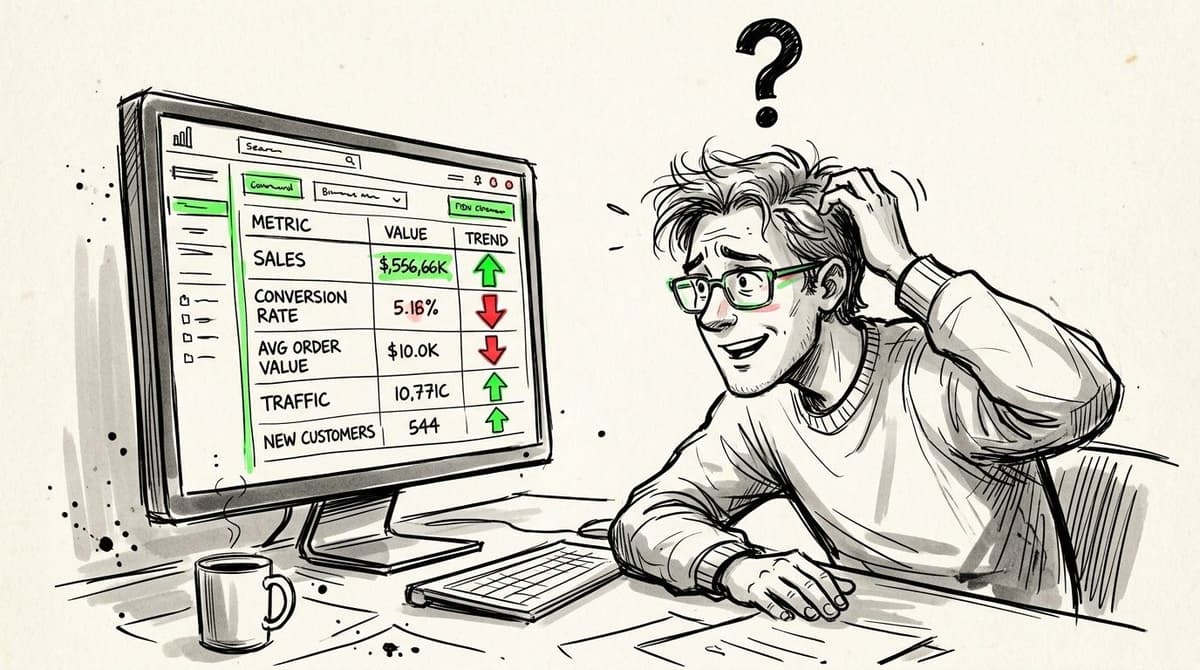
Here’s the fix. Stop asking, “What should I track?” Start asking, “What decision should this number help me make?” If a metric doesn’t change budget allocation, site priorities, merchandising, retention work, or channel strategy, it’s background noise.
#A metric is only useful if it creates a next step
Founders usually drown because they look at metrics in isolation.
- Conversion rate fell: Was traffic quality worse, or did the PDP break on mobile?
- AOV rose: Did bundles work, or did discounting hide a volume problem?
- Revenue held steady: Did retention save you while acquisition got more expensive?
Those are management questions, not dashboard questions.
Practical rule: Every KPI review should end with one owner, one action, and one expected business outcome.
If you want a broader reference list before you cut it down, this roundup of ecommerce metrics for growth is useful. Just don’t confuse a library of metrics with an operating system.
For founders who need a plain-English way to connect analytics to decisions, this breakdown of analytics in ecommerce is worth reading alongside your own store reports.
#What good KPI interpretation looks like
Good KPI work is boring in the best way. It tells you:
| Signal | What it probably means | What you do next |
|---|---|---|
| Traffic up, revenue flat | New visitors aren’t buying | Audit landing pages and traffic quality |
| CVR stable, AOV down | Customers are buying smaller baskets | Test bundles, thresholds, and upsells |
| Revenue up, CAC pressure rising | Growth may be getting less efficient | Tighten acquisition and watch customer value |
That’s the lens for the rest of this article. Not more reporting. Better decisions.
#Mastering the Three Foundational Revenue KPIs
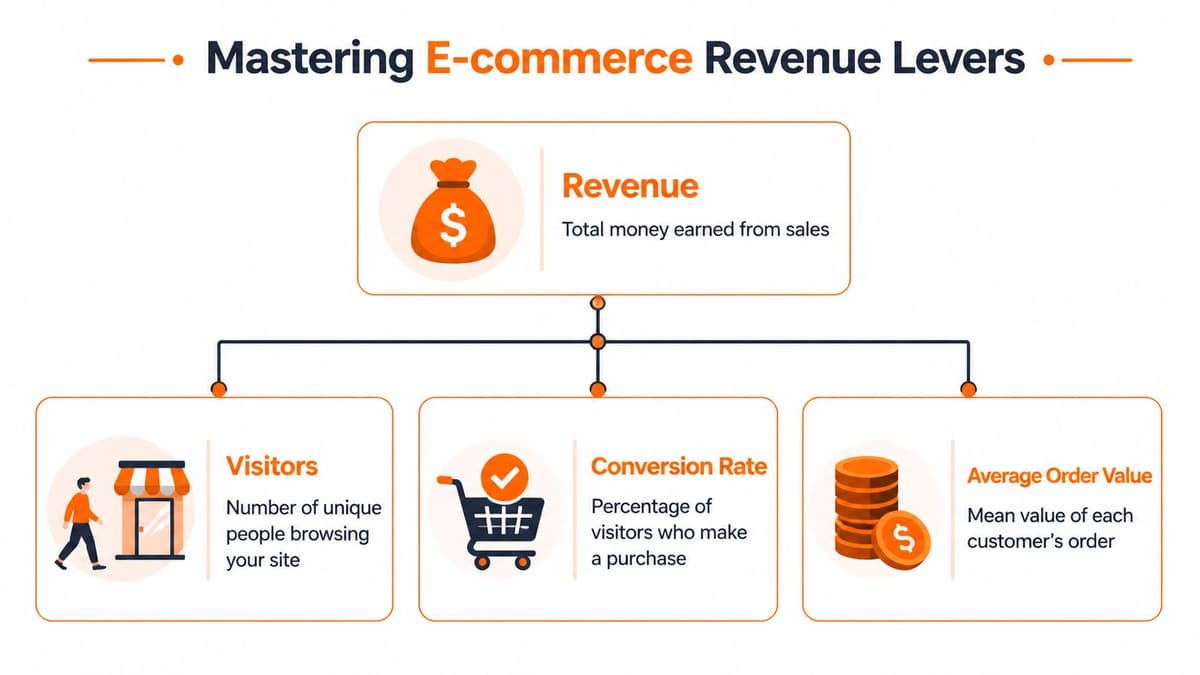
Before you touch retention models, attribution arguments, or fancy dashboards, lock in the three levers that create ecommerce revenue: traffic, conversion rate, and average order value.
If one of these breaks, revenue breaks. It’s that simple.
#Revenue is a simple equation
Revenue is the output of this equation:
Traffic × Conversion Rate × Average Order Value = Revenue
That’s why most revenue problems are easier to diagnose than founders think. You don’t need a bigger dashboard. You need to identify which lever slipped.
On conversion rate, Shopify’s 2024 survey of all its stores found an average conversion rate of 1.4%, and 3.3% places a merchant in the top 20% of performers according to FindMine’s summary of Shopify benchmarks. That benchmark matters because it gives founder-led brands a reality check. If your store sits below average, your site experience or offer likely needs work. If you’re near top-tier territory, your next gains may come faster from AOV or traffic quality.
A short explainer on paid efficiency helps here too. If you’re still treating top-line sales as success while ignoring margin and acquisition cost, read this comparison of ROAS vs ROI.
Here’s a useful visual walkthrough before you start changing anything:
#What to do with each lever this week
Don’t “optimize the funnel” in the abstract. Attack one lever at a time.
-
Traffic
More traffic only helps if it’s qualified. If paid social sends a lot of sessions that bounce mentally, even if not visibly in your dashboard, you’ve bought attention without intent. Review traffic by channel and landing page. If a campaign promises one thing and the landing page delivers another, fix the message match before spending more.
-
Conversion rate
This is the cleanest signal for offer clarity and site usability. If people arrive but don’t buy, something is off in the experience. Start with your highest-traffic PDPs and collection pages. Tighten headlines, clarify shipping and returns, improve social proof, and remove friction in checkout. If you want a tactical list, these conversion rate optimization strategies are a solid reference.
-
Average order value
AOV is where many founders leave easy profit on the table. If customers are already buying, increase basket size before you chase more traffic. Test bundles, cart add-ons, and a free shipping threshold. Also review your cart drawer. If it’s just a dead-end summary, it should become a selling tool.
Don’t ask which KPI matters most in general. Ask which lever is cheapest to improve right now.
A fast diagnostic looks like this:
| KPI | What weak performance usually points to | First move |
|---|---|---|
| Traffic | Channel mix or weak creative | Cut low-intent campaigns and improve landing page fit |
| Conversion rate | Offer confusion or UX friction | Fix PDP clarity and checkout friction |
| AOV | Small baskets and weak merchandising | Add bundles, cross-sells, or thresholds |
Most founders don’t need more metrics than this at the start. They need discipline. Diagnose the broken lever. Fix it. Measure again.
#Beyond the First Sale Customer Value and Acquisition Costs
A store can look healthy on top-line revenue and still be unprofitable. That happens when teams celebrate purchases without asking what it cost to acquire those customers and what those customers are worth over time.
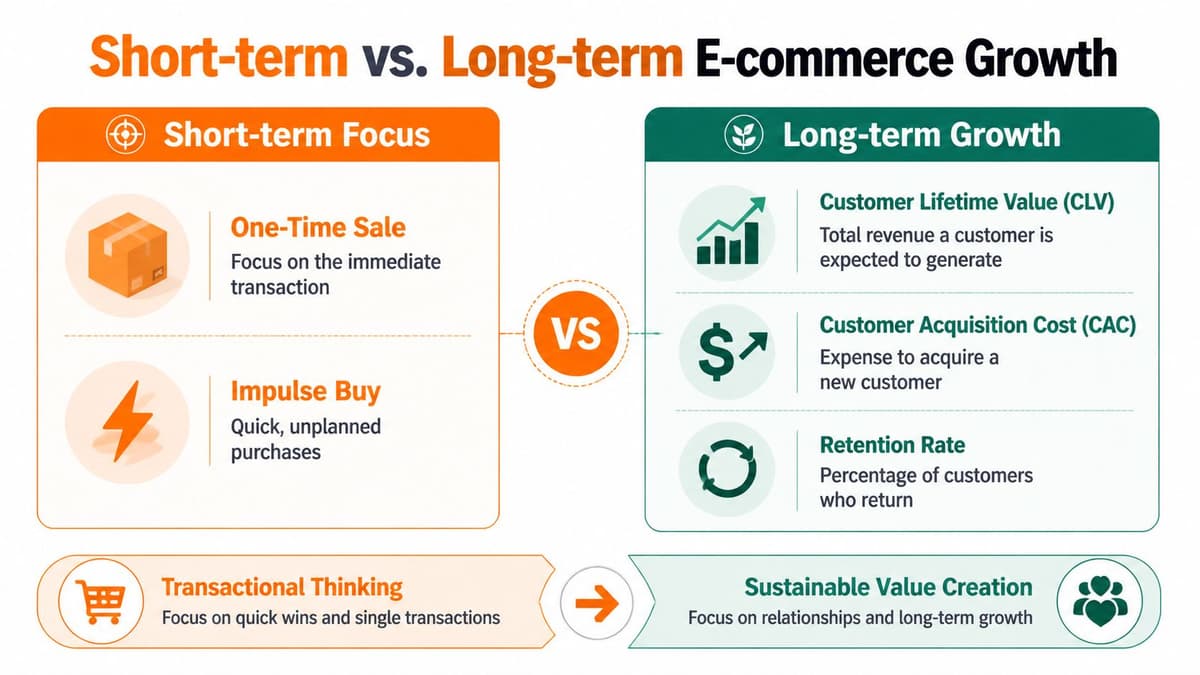
That’s why Customer Acquisition Cost (CAC) and Customer Lifetime Value (LTV) belong together. Separately, they’re interesting. Together, they tell you whether your growth has a future.
#Why CAC alone is a trap
Founders often obsess over lowering CAC as if cheaper is always better. It isn’t. Cheap customers who never buy again are not efficient. They’re just discounted disappointment.
The ratio that matters is LTV to CAC. Top-performing DTC brands aim for at least 3:1, and CAC has risen over 60% since 2020, which makes that ratio even more important according to Saras Analytics on ecommerce KPIs. That benchmark cuts through a lot of nonsense. If your ratio is below that line, you don’t have a scaling problem. You have a business model, retention, or channel quality problem.
A founder who wants more first-time customers without watching this ratio usually does three bad things at once: spends too much on cold traffic, discounts too aggressively, and ignores post-purchase retention.
If new-customer growth is your current priority, this guide to new account acquisition helps frame acquisition work without disconnecting it from profitability.
#How to improve the ratio
Improving LTV:CAC isn’t one task. It’s a coordinated set of moves.
- Lower CAC by cutting waste, not reach: Pause campaigns that bring low-intent traffic. Keep channels that attract buyers who come back, not just buyers who convert once.
- Raise LTV with retention systems: Build email and SMS flows that matter. Welcome, post-purchase education, replenishment, win-back, and browse or cart recovery should exist for a reason, not because a template library said so.
- Increase value after the first order: Cross-sells, subscriptions, replenishment reminders, and product education all push customer value up when the offer fits the product.
- Segment by customer quality: Don’t lump all acquisition together. Customers from creator partnerships, organic search, and paid social often behave differently after purchase.
A profitable brand can tolerate higher acquisition costs. An unprofitable brand can’t tolerate scale.
There’s also a timing issue founders miss. CAC hits immediately. LTV reveals itself over time. If you review acquisition every day but retention once a quarter, you’ll naturally overfund channels that look good short term and underinvest in the customers who create durable profit. Cohort LTV tools exist for exactly this gap. If you’re evaluating one, our Lifetimely pricing and fit comparison covers what it does well and where it stops.
Use this decision frame:
| If this is happening | It usually means | Decision |
|---|---|---|
| CAC is rising and repeat orders are weak | You’re buying shallow demand | Tighten spend and improve post-purchase retention |
| CAC is acceptable but LTV is flat | Customers don’t see enough reason to come back | Improve product education, replenishment, and win-back |
| LTV is strong but growth is slow | Your unit economics can support more acquisition | Scale channels carefully and watch payback |
Arlo is one option for making this easier. It analyzes Shopify store data and produces a weekly report that ranks actions by urgency and dollar impact, which is useful when you need to decide whether to fix acquisition waste, retention leaks, or site conversion first.
The point isn’t to worship the ratio. It’s to use it to make hard choices. Spend more where customer value supports it. Cut faster where it doesn’t.
#Using Retention Metrics to Build a Resilient Brand
Retention is where a fragile store becomes a real business. Plenty of brands can force a first purchase with a good ad, a discount, or a timely trend. Fewer can get that customer to come back willingly.
If you want kpis for ecommerce that predict long-term stability, retention metrics matter more than vanity acquisition wins.
#Stop looking at store-wide averages
Store-wide averages blur the truth. They mix old customers, new customers, seasonal spikes, one-off campaigns, and product launches into one polite-looking number.
Cohort analysis fixes that. Instead of asking, “How is retention overall?” ask, “How are the customers we acquired in one period behaving compared with customers from another period?” That’s how you spot whether a new acquisition channel is bringing weak buyers, whether a product launch attracted low-loyalty customers, or whether post-purchase experience improved.
Here’s a simplified cohort table you can use as a mental model:
Simplified Cohort Analysis: Customer Retention by Month
| Cohort (First Purchase Month) | Month 1 | Month 2 | Month 3 | Month 4 |
|---|---|---|---|---|
| January | Strong repeat activity | Moderate repeat activity | Stable returning buyers | Loyal core remains |
| February | Strong repeat activity | Drop after first reorder window | Weak returning buyers | Small loyal base |
| March | Moderate repeat activity | Improving after post-purchase flow update | Stable returning buyers | Healthy repeat pattern |
| April | Early signal only | Too early to judge | Too early to judge | Too early to judge |
This kind of view tells you much more than a store-wide repeat purchase rate ever will.
Look for trend breaks, not perfect curves. A bad cohort often points to a specific problem you can fix.
#A simple retention review
Retention work gets practical when you break it into customer moments.
- After first purchase: Did the customer get reassurance, product education, and a reason to return?
- Before expected reorder timing: Did you remind them at the right moment?
- After inactivity: Did you give them a relevant reason to come back?
- After a support issue or return: Did you repair trust, or did you lose them?
Most retention problems come from one of three places:
- The product didn’t match the promise. Ads oversold the outcome or PDPs left room for bad assumptions.
- The post-purchase experience was weak. Shipping communication, onboarding, or usage guidance failed.
- There was no second-order strategy. The brand treated the first order as the finish line.
#What founders should do next
Use a monthly retention review that answers real business questions:
- Compare recent cohorts: Are newer customers coming back at the same pace as earlier ones?
- Break retention by product: Which first-purchase products create the best returning customers?
- Review by acquisition source: Which channels bring buyers with long-term value versus one-time bargain hunters?
- Inspect post-purchase flows: Are your welcome, education, and win-back automations aligned to actual customer behavior?
A resilient brand doesn’t rely on constant reacquisition. It builds systems that make the second and third order more likely. That’s what cushions your store when ad performance gets erratic, competition gets louder, or a launch underperforms.
#Choosing Your North Star KPI by Business Stage
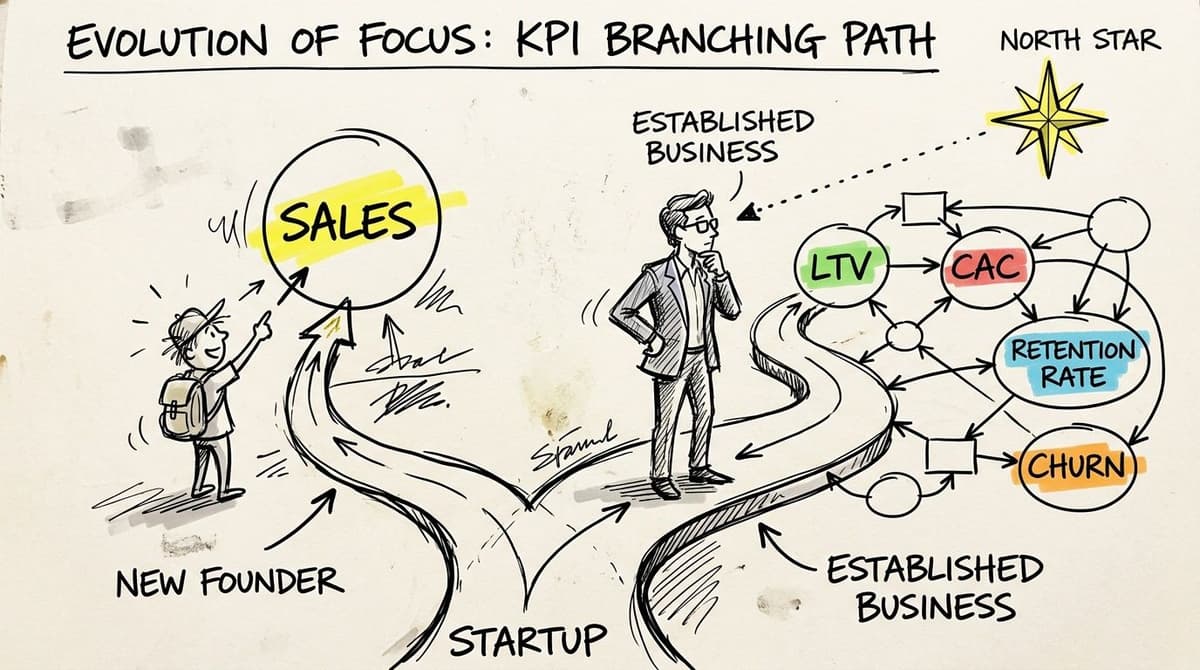
The right KPI depends on where your business is, not where you want it to look like it is. A founder doing early validation should not track the same north star as an established brand with repeat-purchase depth.
That’s where most KPI advice fails. It treats every store like the same business.
#What early-stage brands should watch
If your store is still proving product-market fit, your job is simple. Get visitors to buy. That means conversion rate deserves disproportionate attention.
At this stage, don’t hide behind blended reporting. If people visit and don’t convert, your offer, pricing, merchandising, or site experience still needs work. You do not need a giant KPI stack to tell you that, and you probably do not need a paid Shopify analytics alternative yet either. You need cleaner pages, stronger product communication, sharper offers, and less checkout friction.
A founder in this phase should ask:
| Question | Why it matters |
|---|---|
| Are people reaching product pages and buying? | It shows whether the offer is resonating |
| Which landing pages convert best? | It reveals message-to-product fit |
| Which products convert first-time visitors best? | It helps focus merchandising and traffic |
#What growth-stage and scaled brands should watch
Once the store has consistent demand, Revenue per Visit (RPV) becomes a strong north star. It’s calculated as total revenue divided by total sessions, and it works because it captures both traffic quality and conversion efficiency. According to Fast Slow Motion’s discussion of commerce KPIs, RPV can be an optimal north star KPI for growth-stage brands, and a 10% uplift can yield tens of thousands in annual revenue without any new traffic.
That’s a much better operating metric than staring at conversion rate alone once you have multiple channels, merchandising changes, and AOV shifts happening at the same time.
For more mature brands, retention quality starts to matter more than first-order volume. Cohort behavior, customer value, and repeat purchase health become the lens. At that stage, you already know how to generate demand. The bigger question is whether the demand you’re buying compounds or evaporates.
Pick one north star for your current stage. Everything else is supporting evidence.
My blunt recommendation:
- Early stage: Watch conversion rate.
- Growth stage: Watch RPV.
- More mature repeat-purchase brands: Watch cohort retention and customer value trends.
That’s enough. If your team can’t say what the current north star is, your reporting is too complicated.
#From Measurement to Action Your Weekly Reporting Cadence
Good reporting isn’t a dashboard. It’s a rhythm. The founders who stay clear-headed review a short set of numbers on a schedule, ask the same hard questions, and turn the answers into an action list.
The tendency is to check metrics all week, react emotionally, and never separate short-term movement from structural health. A bigger dashboard does not fix that tendency. If you’re considering building one anyway, look at Polar Analytics pricing next to what a weekly rhythm actually requires before you commit.
#What to review every week
A weekly review should be brief and operational. Think of it as a pulse check.
Use a compact list:
- Revenue movement: Did sales rise or fall, and what changed with them?
- Traffic quality: Which channels sent visitors who behaved like buyers?
- Conversion rate: Did site performance improve or slip?
- Average order value: Are customers building strong baskets?
- Product and landing page signals: Which pages are making money and which are wasting attention?
Then force decisions from the numbers.
- What changed? Pick the few metrics that moved enough to matter.
- Why did it change? Tie the movement to channel mix, offers, product shifts, or site behavior.
- What should we do? Choose the one to three actions with the biggest likely revenue impact.
- Who owns it? Every action needs one accountable person.
- What gets deprioritized? This part matters. Focus comes from saying no.
If a report doesn’t change next week’s priorities, it’s just documentation.
#What to review monthly
Monthly review is for health, not noise.
That’s where you step back and evaluate:
- LTV to CAC direction: Are you growing profitably or paying more for weaker customers?
- Cohort retention: Are newer customers behaving better or worse than past cohorts?
- Channel quality: Which acquisition sources create lasting customers?
- Merchandising patterns: Which first-purchase products lead to repeat behavior?
A clean monthly review should also ask one uncomfortable question: where are you mistaking activity for progress? More campaigns, more tests, and more dashboards don’t count unless they improve the few KPIs that matter for your current stage.
A simple weekly cadence works like this:
| Cadence | Focus | Output |
|---|---|---|
| Weekly | Pulse metrics and immediate changes | Short action list for the next seven days |
| Monthly | Profitability and retention health | Bigger strategic shifts in budget, channel mix, and lifecycle work |
Do this consistently and your KPI stack gets smaller, not bigger. That’s the point. Better operators don’t review more. They decide faster with less noise.
Arlo helps Shopify merchants turn raw store data into a concise weekly “20 Minute CMO” report with clear actions, ranked by urgency and dollar impact. If you’re tired of stitching together dashboards and want plain-English guidance on what changed, why it matters, and what to do next, you can learn more at Arlo.