Facebook Ad Copywriting: DTC Guide to High Conversions
By Arthur Falcone · Founder of Arlo
You're probably staring at Meta Ads Manager right now, flipping between ads that got clicks and ads that got purchases, and wondering why the copy that sounded strong in your head turned into weak economics in market. That's the normal founder loop. You write a sharper headline, test a new CTA, shorten the primary text, and hope the next round fixes it.
Most of the time, it doesn't.
That's because Facebook ad copywriting isn't mainly a writing problem. It's a message-market match problem inside a low-attention feed. If your angle is wrong, better phrasing won't save it. If your angle is right, average writing can still work.
For Shopify brands, that distinction matters. You don't need more clever lines. You need a system that tells you what promise to lead with, for which audience, in which format, and what to test next.
#Table of Contents
- Why Your Facebook Ad Copy Is Probably Failing
- Find Your Winning Angle Before You Write a Word
- Use Messaging Frameworks to Build Your Copy
- The Anatomy of a High-Converting Facebook Ad
- Pairing Copy with Creative and Planning Your Tests
- Measure and Optimize Your Copy for Profit
#Why Your Facebook Ad Copy Is Probably Failing
You launch a new campaign on Monday. Click-through rate looks decent. Add-to-carts trickle in. By Friday, CPA is too high, MER is getting worse, and the team starts rewriting headlines again.
That cycle usually points to a message problem, not a wordsmithing problem.
Founder-written ads often fail because the copy starts with the company's preferred talking points instead of the buyer's current buying trigger. The product story may be accurate. It still misses because the message is aimed at the wrong pain, the wrong desire, or the wrong stage of awareness.
That is why generic Facebook ad copywriting advice rarely helps a Shopify brand scale. “Write stronger hooks” and “focus on benefits” sound useful, but they do nothing when the ad is built on a weak sales angle. If you pitch energy to a shopper who cares about convenience, or lead with premium ingredients to a cold prospect who still doubts the category, cleaner copy just wastes budget more efficiently.
The broader pattern is well established. In Meta's own guide to ad creative, the company points advertisers toward audience-first messaging, clear value communication, and systematic testing because performance improves when the message fits the person seeing it, not merely when the copy sounds sharper, as explained in Meta's advertising creative guidance.
#Clever copy is overrated
Originality is not the job. Relevance is.
Founders usually write from inside the brand. They obsess over tone, try to squeeze every feature into one ad, and rotate random concepts without a stable testing logic. The result is familiar. One ad pushes ingredients. Another pushes urgency. Another sells aspiration. Another tries to educate from scratch.
You are not building signal that way. You are creating noise.
For stores focused on efficient growth, especially brands pushing for new customer acquisition without crushing contribution margin, ad copy needs to do one thing first. Match a specific buyer motivation tightly enough that the click is qualified before the landing page does the rest.
A simple diagnostic helps:
| Question | Why it matters |
|---|---|
| What problem feels expensive or annoying right now? | Urgency shapes the hook. |
| What outcome does this segment actually want? | The promise has to match desire. |
| What is stopping the click or purchase? | Objections determine the body copy. |
| How familiar is the shopper with the product or category? | Awareness determines how direct the ad should be. |
This is the shift many brands miss. Facebook ad copywriting is angle management. Good operators treat copy as a distribution tool for customer insight, then test messages by segment, awareness level, and buying intent.
If spend is going out, traffic is coming in, and profit still is not showing up, stop polishing lines in isolation. Diagnose the message first.
#Find Your Winning Angle Before You Write a Word
The blank page is where weak ads begin.
If you start Facebook ad copywriting by opening a doc and “coming up with ideas,” you're already behind. Winning brands don't begin with a headline. They begin with an angle, meaning the specific way the product becomes relevant to a specific buyer.
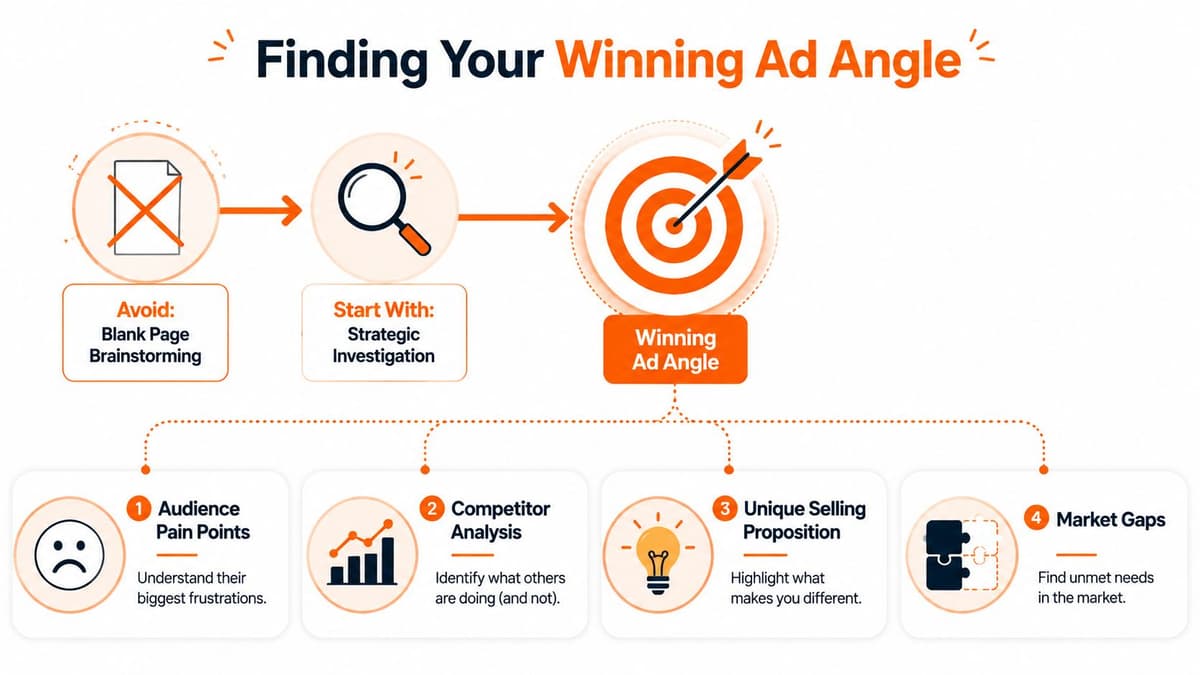
A lot of teams call creative fatigue a production problem. It usually isn't. Recent practitioner guidance argues that creative fatigue is often an angle-management problem, and better performance comes from testing different awareness levels and desires instead of endlessly remaking the same ad concept, as discussed in this angle-management breakdown on YouTube.
#Mine customer language, not your imagination
Your best hooks are already sitting inside your business.
Look at:
- Reviews: Pull repeated phrases customers use when they describe the problem, the switch, and the result.
- Support tickets: These reveal confusion, resistance, and post-purchase friction.
- Post-purchase surveys: Especially useful for finding trigger moments. Why did they buy now?
- On-site search and quiz responses: These tell you how shoppers classify the problem in their own words.
Don't clean up the language too early. If customers say, “I needed something that didn't feel greasy by noon,” that's better raw material than “lightweight formula for daily use.” One sounds like a person. The other sounds like a brand meeting.
Your ad should sound like the customer's internal monologue, not your product page.
#Study competitor ads to find what they ignore
Competitor research isn't for copying hooks. It's for spotting stale market narratives.
Open the Meta Ad Library and audit the category. You're looking for patterns:
- Everyone pushes the same before-and-after promise
- Every ad focuses on the same feature
- Nobody addresses the same objection your customers mention
- Competitors all speak to the same awareness stage
That gap is where your angle lives.
If every brand in your niche is shouting outcomes, you may win by leading with mechanism. If they all lead with product superiority, you may win by naming the frustration more sharply. If they all target ready buyers, you may win by educating earlier in the funnel.
This matters even more if your growth goal is new account acquisition for Shopify brands, because cold audiences don't need more of the same category language. They need a clearer reason to care.
#Map angles to awareness, not just audiences
Most brands segment by demographics or interests. That's too shallow for copy.
Segment by buyer mindset:
| Awareness stage | What the copy should do |
|---|---|
| Problem aware | Name the pain and make it feel urgent |
| Solution aware | Explain why your approach is different |
| Product aware | Reduce friction and answer objections |
| Most aware | Give a direct offer and a reason to act |
A cold prospect scrolling feed content needs a different message than someone who visited product pages last week. That sounds obvious, but most ad accounts still recycle one angle across all traffic.
#Build message pillars before ad variations
Once you've done the research, create 3 to 5 message pillars. Not ten. Not one.
For a DTC skincare brand, that might be:
- Midday oil control
- Non-irritating daily use
- Fast routine for busy mornings
- Confidence without makeup
Each pillar can produce multiple hooks, bodies, creatives, and retargeting versions. That gives you range without chaos. It also prevents the classic mistake of making tiny wording tweaks to a tired concept and calling it testing.
Your goal isn't to produce more copy. It's to produce distinct persuasion angles.
#Use Messaging Frameworks to Build Your Copy
A strong angle can still lose if the copy has no order.
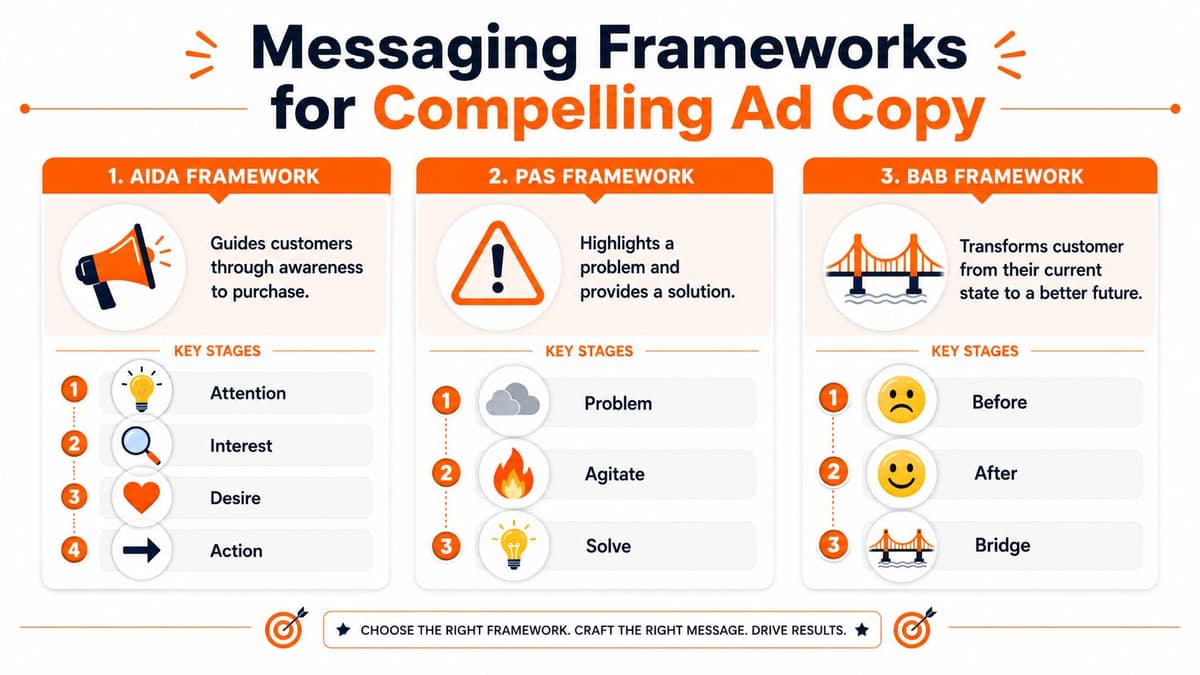
That's why frameworks matter. They turn a raw message into a clear persuasion path, so the ad moves from hook to payoff without wandering into feature soup. For Shopify brands, that matters more than clever writing. Facebook ad copywriting is angle management first, structure second, wordsmithing third.
Use a framework to control the sequence. One problem. One promise. One next step.
#PAS for pain-led products
Problem-Agitate-Solution works best when the buyer already feels friction in their day. The pain is active. They do not need education first. They need language that names the issue, sharpens the cost, and offers relief.
Use PAS for products tied to irritation, wasted time, embarrassment, discomfort, or inconsistency.
Formula
- Problem
- Agitate
- Solution
Example for a Shopify supplement brand:
Tired of energy products that spike hard and fade fast?
That crash wrecks your afternoon and makes it harder to stay consistent.
Switch to a daily formula built for steady support.
Why it works:
- It starts with a problem the buyer already recognizes
- It shows why the problem matters
- It presents the product as a direct fix
The common mistake is obvious. Founders push the solution too early, or they overdo the pain and make the ad sound theatrical. Keep it tight. If the buyer already knows the problem, one sharp line will do more than three dramatic ones.
#BAB for transformation offers
Before-After-Bridge is built for desire. It works when the product helps the customer picture a better version of daily life, identity, or routine.
This framework fits apparel, beauty, home, organization, and wellness especially well because the outcome is easy to visualize.
Formula
- Before
- After
- Bridge
Example for a Shopify home organization brand:
Your entryway is always cluttered. Shoes stack up, bags get lost, mornings start rushed.
A clean drop zone changes that. Everything has a place, and leaving the house feels easier.
Our modular storage system gives you that setup without a full home overhaul.
Why it works:
- It creates contrast fast
- It sells the outcome before the product
- It makes the product feel practical, not hyped
BAB tends to outperform feature-led copy when the underlying sale is emotional. The shopper is buying the calmer morning, the cleaner counter, the more put-together version of themselves. The product is the vehicle.
#AIDA for broad prospecting
Attention-Interest-Desire-Action is the workhorse framework. Use it when you need to stop the scroll, explain the offer quickly, and tell the shopper exactly what to do next.
It gives cold traffic enough context without turning the ad into a paragraph dump.
Formula
- Attention
- Interest
- Desire
- Action
Example for a Shopify apparel brand:
The everyday tee people replace too often.
Ours keeps its shape, feels soft, and works with casual or dressed-up outfits.
If your basics wear out fast, this is a smarter staple.
Shop the core collection.
Why it works:
- The first line earns attention
- The middle builds relevance
- The close gives a clear action
My rule is simple. Use one framework per ad. Once you start mixing structures, the copy loses direction and the angle gets diluted.
#Match framework to angle, not personal taste
Teams often choose frameworks based on what sounds good in the draft. That's amateur thinking. Pick the framework that best carries the angle you're testing.
| If your angle is about... | Use... |
|---|---|
| Pain, friction, irritation | PAS |
| Aspiration and transformation | BAB |
| Broad persuasion from cold traffic | AIDA |
This is the intended use case for frameworks. They make testing cleaner.
If your media buyer is testing three message pillars across prospecting, each pillar should follow a structure that fits the buying motive behind it. That makes performance easier to read. If PAS wins, you learned that pain-led framing resonates. If BAB wins, the audience is responding to the outcome. That insight is more valuable than arguing over adjectives in Slack.
Frameworks do not limit creativity. They remove sloppy sequencing so you can test angles with discipline. That is how you get from random copy drafts to a system that produces profitable ads.
#The Anatomy of a High-Converting Facebook Ad
Most ads fail in the first line. Not because the product is bad. Because the ad doesn't earn the second sentence.
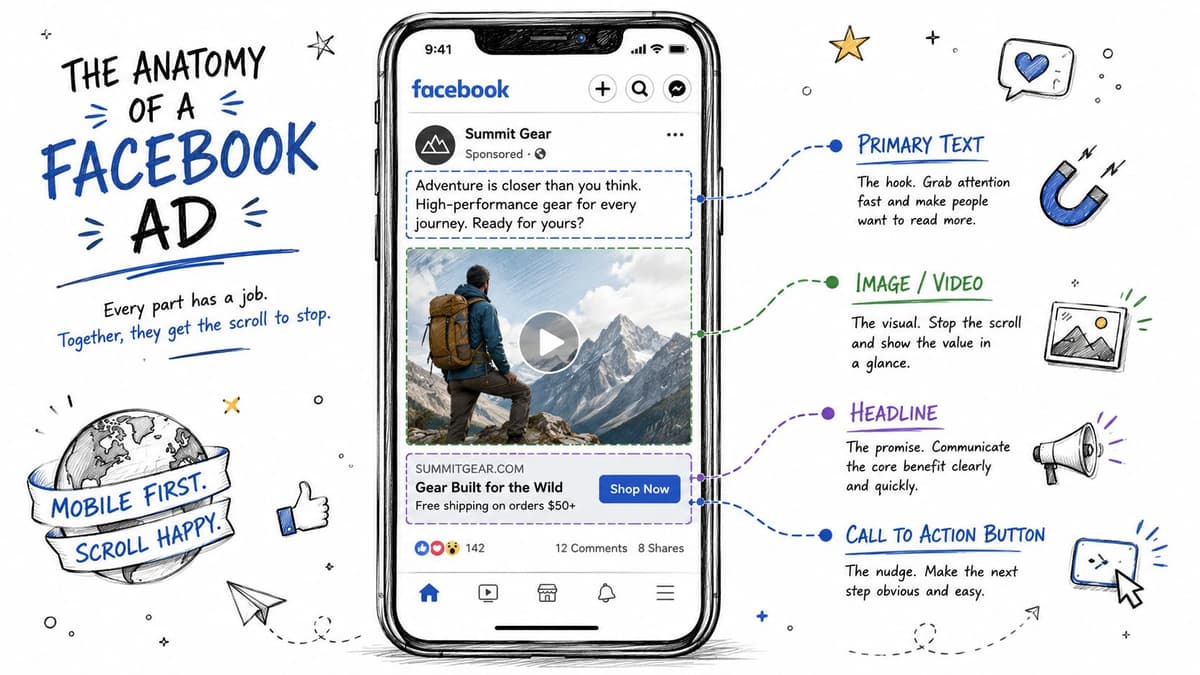
Meta's own creative guidance says ads should be built around 125 characters for Primary text, 40 characters for Headline, and 25 characters for Description because copy can be truncated across placements and devices, according to Meta's ad creative recommendations. That constraint changes everything. It means your opening line has to carry the load.
#The hook
The hook is the first line of primary text. It doesn't need to be clever. It needs to create relevance fast.
Good hooks usually do one of four things:
- Name a pain: “Still dealing with frizz by lunch?”
- Call out a buyer: “For runners who hate bulky hydration packs.”
- Challenge a belief: “Most collagen powders don't fix the underlying issue.”
- Create curiosity: “The mattress upgrade people notice in one night.”
Bad hooks are vague:
- “Meet your new favorite”
- “Game-changing innovation”
- “Upgrade your routine”
Those sound like brand filler. Nobody stops for them.
#The body
The body has one job. Deliver on the hook without splitting attention.
If the hook names a pain, the body should deepen that pain and introduce the solution. If the hook promises an outcome, the body should explain why your product can credibly get the buyer there.
Use one objective per ad:
| Objective | What the body should do |
|---|---|
| Cold prospecting | Establish relevance and interest |
| Warm retargeting | Reduce objections |
| Bottom-funnel push | Reinforce urgency or offer clarity |
The fastest way to ruin the body is stacking multiple goals. Don't educate, entertain, explain the founder story, and push urgency in the same unit. Pick one.
A useful breakdown of ad construction on mobile is below.
#The headline
The headline sits below the creative, and it should usually act like a compact benefit statement.
Think:
- Sweatproof hold
- Better sleep, less bulk
- Daily protein without the chalky taste
Don't waste headline space repeating the brand name unless your audience already knows you. On most prospecting ads, the headline should sharpen the promise, not label the asset.
#The CTA
The CTA should feel obvious from the copy that came before it. If the CTA is “Shop now,” the ad should have already made the product category, outcome, and next step clear.
A strong CTA doesn't rescue weak copy. It closes strong copy.
If you need more than a few words to explain what action the user should take, the rest of the ad isn't doing its job.
#Pairing Copy with Creative and Planning Your Tests
Copy doesn't perform on its own. On Facebook, the buyer experiences the ad as one unit. Visual, opening line, body, headline, CTA. If those pieces aren't aligned, even decent copy underperforms.
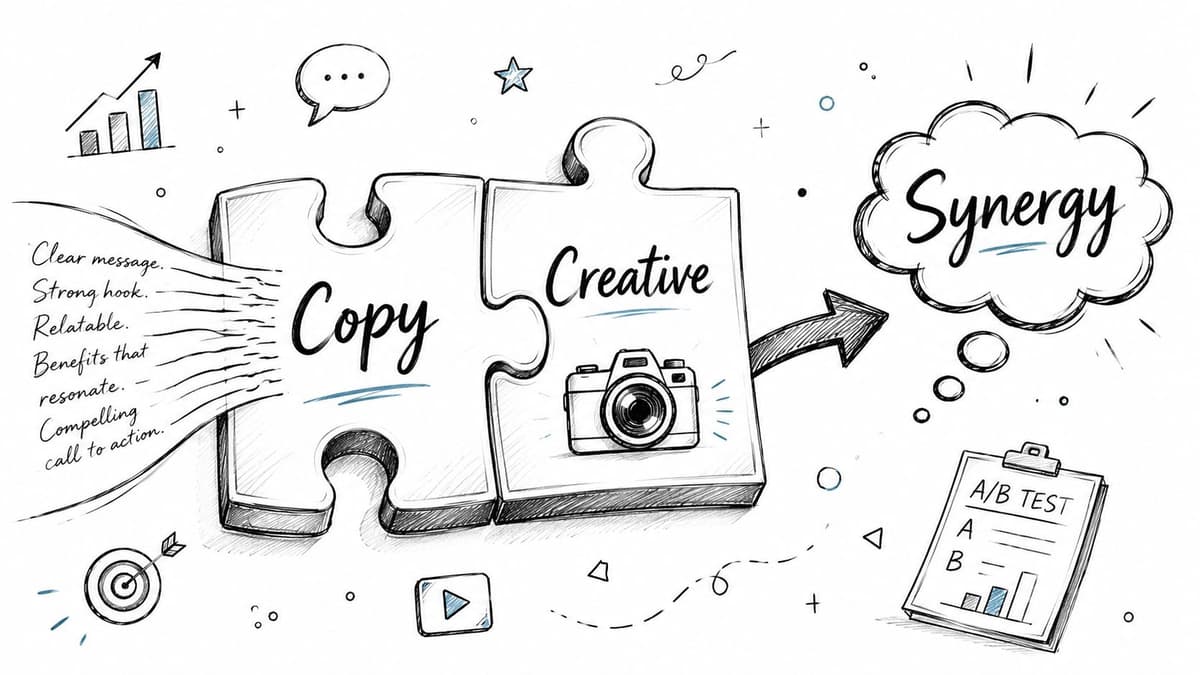
A practical Meta workflow emphasizes Hook → Body → CTA, with roughly 80% of creative energy focused on the hook and up to 5 copy variations tested at once in Ads Manager. The same guidance says question-based hooks can generate 23% more comments and 31% higher engagement, according to this Meta ad copy workflow video.
#Match the copy to the asset
Different creative formats need different copy behavior.
| Creative type | Copy approach |
|---|---|
| Raw UGC video | Keep text tighter. Let the creator carry detail and emotion. |
| Product demo | Lead with mechanism or outcome. Explain what the viewer is about to see. |
| Static image | Make the hook do more work because motion won't stop the scroll for you. |
| Founder video | Use copy to frame credibility and problem awareness, not to repeat the spoken script. |
A common mistake is writing one block of copy and pasting it across every format. That kills clarity. A raw selfie-style testimonial can support a more direct emotional hook. A clean product shot often needs a sharper promise because the visual itself carries less narrative.
#Run simple tests that teach you something
Most founders overcomplicate testing. They change the hook, creative, audience, landing page, and offer, then try to decide what worked. You can't learn that way.
Start smaller:
- Keep the offer fixed
- Keep the audience fixed
- Keep the creative family consistent
- Test hooks first
- Then test body variations under the winning hook
If you've got limited time, don't ask “which ad won?” Ask “which message earned attention from this audience?”
That's a much better use of ad spend. It gives you transferable insight for your next round.
For stores that want a faster read on ad viability, tools can help triage decisions. For example, Arlo's Facebook ad kill-check workflow gives a verdict using Meta ROAS, a breakeven gap, and a projection window. That's useful when you need a tighter feedback loop between copy tests and budget decisions.
Operator move: If an ad dies, don't just replace the asset. Log the angle, hook type, audience, and creative format so you can see which combinations fail repeatedly.
That's how you build a real playbook instead of a graveyard of disconnected tests.
#Measure and Optimize Your Copy for Profit
A lot of brands judge copy with the wrong scoreboard.
If you only look at blended ROAS, you won't know whether the problem sits in the hook, the promise, the landing page handoff, or the audience. Facebook ad copywriting improves when you read the funnel in sequence.
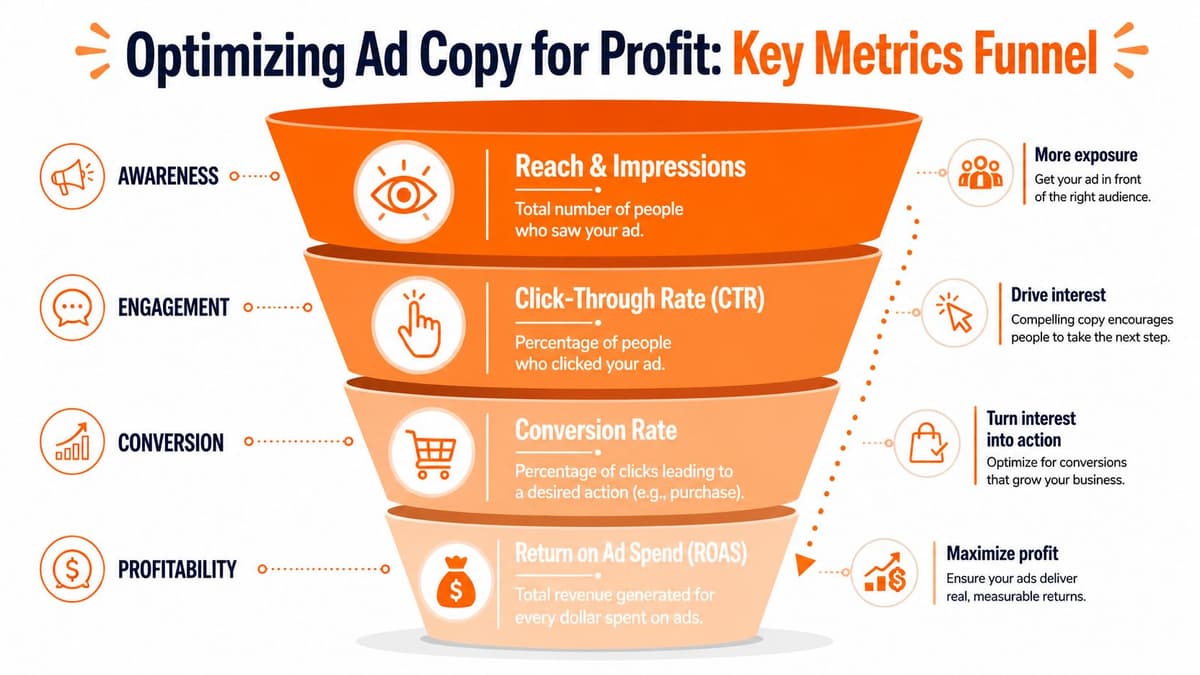
A useful baseline is that Facebook reaches 3.07 billion monthly active users, and average Facebook lead ads see 2.59% click-through rate, while traffic campaigns average 1.71% CTR, according to Sprout Social's Facebook stats for marketers. That tells you two things. The platform is massive, and attention is still scarce. Your copy has to earn progression through the funnel.
#Read the copy through the funnel
Use a simple diagnostic stack:
- Outbound CTR: Tells you whether the hook and core promise are compelling enough to win the click.
- Cost per landing page view: Tells you whether your ad is attracting relevant traffic and whether the click quality is decent.
- Purchase conversion rate: Tells you whether the promise carries through after the click.
If CTR is weak, fix the angle or hook.
If CTR is healthy but landing page behavior is weak, tighten alignment between ad message and page.
If clicks and page views look fine but purchases lag, your ad may be overselling or attracting the wrong intent.
#Adapt winners by placement and audience temperature
Copy should not be universal across Meta surfaces. Platform and placement-specific strategy matters, with guidance emphasizing optimization for News Feed, Instagram, and Audience Network instead of treating copy as one-size-fits-all, as discussed in Copyhackers' Facebook ad writing guidance.
That means:
| Context | Copy adjustment |
|---|---|
| Feed prospecting | Lead with the strongest angle and clearer context |
| Warmer retargeting | Shorten the path to objection handling or offer |
| Tighter placements | Compress harder and front-load the promise |
| Creator-led formats | Reduce text repetition and support the visual story |
If you want a cleaner view of whether your account is producing profitable signal, not just noisy dashboard outputs, it helps to review why Meta ads ROAS can look broken before you overreact to surface-level metrics.
#Decide what to do next
Every ad should fall into one of three buckets:
- Scale it: The angle is working and the funnel holds together.
- Iterate it: The angle has promise, but one layer is leaking.
- Kill it: The message isn't resonating, and more spend won't teach you much.
The point of measurement isn't reporting. It's direction. Good copy gives you revenue. Better analysis tells you why.
If you want a simpler way to turn ad results, store performance, and customer signals into clear weekly actions, Arlo gives Shopify brands a concise “20 Minute CMO” report that explains what changed, why it matters, and what to do next. It's built for founders and lean teams that need practical decisions, not another dashboard.