Strategic Planning Framework: A Guide for DTC Brands
By Arthur Falcone · Founder of Arlo
You open Shopify to check yesterday's sales. Then Klaviyo needs attention. Meta spend drifted. A top product is low on stock. Customer support found a broken discount code. By noon, you've made a dozen decisions and none of them feel connected.
That's the operating reality for a lot of founder-led DTC brands. The calendar is full, Slack is active, dashboards are open, and the brand still feels directionless. Being busy isn't the same as moving the business forward.
The brands that break out of that loop usually don't do it by working harder. They get there by choosing a strategic planning framework that forces focus. The payoff is real. Companies that create and maintain written business plans grow 30% faster than those without them, and 71% of fast-growing companies use strategic plans according to Funding for Good's strategic planning statistics.
That matters for DTC because chaos looks productive right up until margin slips, inventory gets lumpy, and paid acquisition stops covering your mistakes. A strategic plan won't make e-commerce simple. It will make your decisions cleaner.
#Table of Contents
- The End of Reactive Chaos
- What Is a Strategic Planning Framework Really
- A DTC Founders Guide to Common Frameworks
- Choosing Your Framework Stage by Stage
- Building Your One-Page DTC Strategic Plan
- Putting Your Plan into Motion with a Weekly Rhythm
- Your Plan Is a Compass Not a Map
#The End of Reactive Chaos
A founder I've seen many times in DTC looks like this. They know the catalog better than anyone, they can quote top-line sales from memory, and they spend every day fixing issues fast. They also can't answer a harder question without pausing. What is the brand trying to achieve this quarter, and what will the team stop doing to get there?
That gap creates expensive noise. One week the focus is customer acquisition. The next week it's retention. Then wholesale appears. Then Amazon. Then a site redesign. None of those moves are automatically wrong. The problem is that they often arrive as reactions, not choices.
#The hidden cost of staying reactive
Reactive brands usually show a few familiar patterns:
- Channel hopping: Teams move budget between Meta, Google, email, and influencers based on emotion instead of rules.
- Priority drift: The homepage gets rewritten while the checkout problem stays untouched.
- Metric confusion: One person watches revenue, another watches blended ROAS, another watches conversion rate, and no one agrees on what matters most this month.
- Founder bottlenecks: Every decision routes back to one person because the company hasn't defined how decisions should be made.
The issue usually isn't lack of effort. It's lack of a shared operating lens.
For a Shopify brand, that lens doesn't need to be a thick annual deck. It can be a one-page plan that tells everyone what winning looks like, how the brand will pursue it, and what signals trigger action.
#Clarity creates control
A good strategic planning framework gives a founder three things that chaos never will:
- Fewer decisions because the big ones are already made.
- Better trade-offs because priorities are explicit.
- Faster execution because the team knows what matters now.
That's why planning works so well in e-commerce. The operating environment changes every week, but the business still needs a stable way to decide. Without one, every dip in Shopify, every noisy ad result, and every competitor launch can throw the brand off course.
#What Is a Strategic Planning Framework Really
A strategic planning framework is a decision system. It helps you define where the business is going, how it will get there, and how you'll know if execution is working.
#Think of it as business GPS
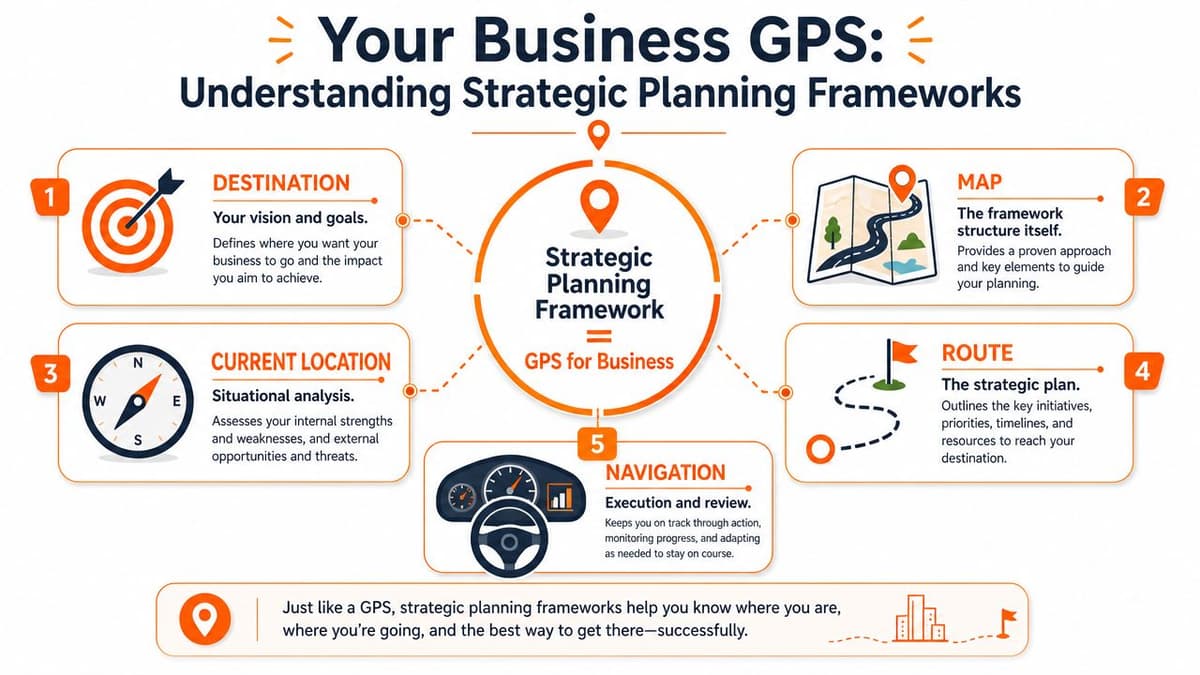
The simplest way to explain it is this. A strategic planning framework is your business GPS.
Your GPS doesn't just name a destination. It also checks where you are, suggests a route, and keeps updating based on what happens on the road. That's exactly what a founder needs in DTC.
If you've ever needed a simpler way to pressure-test decisions before they become expensive distractions, this guide for founder decision-making is a useful companion to the planning work. It's especially relevant when everything feels urgent and you need a filter, not more opinions.
#The three parts that matter
The best frameworks aren't complicated. They rely on a few fundamentals done consistently. Effective strategic frameworks rely on three core components: defining success with 3–6 strategic priorities, formulating a strategy with SMART goals, and executing the plan with consistent implementation and KPI reporting, as outlined in Envisio's overview of strategic planning models.
Here's what that means in plain English for a Shopify operator.
#Define success
Many brands remain vague. “Grow faster” is not a direction. “Improve retention while protecting margin” is closer. Better still is selecting a short list of priorities that can govern decisions across merchandising, paid media, retention, and operations.
#Form a strategy
Strategy is not a list of tasks. It's the logic behind the choices. For example, a brand might decide to reduce dependence on paid social by pushing bundles, improving first-order economics, and building stronger email capture on product pages.
#Execute and measure
Most plans typically fail at this stage. Teams create goals, then don't assign owners, deadlines, reporting cadence, or practical KPIs. Once that happens, the plan turns into a document instead of an operating system.
Practical rule: If a strategy can't be linked to a weekly action inside Shopify, your ad account, your email platform, or your inventory workflow, it's still too abstract.
A framework doesn't make you rigid. It does the opposite. It gives you a stable structure so you can adapt without losing your north star.
#A DTC Founders Guide to Common Frameworks
Founders often ask which framework is best. That's the wrong question. The useful question is which framework solves the problem in front of you.
Some frameworks help you diagnose. Others help you align a team. One helps you turn strategy into daily execution.
#When SWOT helps
SWOT is fast and useful when a founder needs a clear-eyed annual review. For a DTC brand, the value isn't in doing a textbook exercise. It's in surfacing what the team already knows but hasn't written down.
A Shopify SWOT might reveal strengths like a high-repeat product, weaknesses like overreliance on one acquisition channel, opportunities in subscription or bundles, and threats from rising acquisition costs or marketplace copycats.
Use SWOT when:
- You need perspective: The business has been moving quickly and no one has paused to assess position.
- You're planning the next season: Product launches, inventory bets, and channel focus need a simple strategic reset.
- You want founder alignment: Co-founders or department leads need a shared starting point.
SWOT is not enough by itself. It identifies reality. It doesn't run the business week to week.
#When the Balanced Scorecard helps
Balanced Scorecard is more useful when the brand is no longer one person and one operator. Once teams start forming around acquisition, lifecycle, ops, creative, and CX, misalignment becomes a bigger risk than lack of ideas.
This framework helps leaders avoid over-focusing on one area. A DTC brand can use it to ensure revenue goals don't bury customer experience, process quality, or team capability.
It's especially helpful if your brand has issues like:
- Strong top-line, weak fulfillment
- Good conversion, poor retention
- Creative output, but no reporting discipline
- Marketing wins that ops can't support
For founders with marketplace exposure, this type of cross-functional thinking matters even more. If Amazon is part of the mix, these Insights for C-suite Amazon leaders can help frame channel management as an operating decision, not just a listing problem.
#Where OGSM fits
OGSM stands for Objective, Goals, Strategies, and Measures. It's a practical format for busy founders because it compresses the plan onto one page.
That matters in DTC. If the strategy only exists in a slide deck nobody reads, it won't influence pricing, merchandising, media, or retention work. OGSM is strong because it's compact. It gives the founder a summary view of what matters without pretending the business needs a giant planning process.
Use it when the business needs simplicity and a common language.
#Why OKRs carry execution
OKRs are where the plan starts to live. OKRs function as the execution layer that translates insights from broader frameworks like SWOT or Balanced Scorecard into the daily operating rhythm that determines whether strategy becomes reality, as described in WorkBoard's guide to strategic planning frameworks.
That's the key distinction. SWOT can tell you what's true. Balanced Scorecard can show whether the business is aligned. OGSM can summarize the plan. OKRs tell the team what to do next and how progress will be judged.
If you want a sharper view on how strategy turns into action inside an online store, this piece on e-commerce growth strategy is worth reading alongside your planning process.
#Strategic Framework Comparison for DTC Brands
| Framework | Best For... | Key Focus | Best Suited For |
|---|---|---|---|
| SWOT | Annual review and strategic reset | Position and reality check | Founder-led brands that need clarity fast |
| Balanced Scorecard | Cross-functional alignment | Performance across teams and systems | Brands with multiple functions or managers |
| OGSM | One-page planning | Strategic summary and accountability | Busy operators who need simplicity |
| OKRs | Turning strategy into execution | Quarterly focus and measurable progress | Brands that need operating rhythm and owner-level accountability |
A practical stack often looks like this. Use SWOT to assess. Use OGSM to summarize. Use OKRs to execute.
#Choosing Your Framework Stage by Stage
The right framework depends less on founder preference and more on business stage. A brand at launch doesn't need the same planning structure as a brand managing multiple channels, a larger catalog, and team leads.
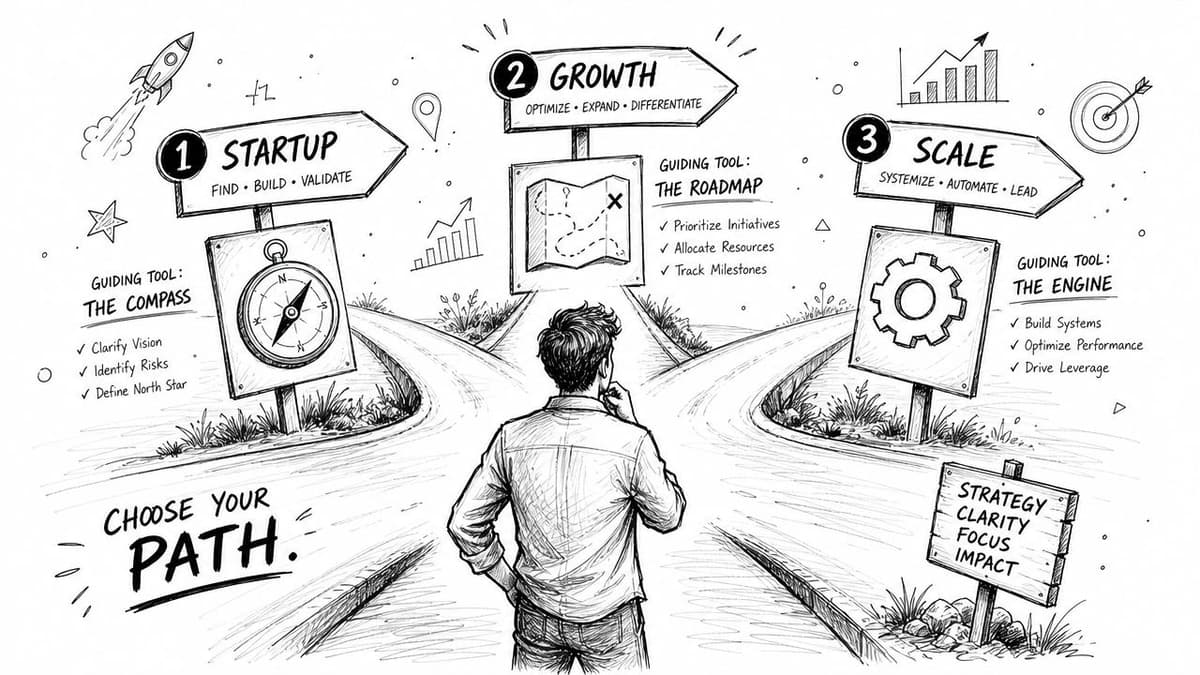
#Launch
At launch, survival and validation matter most. You're still learning whether the offer resonates, whether the product page converts, and whether acquisition is even economically viable.
A heavy framework slows you down here. Use a light strategic planning framework built around:
- Primary tool: SWOT
- Secondary tool: Simple goal list with owners
- Focus: Offer clarity, traffic quality, conversion blockers, and customer feedback loops
At this stage, founders should avoid writing a grand strategy that assumes certainty. Keep it tight. What are you testing, what must be true, and what would make you change direction?
#Growth
Growth is where planning starts paying off in a bigger way. The store has traction. More channels are in play. Team members or agency partners are involved. Without structure, the brand starts leaking money through misalignment.
This is the stage where OKRs become valuable. Break the annual direction into quarterly commitments. That gives you enough flexibility to adjust while still protecting focus.
Recommended setup:
- Primary tool: OKRs
- Secondary tool: OGSM
- Focus: Acquisition efficiency, retention systems, AOV improvement, merchandising discipline, team accountability
Growth-stage brands usually don't need more ideas. They need fewer priorities and tighter follow-through.
#Scale
Scaled brands face a different set of risks. Revenue may be healthy while profitability, coordination, and channel complexity become harder to manage. The founder can no longer personally stitch every decision together.
At this point, use a broader structure to keep the business coherent:
- Primary tool: Balanced Scorecard or OGSM
- Secondary tool: OKRs for department and quarterly execution
- Focus: Profit quality, operational alignment, customer experience consistency, expansion decisions, and leadership accountability
What doesn't work at scale is treating strategy as a founder-only activity. The plan must be visible enough that leaders in marketing, retention, ops, and merchandising can make good decisions without waiting for permission.
The best framework is the one your stage can support. If it's too light, it won't guide the business. If it's too heavy, the team will ignore it.
#Building Your One-Page DTC Strategic Plan
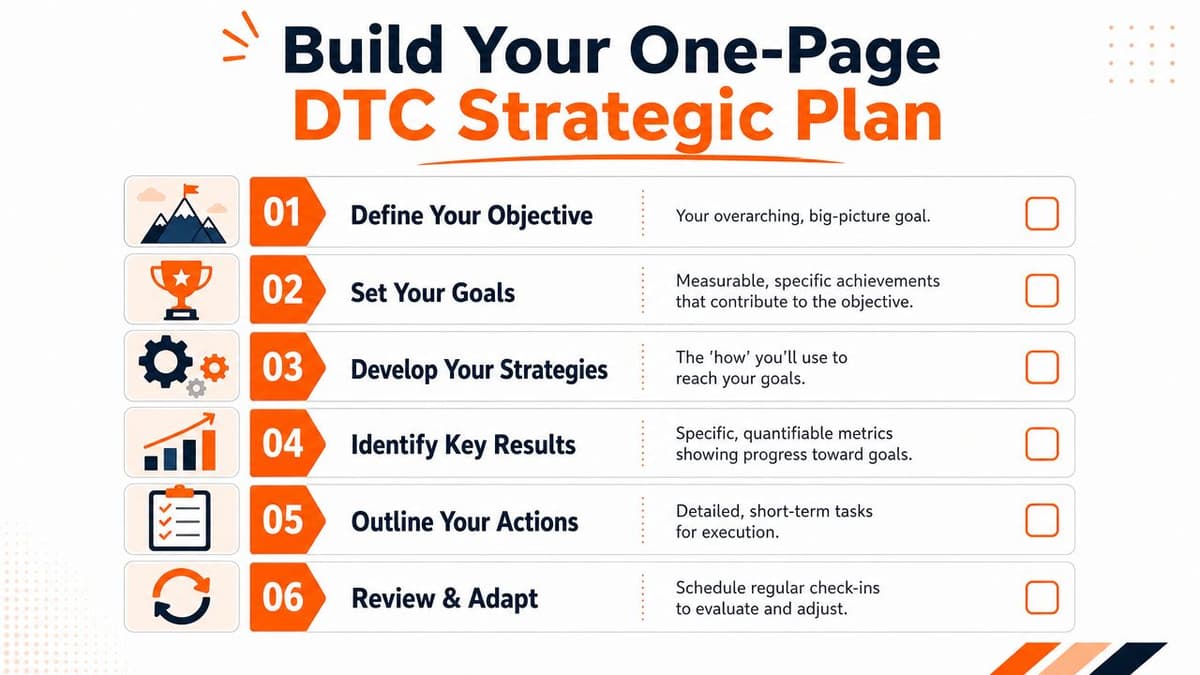
Most founder-led brands don't need a thick annual plan. They need a one-page document that connects the brand's direction to weekly operating decisions. The simplest version combines OGSM structure with OKR discipline.
#What goes on the page
Use these five blocks.
-
Objective
Your north star. Keep it directional, not vague. Example: become the go-to brand in your category for profitable repeat purchase. -
Goals
These are the outcomes that define progress. They should be specific and measurable, but they don't need to become a spreadsheet graveyard. -
Strategies
This is the “how.” Choose only the moves that matter most. If every idea makes the page, the page is useless. -
Measures
This is your KPI layer. Pick metrics that connect directly to the strategy, not vanity metrics that look busy. -
Actions and owners
Tie each major action to a person and a near-term review point.
#A practical Shopify example
A clean one-page plan for a Shopify brand might look like this:
- Objective: Increase profitable repeat purchase while reducing dependence on one paid channel.
- Goal: Improve average order value.
- Measures: Items per order, post-purchase upsell rate, bundle adoption
- Strategies: Launch curated bundles, improve cart cross-sells, revise product page merchandising
- Goal: Strengthen retention.
- Measures: Repeat purchase trend, email flow performance, subscription take-up
- Strategies: Rebuild welcome flow, tighten post-purchase education, introduce replenishment reminders
- Goal: Improve paid media discipline.
- Measures: Channel-level ROAS, landing page conversion quality, offer alignment
- Strategies: Simplify account structure, align creative with merchandising priorities, cut low-intent traffic
If you're also shaping how the brand should look relative to competitors, this guide to competitive positioning is a practical add-on to the planning work.
#Rules that keep the plan honest
Most one-page plans fail for ordinary reasons. The founder includes too many goals. The metrics don't connect to strategy. The team reviews it once and moves on.
Use these rules instead:
- Limit priorities: If the page reads like a wishlist, narrow it.
- Write triggers: Don't just define a metric. Define what happens when it misses.
- Assign ownership: Every major line item needs a person, not a department.
- Review in public: Shared visibility creates better follow-through than private documents.
For paid channels, founders should be especially strict. E-commerce founders must establish a minimum ROAS threshold of 2:1 for each marketing channel and define a trigger such as ROAS below 2:1 for 30 days to automatically reallocate budget, according to this e-commerce strategy plan reference.
A threshold without an action rule is just a metric you're hoping will improve on its own.
That one line changes behavior. It stops endless “testing” that wastes cash and forces the team to move budget based on agreed rules.
#Putting Your Plan into Motion with a Weekly Rhythm
A plan only matters if it changes what the team does every week. That's where most strategy work dies. The document is good. The meeting rhythm is missing.
A useful operating cadence starts with visibility. Many founders need one place to review sales, traffic, product, and marketing signals before they decide what to do next.
#The weekly meeting that actually works
The fix is simple, but it has to be mandatory. To close execution gaps, leaders should break annual goals into quarterly OKRs and hold weekly check-in meetings to maintain momentum, as noted in these strategic planning best practices.
A strong weekly review doesn't need to be long. It needs to be structured.
- Start with objective status: Are the quarterly OKRs on track, at risk, or off track?
- Review key signals: Look at the few KPIs tied to your one-page plan.
- Decide on actions: Name what changes this week in media, lifecycle, site, product, or ops.
- Confirm ownership: Every action gets a clear owner.
- Check the next trigger: Know what result would cause budget shifts, creative changes, or merchandising edits next week.
Many founders rediscover control. The team stops reporting random metrics and starts discussing the business through a shared lens.
#Why automated reporting changes execution
Manual reporting creates drag. Someone has to pull Shopify data, ad data, email performance, product movement, and customer behavior into one view. By the time the meeting starts, the team is already tired.
That's why automated review systems are so useful in a planning cadence. They reduce time spent collecting data and increase time spent making decisions. If you want a model for that cadence, this article on the weekly growth review is a good reference point.
This walkthrough shows the kind of review rhythm many teams are trying to build:
Weekly rhythm is where strategy stops being aspiration and starts becoming management.
#Your Plan Is a Compass Not a Map
The strongest strategic planning framework doesn't try to predict every turn. It gives the brand a reliable direction and a way to adjust without losing focus.
That's why the best plans act like a compass, not a map. A map assumes the route is fixed. DTC never works that way. Inventory shifts. Ads fatigue. Offers stop landing. Competitors react. Customer behavior changes. Founders still need to make smart decisions in motion.
A compass is more useful. It keeps the brand pointed toward its objective while allowing detours that make sense. That's what your one-page plan, your KPIs, and your weekly review rhythm are supposed to do.
If your store feels scattered right now, don't start with a giant planning exercise. Start with one page. Pick the few priorities that matter. Define the measures that govern action. Review them every week. That's how a strategy becomes operational.
Arlo helps Shopify brands turn planning into a weekly operating habit. Its AI-powered analyst translates store, marketing, customer, and product data into a plain-English “20 Minute CMO” report with prioritized actions, clear reasoning, and concrete next steps. If you want a simpler way to keep your strategic plan tied to real execution, explore Arlo.