Competitive Positioning: A DTC Founder's Playbook
By Arthur Falcone · Founder of Arlo
You've probably lived this already. Your product is solid, your reviews are decent, your returning customers get it, and yet your store still sounds like ten other brands in the category. Traffic comes in, bounces around, and leaves. Ads work for a week, then fatigue hits. Your homepage says all the right words, but buyers still don't feel why you over the cheaper, louder, or more established option.
That's a positioning problem, not a product problem.
Most founders treat competitive positioning like a branding workshop artifact. It isn't. It's the operating decision that tells your ads what angle to lead with, your homepage what promise to make, your emails what tension to resolve, and your product pages what proof to emphasize. If your position is vague, every downstream asset gets weaker. If it's sharp, the whole machine gets cheaper to run and easier to scale.
#Table of Contents
- Your Competitive Positioning Is Not Your Mission Statement
- Find Your Angle with Competitor and Customer Signals
- Write a Positioning Statement That Actually Works
- Turn Your Positioning into High-Converting Copy
- Validate Your Positioning with Shopify Data and Arlo Signals
- How to Test Iterate and Protect Your Wins
#Your Competitive Positioning Is Not Your Mission Statement
A mission statement can inspire your team. It rarely closes the sale.
Your customer isn't standing on your homepage wondering whether your brand has heart. They're asking a simpler question. Why should I buy this from you, in this situation, instead of the other options I already know? Competitive positioning answers that. A mission statement usually doesn't.

#Mission tells people why you exist
Founders often blur brand purpose and market position. That's expensive. “We believe everyone deserves better basics” may be true, but it doesn't give a buyer a reason to choose you today.
A real position has edges. It excludes people. It names the use case. It implies who should buy now and who probably shouldn't. That's what makes it useful in paid social, search, email, landing pages, and retail conversations.
Practical rule: If your homepage headline could fit on three competitor sites with only the logo changed, you do not have positioning. You have category wallpaper.
The most practical advice for ecommerce founders is still the simplest: define a specific buying context and target one customer segment instead of trying to speak to everyone. Broad positioning fails to communicate value. Shopify's guidance is direct on this point. Name the segment and the specific situation in which they need your product, rather than aiming at “everyone” in a general way through Shopify's competitive positioning advice.
#Specific beats broad every time
Founder ego often impedes progress. You want a bigger market, so you write broader copy. Buyers read that broad copy and assume the product is generic. Then conversion softens and you decide the answer is more traffic. It usually isn't.
Instead, force your positioning through three filters:
- Who is it for: Not “women 25 to 44.” Think “new moms rebuilding a five-minute skincare routine” or “runners who want anti-chafe gear for humid weather.”
- When does it matter: Buying context is where revenue hides. “For travel” and “for sensitive skin after laser treatments” are not the same market, even if the same product can serve both.
- Why is it safer to choose you: This is the proof layer. Materials, formulation choices, shipping reliability, fit consistency, refill system, bundle logic, customer support quality. Pick the proof that reduces purchase anxiety fastest.
Founders don't lose because they have no mission. They lose because the customer can't quickly map the brand to a clear problem.
#Find Your Angle with Competitor and Customer Signals
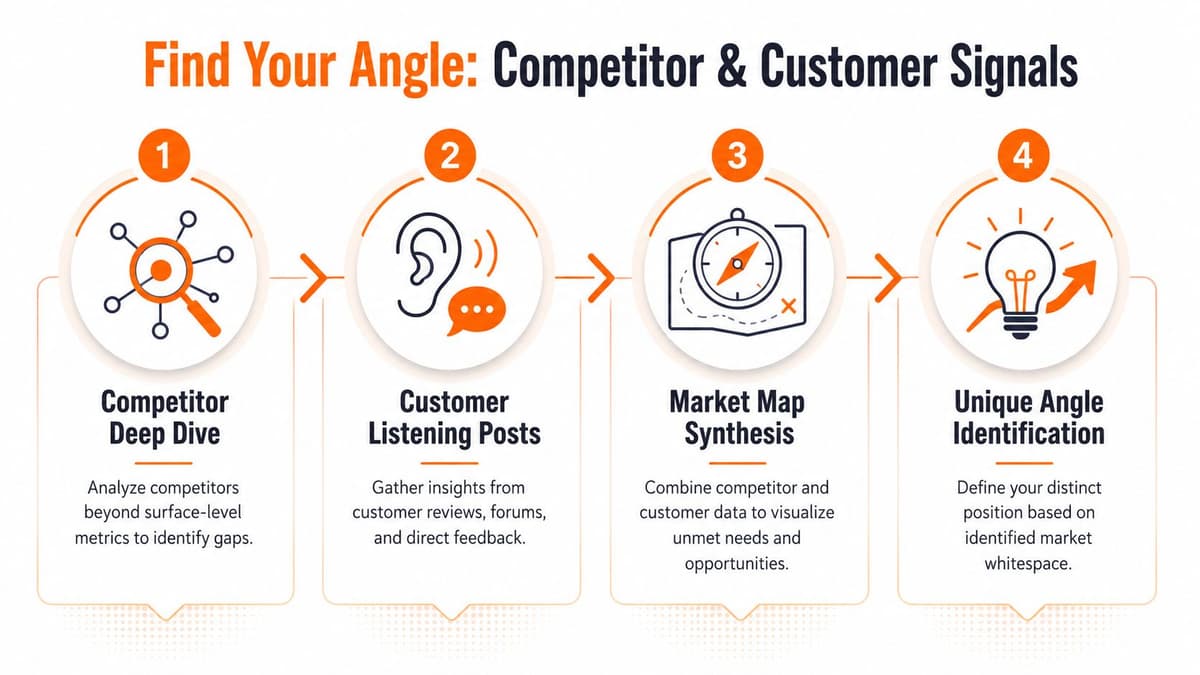
Most competitive positioning work is lazy. Founders skim a few homepages, jot down a feature matrix, and call it research. That won't get you to a usable angle. Competitors don't expose their weaknesses in hero copy. Customers do it for them in comments, reviews, and buying behavior.
#Stop analyzing only homepages
If you sell on Shopify, start with a manual sweep. Identify direct competitors and indirect competitors using Google, Amazon, and social platforms, then review their product mix, pricing, and marketing execution. That includes their newsletters and social presence, which you can track with tools such as Hootsuite or SendView, as outlined in this Shopify competitor analysis walkthrough from Sufio.
Then go deeper than most founders bother to go:
- Read 3-star reviews, not just 1-star reviews. One-star reviews can be noise. Three-star reviews often reveal friction in shipping, sizing, onboarding, scent strength, packaging durability, or product expectations.
- Study comment sections on paid social. People ask blunt questions there. “Does this pill?” “Is this safe for color-treated hair?” “Why is this more expensive than X?” Those questions tell you which objections your positioning must absorb.
- Join category conversations. Reddit threads, TikTok comments, Instagram Q&As, and creator replies show where the category is overpromising.
If you want a grounded framework for structuring this research, Silva Marketing's Prescott competitor analysis guide is useful because it pushes you past surface-level comparison and into actual market context.
#Your own store is the best signal source
Most founders are sitting on better data than they think. Shopify orders, support tickets, reviews, post-purchase surveys, repeat-purchase patterns, and session behavior tell you what customers value, not what you hope they value.
A lot of teams miss this because they only look at dashboards after something breaks. If you want cleaner positioning, map the full customer digital journey and note where buyers hesitate, what product questions repeat, and which landing pages attract the highest-intent sessions.
Customers tell you your position long before your copywriter does. They say it in support tickets, return reasons, product questions, and the language they use right before buying.
One useful signal that many founders overlook is competitor dissatisfaction. Analysis discussed in this Reddit SaaS thread on positioning angles notes that 62% of founders scan negative competitor reviews for emotional pain points, yet many still don't have a framework to turn those insights into positioning around unmet needs. That gap matters. If buyers keep complaining that competitor products are confusing, slow, fragile, hard to clean, wasteful, or inconsistent, you've found raw material for your angle.
#A simple founder workflow for this week
Don't overcomplicate this. Run this process in one working session:
- Pull five direct competitors and three indirect ones.
- Capture their homepage promise, top product promise, price framing, and offer framing.
- Read recent reviews and social comments until patterns repeat.
- Pull your own top support questions, return reasons, and review highlights.
- Write down the three pains your category handles badly.
- Circle the one pain your brand can credibly solve and prove.
That last word matters. Credibly. If you can't prove the claim in your product, service, fulfillment, or customer experience, it's not positioning. It's wishful copy.
#Write a Positioning Statement That Actually Works
A positioning statement is not customer-facing copy. It's the internal sentence that keeps your team from drifting into vague messaging every time someone opens Figma or writes a Meta ad.
The version that works is simple enough to remember and strict enough to constrain bad ideas.
#Use a five-part statement
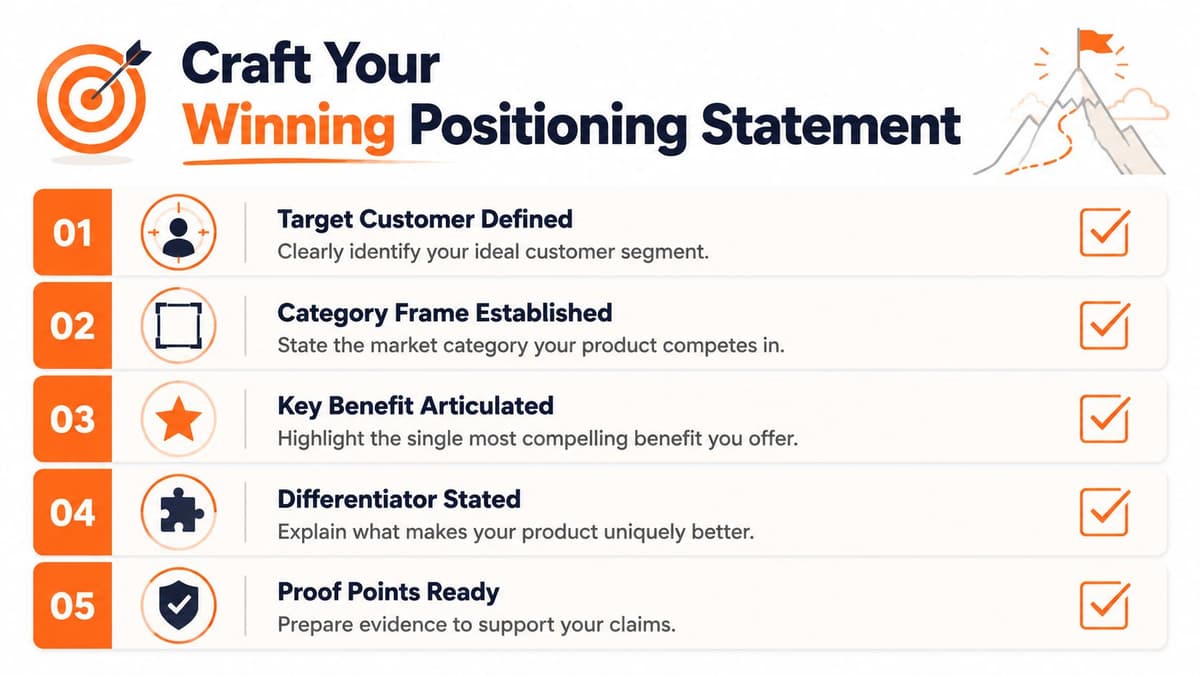
Write yours in five parts:
-
Target customer
Who exactly are you trying to win? -
Buying situation
When do they need you? What's happening in their life, work, or routine? -
Category frame
What kind of solution are you? Don't be cute here. Buyers need a familiar box first. -
Primary benefit
What outcome matters most to them? -
Reason to believe
Why should they trust that you can deliver it?
A rigorous approach to competitive positioning starts with objective inputs, not creative brainstorming alone. That means using evidence like CRM win/loss notes, competitor mentions, and sales call transcripts so positioning becomes a strategic hypothesis you validate with real-world evidence rather than a tagline debate, as described in Want Branding's positioning methodology.
Here's the operating principle: if your statement can't guide a homepage headline, ad angle, offer test, and product page rewrite, it's too abstract.
For a few sharp examples of concise language, Skup's piece on crafting effective brand statements is worth reviewing. Not to copy a format blindly, but to see how specificity changes the force of a statement.
#Bad statement versus usable statement
A weak DTC statement sounds like this:
We make premium wellness products for modern consumers who care about quality, sustainability, and balance.
That sounds polished. It also says almost nothing.
A usable one sounds more like this:
For busy professionals who want better sleep without rebuilding their entire routine, our magnesium-based nighttime supplement is the simplest sleep support option because it fits into a two-minute evening habit, avoids complicated stacks, and is backed by clear dosage guidance and a refill plan that removes decision fatigue.
Now your team knows what to do. The buyer is specific. The moment is specific. The benefit is singular. The proof is operational.
Use this fill-in template:
| Part | Question to answer | Example |
|---|---|---|
| Target customer | Who are we for first | Busy professionals with inconsistent evening routines |
| Buying situation | When do they reach for us | When stress is wrecking sleep and they want something simple |
| Category frame | What kind of product are we | A nighttime supplement |
| Primary benefit | What do they get | Easier sleep support without a complex routine |
| Reason to believe | Why trust us | Clear dosage, simple habit fit, refill convenience |
If your statement includes three different audiences, four benefits, and no proof, throw it out and rewrite it.
#Turn Your Positioning into High-Converting Copy
Most founders stop too early. They get a decent positioning statement, save it in a doc, and then go right back to generic copy on the site.
That's where the value gets lost.
#Translate the strategy into channel language
Your positioning should change how every channel sounds. Not in a cosmetic way. In a revenue way. It should alter what promise leads, what objection gets handled first, and what proof appears before the click dies.
One of the most useful inputs here is competitor frustration. As noted earlier in this article, many founders look at negative reviews to spot emotional pain points. The mistake is stopping at insight. You need to convert those complaints into direct claims, relief, and proof.
Try this translation process:
- Homepage headline: Lead with the main buying-context benefit, not the brand philosophy.
- Meta ads: Open on the pain competitors leave unresolved.
- Email subject lines: Make the value legible in one glance.
- Product descriptions: Replace adjective stacks with concrete use-case language and proof.
If your product page still sounds like a brochure, fix that next. This guide to product description writing is a useful reminder that good conversion copy doesn't decorate the product. It reduces doubt.
#Messaging transformation before and after
Here's what the shift looks like in practice.
| Marketing Channel | Before (Generic Copy) | After (Positioning-Led Copy) |
|---|---|---|
| Homepage hero | Premium essentials for modern living | Skincare for new moms who need a fast routine that still feels put together |
| Meta ad | Clean ingredients. Beautiful results. | Your routine got cut to five minutes. Your skin doesn't have to suffer for it |
| Welcome email subject line | Welcome to our world | The easiest way to rebuild your routine after the baby arrived |
| Product description | Hydrating botanical formula with a luxurious finish | A fast-absorbing moisturizer for tired, sensitive postpartum skin that won't leave residue before sunscreen or makeup |
Notice what changed. The “after” copy doesn't try to sound elevated. It tries to sound useful.
A good positioning-led headline makes the right customer feel recognized. A weak one just makes the brand feel pleased with itself.
You don't need every channel to use the same exact wording. You need them to carry the same strategic promise. That's the difference between integrated messaging and random acts of copywriting.
If a competitor owns “luxury,” don't try to out-luxury them unless you can back it up across packaging, experience, and price architecture. Find the ignored buying context instead. Faster routine. Easier refill. Better fit. Lower friction. More confidence. Less waste. Those are often stronger angles because buyers can feel them immediately.
#Validate Your Positioning with Shopify Data and Arlo Signals
Positioning isn't real because your team agrees with it. It's real when buyer behavior changes.
That's why founders need to stop treating analytics like a postmortem tool and start using it as a validation loop for messaging changes.
#Watch leading indicators first
The first signs of better competitive positioning usually show up before revenue fully catches up. Watch for movement in:
- Click-through rate on ads and emails. If the angle is sharper, more qualified people should choose to engage.
- Bounce behavior on landing pages. Better message match should reduce immediate exits.
- Add-to-cart quality by landing page or campaign angle. Not every click deserves equal weight.
- On-site pathing between hero, product detail, reviews, and cart. Stronger positioning often creates a cleaner path because the buyer understands the offer faster.
Don't stare only at total conversion rate. It lags. It can also hide what is happening if traffic mix changes week to week.
#Then confirm with business outcomes
After the leading signals, look for business-level confirmation:
| Metric type | What to watch | Why it matters |
|---|---|---|
| Lagging outcome | Conversion rate | Confirms whether the new angle persuades buyers to finish |
| Order quality | Average order value | Shows whether the position supports premium perception or bundling logic |
| Customer quality | Repeat purchase patterns | Tells you whether the promise attracted the right buyer |
| Margin health | Discount dependence | Reveals whether your angle is strong enough without constant price pressure |
Founder-led teams don't need more dashboards. They need interpretation. Data cited by Go To Market Alliance on competitive positioning says 73% of Shopify merchants report that urgent, data-driven strategy is their top retention lever, and 81% of founder-led brands abandon jargon-heavy analytics, preferring plain-language, urgency-ranked guidance that tells them what to do next.
That tracks with what happens in real stores. Raw data rarely settles strategic debates. Clear interpretation does.
If you want to get better at reading store performance in a way that informs messaging choices, this article on analytics in ecommerce is a solid place to tighten your thinking. The point isn't to monitor everything. It's to connect a message change to a behavioral response quickly enough to keep iterating while the signal is still fresh.
When a new homepage angle lifts click quality but tanks order value, that's useful. When a revised product page lowers bounce but doesn't improve add-to-cart, that's useful too. Competitive positioning isn't validated by one metric. It's validated when the full buyer journey gets cleaner.
#How to Test Iterate and Protect Your Wins
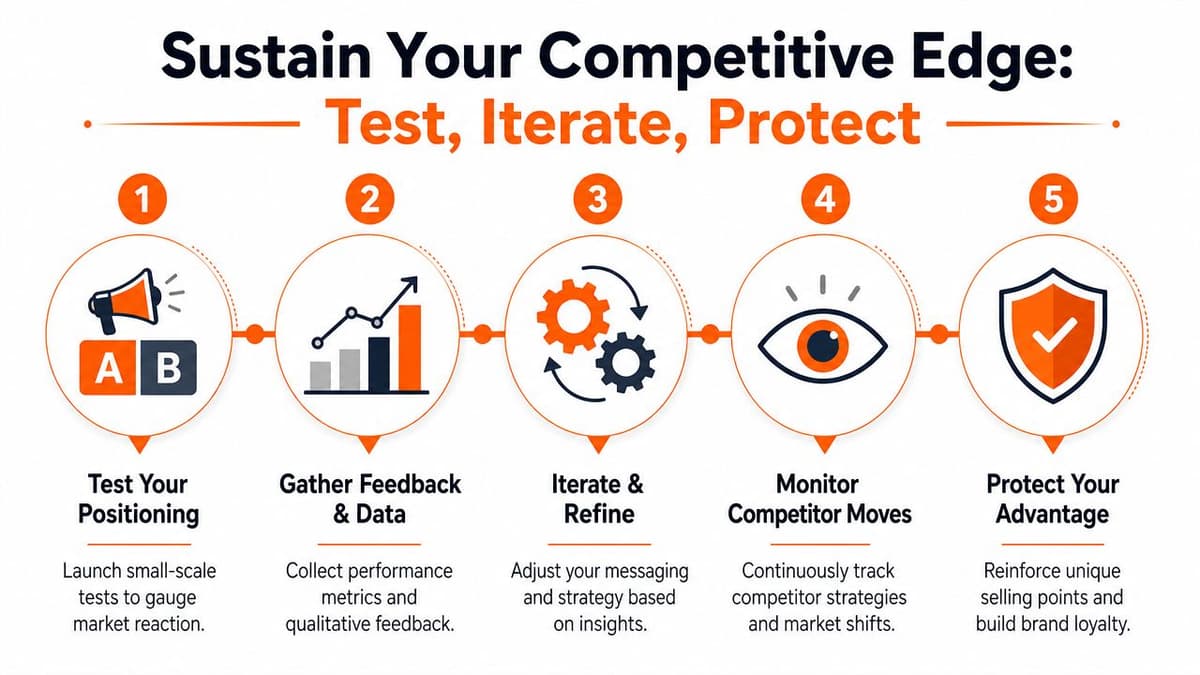
If you treat competitive positioning like a one-time exercise, competitors will catch up and your own team will drift.
Strong brands revisit the position before the market forces them to. Weak ones wait until conversion slips, CAC rises, and suddenly every meeting turns into a panic spiral.
#Run smaller tests than you want to
You don't need a giant rebrand to improve positioning. You need controlled tests that isolate the message.
Try a sane cadence:
- Weekly: Test one headline, one ad hook, or one offer framing change.
- Monthly: Review support questions, review language, and landing page behavior for repeated friction.
- Quarterly: Reassess the category. Are competitors collapsing toward price? Have they improved where they used to be weak? Has your buyer changed context?
Protecting a winning position starts with noticing when it stops sounding distinctive.
Research published in the Brazilian Administration Review study on strategy and competitiveness found that in highly competitive markets, hybrid strategies that combine cost leadership and differentiation outperform pure strategies. The practical lesson for DTC founders is simple. Don't get religious about one angle forever. In crowded categories, the strongest position may combine a clear product difference with a sharper value equation.
#Protect the angle once it starts working
Once a message lands, operationalize it. Put it in your briefs. Train your support team on the promise. Make sure your product pages, bundles, post-purchase emails, and retention flows reinforce the same idea. If your winning angle is “less routine friction,” but your checkout, subscriptions, and support experience feel clunky, you'll destroy your own advantage.
Use this checklist:
- Lock the language: Save the exact phrases that customers respond to.
- Audit channel drift: Check whether paid, email, site, and retention are still telling the same story.
- Track competitor movement: Watch for copycats and category shifts.
- Refresh proof: Add reviews, FAQs, product detail, and service improvements that strengthen the claim.
- Retest before panic: Don't rewrite the position because one campaign underperformed.
Founders who win on positioning usually aren't more creative. They're more disciplined. They listen harder, test faster, and protect what works.
Arlo helps Shopify brands do the part many find challenging after the positioning work is done. It turns store data into clear, plain-language analysis so you can see what changed, why it matters, and what to do next without drowning in dashboards. If you want a simpler way to connect messaging decisions to revenue impact, take a look at Arlo.