Product Description Writing: Shopify Sales Guide 2026
By Arthur Falcone · Founder of Arlo
Most advice on product description writing starts in the wrong place. It starts with wordsmithing.
That sounds reasonable until you look at how buying decisions happen on a product page. Shoppers don't reward effort. They respond to relevance, clarity, and confidence. If the copy doesn't answer the friction they feel in that moment, better adjectives won't save it.
That's why the strongest product descriptions aren't written from a blank page. They're built from signals your store already gives you: which products get traffic but don't convert, which variants get repeat orders, which devices bounce, which reviews repeat the same hesitation, and which customer segments need different reassurance before they buy.
#Table of Contents
- Why Most Product Descriptions Fail and How Yours Will Not
- Foundation First Define Your Voice and Customer Angle
- The Copywriting Playbook Frameworks That Convert
- Writing for Humans and Search Engines
- From Bullets to Blocks Structuring for Maximum Readability
- Measure What Matters Testing and Iterating Your Descriptions
#Why Most Product Descriptions Fail and How Yours Will Not
Product descriptions usually break down long before the writing starts. The page gets treated like a formatting task. Someone grabs specs, adds a few benefits, trims the copy for length, and publishes. The result sounds acceptable, but it does very little to help a shopper choose.
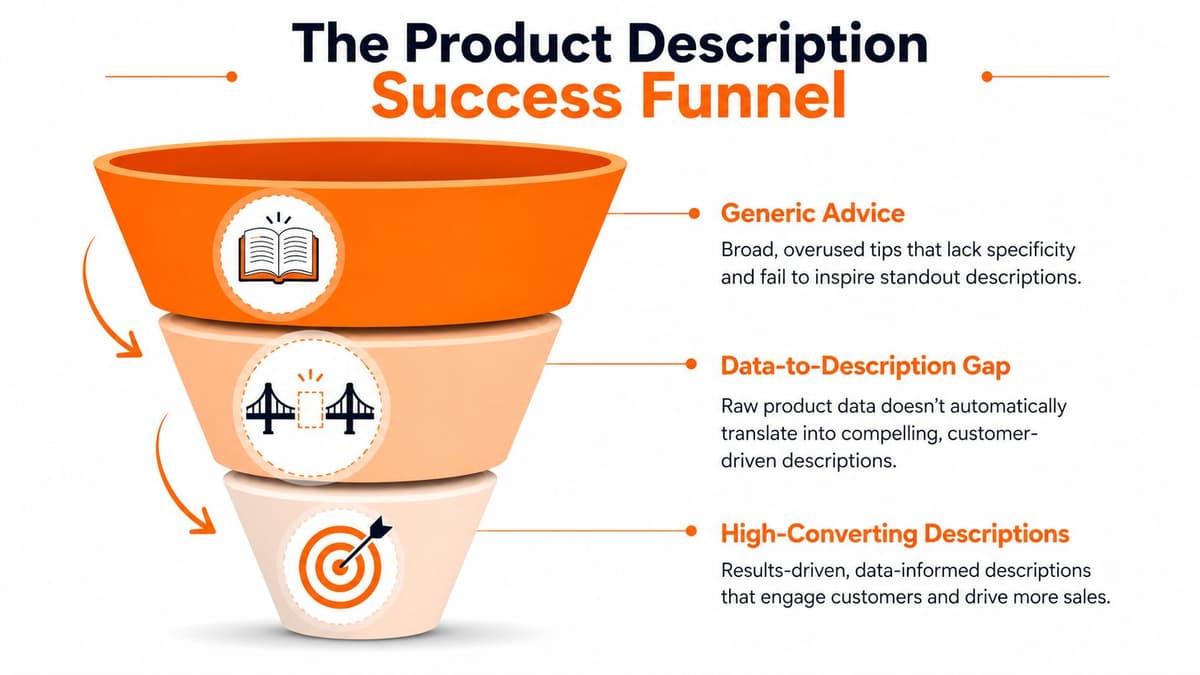
The actual failure sits in the data-to-description gap. Stores collect signals every day. Traffic source, device split, bounce rate, add-to-cart rate, repeat purchase behavior, review language, support questions. Then the description gets written as if none of that exists.
#Generic advice creates generic pages
Standard copy tips are too broad to do the job on their own. "Focus on benefits" is fine advice until you have to choose which benefit earns the first line. "Know your audience" sounds useful until your paid social traffic wants reassurance, your branded search traffic wants specifics, and your email traffic already knows the product.
That is why I start with page behavior. A SKU with strong traffic and weak add-to-cart usually has a hesitation problem. A SKU that converts on first order but stalls on repeat may have an expectation or usage problem. A product that performs well on desktop and poorly on mobile often has a prioritization problem. The opening copy is spending too many words on context and not enough on the buying decision.
A better working question is: what is stopping this shopper from moving right now?
That framing changes the job of the description. It shifts the page from "say persuasive things" to "remove the barrier that shows up in the numbers." It also forces the copy to match where the product sits in the customer digital journey for ecommerce brands, because cold traffic, returning visitors, and existing customers do not need the same narrative hook.
#Product content carries real buying weight
Shoppers use product page copy to reduce uncertainty near the point of purchase. Salsify reports that nearly 90% of consumers say product content is very or extremely important when deciding whether to buy a product, according to its 2024 Consumer Research report. Portent has also found a measurable relationship between readability and conversion performance in B2C ecommerce.
Those findings match what shows up in live stores. Clear copy helps people understand fit, use case, and trade-offs faster. Better understanding raises confidence. Confidence improves conversion.
#What strong operators do differently
Strong operators do not start from a blank page. They start from store signals and turn those signals into angles.
- High traffic, low conversion SKUs: Lead with the friction point. Sizing confusion, compatibility, material quality, setup time, or expected results.
- High repeat purchase SKUs: Reinforce habit, consistency, and the reason the product stays in the customer's routine.
- Mobile underperformers: Rewrite the first screen for speed. Tighter headline, clearer payoff, fewer throwaway adjectives.
- Review-rich SKUs: Pull recurring phrases from customer reviews and use that language in the description so the page reflects how buyers already talk about the product.
Here is the trade-off. A description built from analytics will often sound less "creative" in a brand brainstorm. It will usually perform better because it answers the core question behind the click.
That is how product descriptions stop being filler on a PDP and start contributing to revenue.
#Foundation First Define Your Voice and Customer Angle
Strong product descriptions are usually decided before the first sentence gets written.
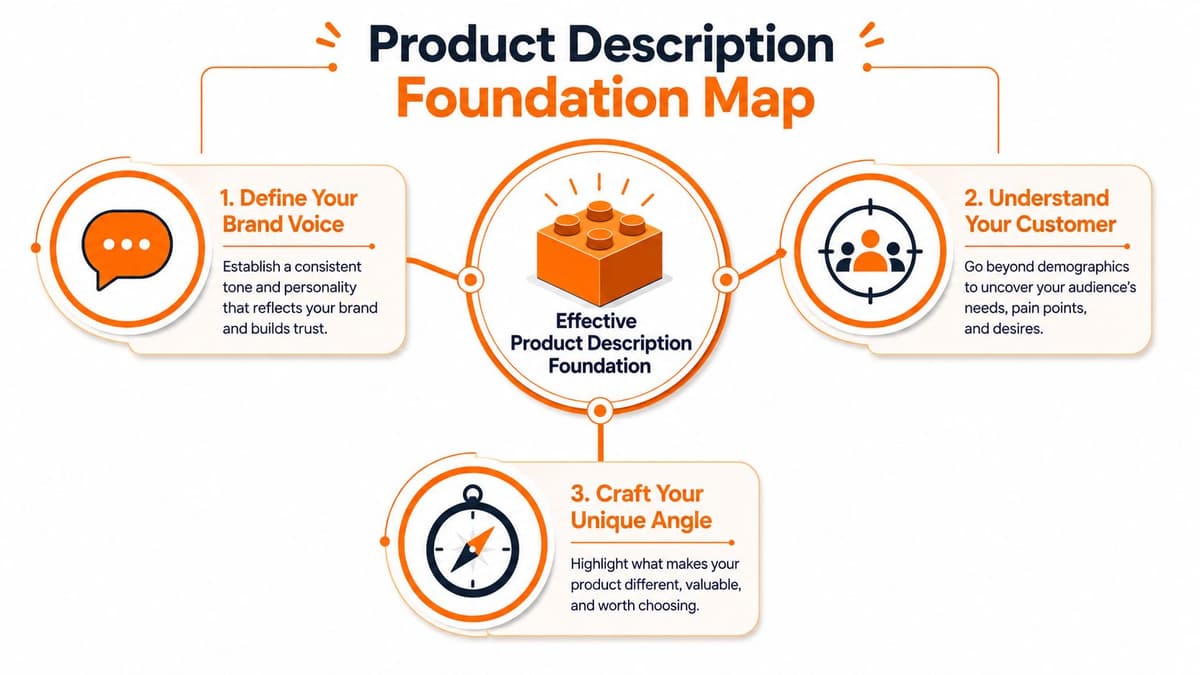
The problem is rarely "writing." The problem is that the team has not chosen who the page is for, what hesitation it needs to resolve, and which commercial outcome matters most. Without that foundation, copy drifts into generic brand language and feature piles.
#Start with buyer evidence, not audience fiction
A persona from a kickoff doc will not help much if it ignores how people shop the SKU.
Use store evidence instead. Pull review phrases. Read support tickets. Look at the bundles people add before checkout. Check which traffic sources convert cleanly and which ones stall. If returning customers buy quickly and first-time visitors hesitate, that gap should shape the copy. One group may need reassurance. The other may need a faster path to the payoff.
This gets clearer when you place the PDP inside the broader customer digital journey for ecommerce brands. Traffic from paid social arrives with a different level of context than traffic from branded search or an email flow. The description has to meet that context, not ignore it.
A useful SKU brief fits on half a page:
- Best current customer: The segment that buys most often, converts fastest, or produces the highest margin
- Primary use case: What the product helps someone do in daily life
- Top hesitation: The objection visible in reviews, support logs, or drop-off behavior
- Desired action: First purchase, bundle add-on, subscription start, or repeat order
- Proof source: The review line, survey answer, or service note that backs up the angle
That brief closes the data-to-description gap. It gives the writer a real buyer, a real job to be done, and a real conversion obstacle to address.
#Build a simple voice matrix
Brand voice needs constraints more than creativity.
A practical way to set it up is with two axes. The first is tone, from practical to expressive. The second is posture, from expert-led to peer-led. A dermatologist-backed skincare line may sit on the expressive and expert-led side. A refill brand for household basics may be practical and peer-led. A premium coffee tool brand may sound technical, measured, and slightly aspirational.
Once the brand has a position, define three rules for how the copy should sound on page and three patterns the team should avoid.
| Voice rule | What it means on page |
|---|---|
| Clear first | Open with use case and outcome before brand language |
| Specific language | Name materials, fit, use moments, and care details |
| Confident, not pushy | Make the case plainly without hype or pressure |
Then set the no-go list. Cut phrases like "state-of-the-art," "perfect for every lifestyle," and supplier jargon that reads like a catalog feed. These phrases do not build trust. They make the page sound interchangeable.
#Choose one narrative angle per product
A PDP loses power when it tries to sell comfort, style, quality, versatility, gifting potential, and technical superiority all at once.
Pick one dominant angle per SKU. Choose it from performance signals, not copywriter preference.
If a product gets plenty of visits but weak conversion, lead with the hesitation that blocks the sale. If it gets strong repeat purchase behavior, reinforce the routine, identity, or result that keeps it in rotation. If shoppers spend time on the page but still bounce, the issue is often message fit. The description may be answering the wrong question.
Four angle types cover most ecommerce catalogs well:
-
Objection removal
Best for products with visible hesitation. Lead with sizing clarity, comfort, compatibility, ingredients, material quality, or setup time. -
Outcome first
Best for products bought for a result. Sleep better, get organized, save time, reduce mess, recover faster. -
Identity and belonging
Best for products tied to taste, routine, or community. Apparel, beauty, hobby products, and many consumables fit here. -
Technical confidence
Best for gear, supplements, tools, and spec-sensitive products where buyers need plain explanation before they trust the offer.
Salsify found that product content matters heavily in purchase decisions in its 2024 Consumer Research report. The practical takeaway is simple. If the angle is blurry, shoppers have to interpret the page for themselves. That extra work lowers confidence and costs sales.
#The Copywriting Playbook Frameworks That Convert
Frameworks help when the product page has a job to do and the team needs consistency. They hurt when people treat them like formulas to pour words into.
The useful way to handle frameworks is to match them to the buyer's decision state. That's where product description writing gets easier. You stop asking, "Which template is best?" and start asking, "What kind of persuasion does this product need?"
#Choosing the right framework
Here is the simplest way to choose.
| Framework | Best For | Example Use Case |
|---|---|---|
| PAS | Friction-heavy products | A pillow with common comfort objections |
| BAB | Aspirational products | A countertop appliance tied to lifestyle improvement |
| FAB | Technical or spec-led products | A grinder, water filter, or travel bag with functional details |
The same thinking shows up in high-performing product description guidance. Start with the target customer, translate features into benefits, and answer the buyer's core question: is this a fit for me? That's also why feature dumping hurts so many pages, as explained in ProductLed's guide to writing product descriptions.
For adjacent messaging work, the same discipline shows up in strong Facebook ad copywriting for ecommerce campaigns. The difference is pacing. Ads interrupt. Product pages confirm.
#PAS for friction-heavy products
Problem-Agitate-Solve works when the shopper already feels the pain and needs confidence that this product will fix it.
A clean PAS structure for a DTC product might look like this:
- Problem: Your current pan sticks, heats unevenly, and makes cleanup annoying.
- Agitate: That turns quick meals into extra work, and you avoid using it.
- Solve: This ceramic pan heats evenly, wipes clean fast, and handles everyday cooking without the usual frustration.
This framework works well for products where the customer has a clear irritation. It doesn't work as well for products bought mainly for identity or taste.
#BAB for identity and aspiration
Before-After-Bridge is stronger when the customer wants a better version of a routine, not just a fix.
A home organization product could use BAB like this:
- Before: Kitchen counters feel crowded and chaotic.
- After: Essentials stay accessible and the space feels calm.
- Bridge: This stackable storage system creates order without making the room look clinical.
BAB tends to produce warmer copy. It's effective for categories where the customer is buying a feeling, a visual result, or a lifestyle upgrade.
The page should sell the improved state, then make the path to that state feel easy and credible.
#FAB for technical and specification-led products
Feature-Advantage-Benefit is the safest option for products that need explanation.
Take a travel backpack:
- Feature: Clamshell opening with separate laptop compartment
- Advantage: Easier packing and faster security checks
- Benefit: Less digging around in transit, less stress on travel days
FAB keeps technical pages honest. It prevents the common mistake of listing material specs with no customer meaning attached.
A practical guardrail is simple. Every feature line should be followed by an implied "so what?" If the answer isn't obvious, the copy isn't done.
#Writing for Humans and Search Engines
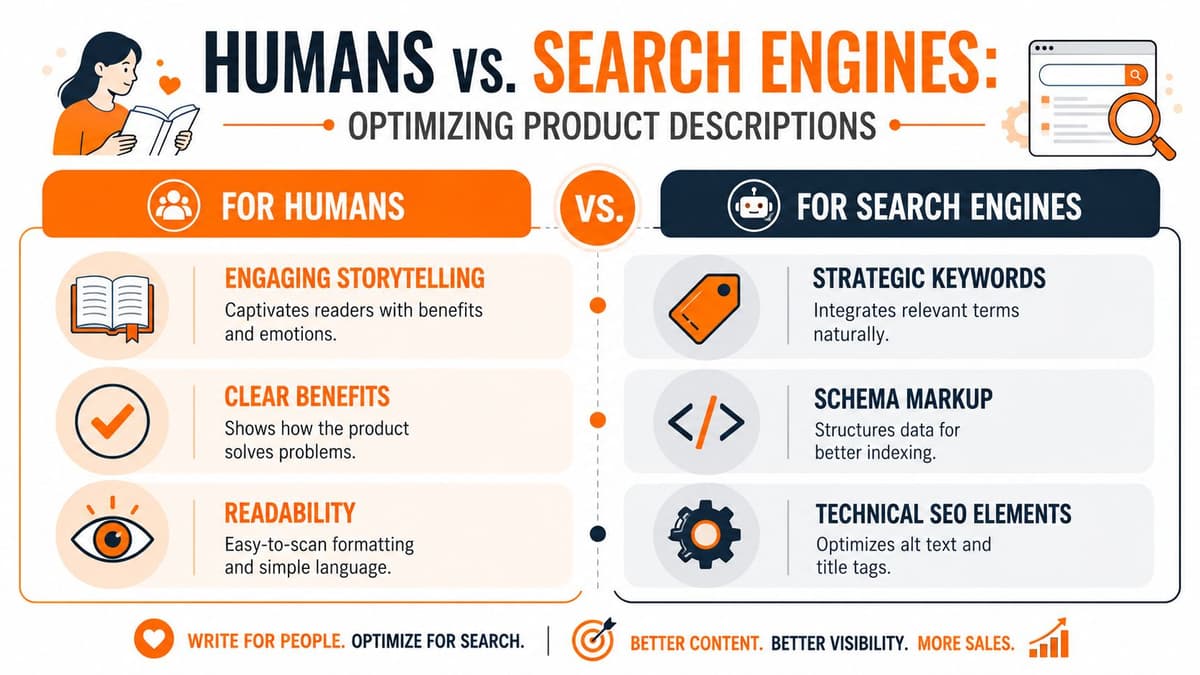
Search and persuasion used to be treated like separate jobs. On modern product pages, they're the same job done badly or well.
If your description ranks but reads like machine output, shoppers bounce. If it reads beautifully but omits the language people search for, fewer qualified shoppers arrive in the first place. The strongest product description writing does both without sounding strained.
#Why modern product pages need both jobs
This shift didn't happen by accident. Product description guidance moved away from print-style copy as ecommerce matured. By the 2010s, the standard became searchable, scannable, and mobile-friendly because product pages had to serve both shoppers and search engines, as described in Mailchimp's overview of modern product descriptions.
That history still matters. Many weak pages are written like mini brochures. They bury the primary term, hide the actual use case, and force mobile shoppers to wade through blocks of text before they understand the product.
#Where keywords belong
Keyword placement doesn't need to be clever. It needs to be natural and deliberate.
A practical placement pattern:
- Product title: Use the clearest primary phrase people would search
- Opening lines: State what the product is and who it's for
- Subheads: Include supporting terms where they help orientation
- Image alt text: Describe the product plainly
- Specs and details: Pick up secondary language around material, size, compatibility, or use
Don't chase density. Use the term where a person would expect it to appear. If the page starts sounding repetitive, you already went too far.
#What persuasive SEO copy sounds like
Good SEO copy doesn't sound like SEO copy. It sounds like a competent merchant who understands the customer.
Try this progression:
- Name the product in plain language.
- State the main benefit in everyday terms.
- Add one concrete use context.
- Expand into the details the buyer needs to feel safe.
That structure serves both discovery and conversion. Search engines get context. Shoppers get clarity.
A few writing rules hold up well:
- Prefer concrete nouns: "linen duvet cover" beats "luxury bedding solution"
- Use sensory cues carefully: texture, weight, fit, finish, smell, or feel can make the item tangible
- Write for mobile first: front-load meaning because the first screen is doing the hardest work
- Keep enthusiasm believable: confidence converts better than hype
Discipline is restraint. You don't need to jam every variation into the copy. You need one page that tells search engines what the product is and tells buyers why it's worth choosing.
#From Bullets to Blocks Structuring for Maximum Readability
Structure decides whether the copy gets read at all. A strong argument hidden inside a clumsy layout still loses.
Most product pages don't need more words. They need better sequencing. Shoppers should be able to understand the offer quickly, scan the essentials, and go deeper only if they need more detail.
#The anatomy of a readable product description
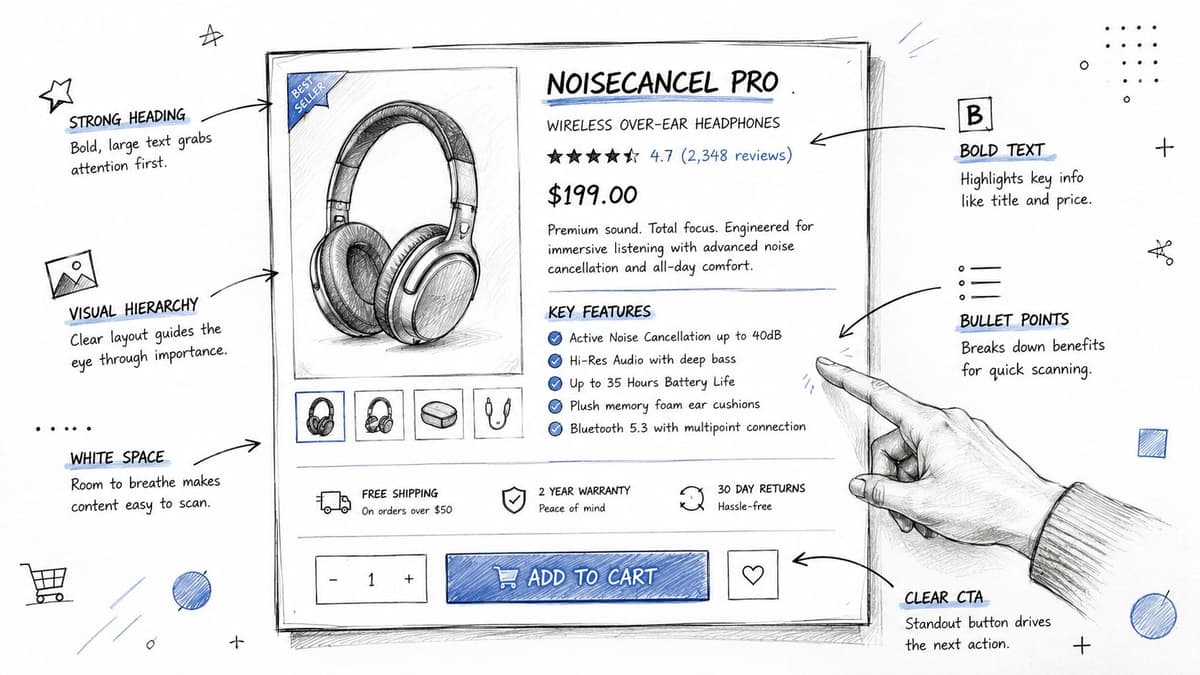
Expert guidance consistently recommends a scannable structure with 3 to 5 bullet points for the core summary and warns against dense prose or overloaded lists, as outlined in ClickHelp's practical guide to product descriptions.
The first screen should usually contain three things:
- A hero sentence: What it is, who it's for, and the main payoff
- A short bullet set: The quickest reasons to care
- A trust cue nearby: Shipping clarity, materials, guarantee language, or compatibility guidance
After that, the page can expand. That's where longer explanation, care instructions, ingredient notes, technical specs, sizing, and FAQs belong.
Dense paragraphs don't make a product feel premium. They make the decision feel harder.
#Three formats worth keeping on hand
You don't need one description format for every SKU. You need a small set of formats and a rule for when to use each.
1. The short bullet stack
Best for straightforward products and mobile-heavy traffic.
Template:
- Made for: [specific user or use moment]
- Main benefit: [clearest outcome]
- Material or spec: [one trust-building detail]
- Use note: [how it fits into life]
- Practical reassurance: [care, shipping, sizing, or compatibility]
2. The narrative block
Best for products that need context, ritual, or emotional framing before specs matter.
Template:
A short opening paragraph on the use moment.
A second paragraph explaining why the construction or ingredients matter.
A spec section below for buyers who want detail.
A useful visual breakdown sits below.
3. The hybrid format
This is my default for most DTC catalogs. Start with a compact paragraph, follow with bullets, and end with expandable detail sections. It gives fast scanners enough to move and gives careful buyers enough to trust.
#Microcopy that carries more weight than people think
Teams spend hours polishing the body copy and ignore the lines that sit closest to action.
That includes:
- CTA support text: "Ships in 24 hours" or "Check fit before ordering"
- Variant guidance: "Runs fitted" or "Best for dry to normal skin"
- Accordion labels: "What it feels like," "Ingredients," "Care," "Fit notes"
- Post-button reassurance: Returns, subscription flexibility, or compatibility notes
These lines aren't decoration. They reduce the final bit of uncertainty.
If your page is structurally sound, the copy feels easier. If it feels easier, more people keep moving.
#Measure What Matters Testing and Iterating Your Descriptions
Publishing the description isn't the finish line. It's the first live draft.
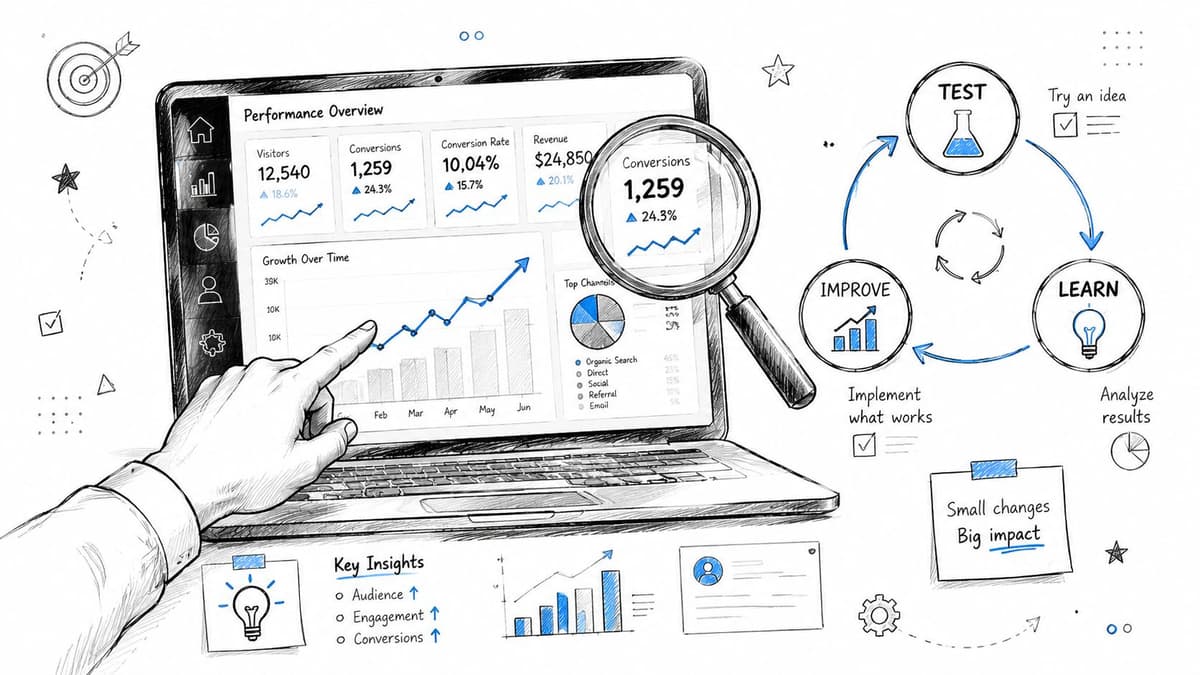
A product page usually underperforms for one of three reasons. The angle is wrong, the structure is hard to scan, or the copy doesn't remove the buyer's main hesitation. You won't know which one is true by rereading it ten times. You find out by testing.
#What to test first
Keep the test design simple. One meaningful change at a time.
Good first tests include:
- Headline angle: Outcome-led versus objection-led
- Framework choice: PAS versus FAB on the same product
- Opening structure: Short hero paragraph versus bullets first
- Objection handling: FAQ block added versus omitted
- CTA-area microcopy: Shipping or fit reassurance near the button
Don't test tiny wording tweaks first. Test the major conversion thesis of the page.
A useful operating habit is to review your core ecommerce KPIs and what they signal before changing copy. If add-to-cart is weak, the issue is often message or trust. If time on page is high but action is low, the page may be clear enough to hold attention but not sharp enough to move intent.
#How to read the results without fooling yourself
Use a small scorecard. You don't need a complex dashboard.
Track:
- Product page conversion rate
- Add-to-cart rate
- Time on page
Those three together tell a better story than any single metric on its own. If time on page rises but add-to-cart falls, the new version may be harder to process. If add-to-cart improves with shorter copy, the old version was probably doing too much. If conversion improves after adding fit guidance or FAQs, hesitation was the underlying problem all along.
Strong product description writing is iterative merchandising. The words are part of the operating system, not a one-time brand exercise.
The best teams keep a simple testing log. Product. Hypothesis. Version A. Version B. Observed change. Next decision. That discipline compounds because each winning test teaches you something reusable across the catalog.
Arlo helps Shopify merchants turn store data into decisions they can act on fast. If you want clearer answers on which products need better angles, where conversion is leaking, and what to fix first, explore Arlo.