10 Cost Reduction Strategies for DTC Shopify Brands
By Arthur Falcone · Founder of Arlo
Where margin leaks before you notice it is usually where the problem feels too small to chase. A founder trims one app, then another, while paid traffic keeps leaking through weak campaigns, shipping costs stay bloated, and support tickets pile up. That's why cost reduction strategies only work when they touch the whole DTC P&L, not just one line item. The smartest cuts protect service quality and move cash back toward profit, not vanity savings. For a useful risk lens on the trade-offs, this risk management framework guide is a solid companion.
The list below gets straight to the levers that matter. Each one starts with the move, then the trade-off, then the metric that tells you whether the change improved profit. If you run a Shopify brand, think in terms of contribution margin, repeat purchase, and cost per profitable customer, not just “spend less.” For broader context on procurement-style savings, McKinsey notes that external spending can represent 50% to 80% of a company's total cost base, which is why the biggest wins usually sit where demand, suppliers, and operations overlap (McKinsey on procurement value creation).
#Table of Contents
- 1. Audit and Cut Wasteful Paid Ad Spend
- 2. Consolidate and Audit Your Shopify App and Software Stack
- 3. Lower Shipping Costs Through Rate Shopping and Smarter Shipping Rules
- 4. Reduce Return Rates and Processing Costs
- 5. Right-Size Inventory and Prune Low-Performing SKUs
- 6. Reduce Packaging and Cost of Goods Through Supplier Renegotiation
- 7. Shift Budget Toward Retention Marketing and Repeat Purchases
- 8. Improve Site Speed and Conversion to Lower Cost Per Order
- 9. Reduce Payment Processing and Chargeback Costs
- 10. Automate Customer Service and Self-Service Support
- 10-Point Cost Reduction Strategy Comparison
- Start With the Cut That Saves the Most Money
#1. Audit and Cut Wasteful Paid Ad Spend
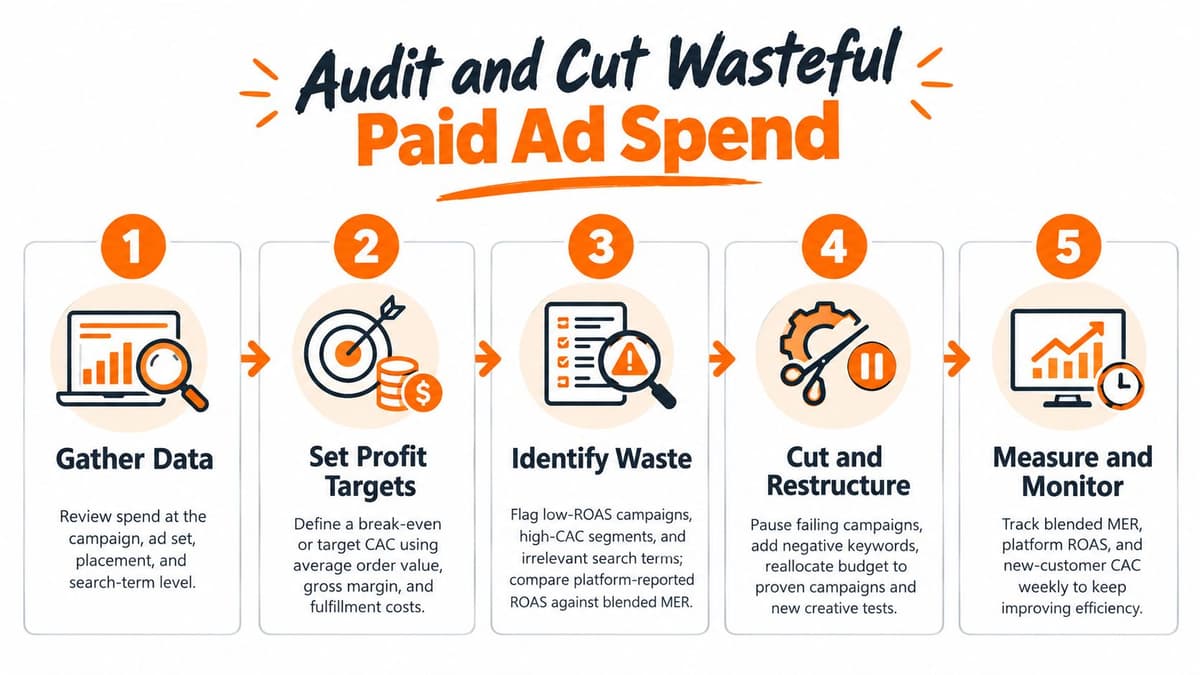
Paid media can produce fast growth, but it can also hide waste behind attractive dashboard metrics. A campaign may show clicks and conversions while still losing money after product margin, fulfillment, payment fees, and advertising costs.
Review spend by campaign, ad set, placement, and search term. Pause activity that exceeds your break-even CAC, calculated from the economics of the order rather than the platform's attribution model. Arlo's weekly report helps rank campaigns by waste, giving you a practical order for investigation. For the pause criteria, see the internal guide on when to kill a losing ad.
#What to cut first
- High-spend, low-intent terms: Add negative keywords when broad searches generate clicks without profitable orders. Move budget toward queries that show clear product intent.
- Retargeting that claims credit for everything: Compare incremental purchases with customers who would likely have returned without the ad. Retargeting that adds little contribution margin should not keep its budget by default.
- Ads with weak blended efficiency: Track MER alongside platform ROAS. MER shows whether total advertising spend supports profitable growth across the account.
Practical rule: judge every campaign by contribution margin after ad spend, not by attributed revenue alone.
A store might find one search theme consuming budget with almost no purchases, then shift spend into product campaigns that consistently bring first-time buyers. The trade-off is volume: cutting broad traffic can reduce reach, but it protects cash when those visits do not produce profitable orders.
Use organic acquisition as another route to reduce dependence on paid clicks. A focused ecommerce SEO services program can support that shift, but measure it against contribution margin and cost per profitable customer rather than traffic alone. For a broader acquisition benchmark, benchmark your acquisition costs against your own channel mix.
#2. Consolidate and Audit Your Shopify App and Software Stack
A Shopify store can lose margin through subscriptions that barely influence sales. Review, popup, loyalty, review, analytics, and upsell tools often overlap, while each adds another script, integration, or renewal date.
Start with the billing export, not the app marketplace. List every recurring charge, assign an owner, and record the business outcome the tool is expected to produce. Then check whether that outcome appears in contribution margin per order, conversion rate, repeat purchase rate, or support cost. A low monthly fee still deserves removal if it produces no measurable improvement.
Use a simple decision table:
- Keep: the app has a clear owner, a distinct job, and a measurable profit contribution.
- Consolidate: two tools serve the same customer or operational need. Choose the one with lower total cost and fewer dependencies.
- Remove: the subscription is unused, duplicated, or no longer needed because Shopify provides the function natively.
Check dependencies before uninstalling anything. A theme block, checkout flow, tracking script, email automation, or fulfillment process may rely on the app. Test the store after removal, including product pages, cart, checkout, and automated messages.
Review annual renewals before they renew, and repeat the audit each quarter. The saving is the subscription fee, but the profit effect can also come from fewer scripts, fewer conflicts, faster troubleshooting, and less staff time spent maintaining the stack. Track software cost per order and contribution margin per order after each change. Consolidating review, Q&A, and loyalty functions can reduce complexity without cutting a customer-facing capability.
#3. Lower Shipping Costs Through Rate Shopping and Smarter Shipping Rules
Shipping is where profit disappears after the customer already said yes. The sale looks good, then the label, the box, the zone, and the free-shipping promise eat back the margin you thought you had.
Start with a 90-day shipping report and sort by zone and weight band. Then compare carrier rates, discounted label services, and your own shipping rules against the actual cost of getting a parcel to the customer. USPS says dimensional-weight pricing applies to several domestic services when a package exceeds 1 cubic foot, or 1,728 cubic inches, and the billable weight is based on length × width × height ÷ 139 when that exceeds actual weight (USPS business shipping). That makes package size a cost lever, not just a packaging choice.
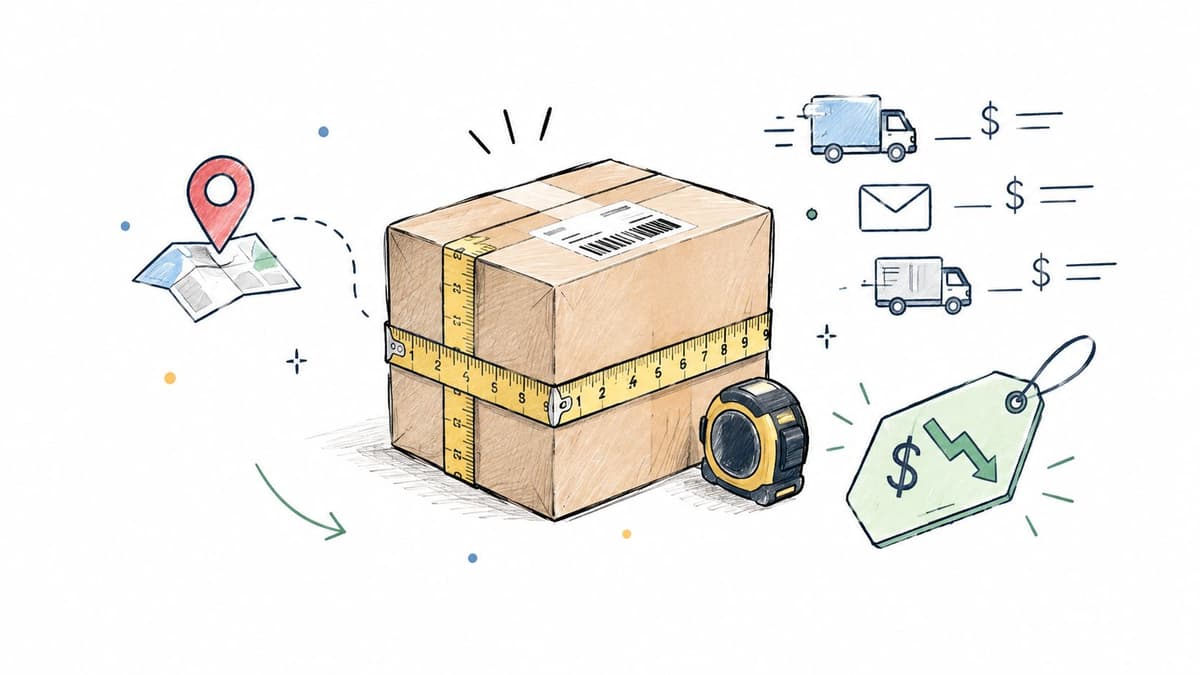
A better setup is usually zone-based pricing with a free-shipping threshold that still leaves room for fulfillment cost. If your threshold is set slightly above average order value, customers often add items to qualify, which can help basket economics without a sitewide discount. But don't assume every threshold works. Track average shipping cost per shipment, order value, and contribution margin before and after the change. USPS also warns that inaccurate dimensions can trigger a dimension-noncompliance fee, so this isn't just a finance issue, it's an ops issue too (USPS parcel size and weight fee standards).
#4. Reduce Return Rates and Processing Costs
A return can erase profit twice. The order already incurred fulfillment and payment costs, then adds inspection, restocking, refund, or replacement work.
Start with the reason, not the total. Group returns by SKU, size, and acquisition source. A high return rate for one product may point to weak fit guidance, while returns from one campaign may signal a promise the product cannot meet. Add measurements, fit notes, and customer photos where shoppers lack confidence. Rewrite product copy when expectations do not match what arrives.
Use three operating changes:
- Required return reasons: Make customers select a clear reason, so recurring product and page issues become visible.
- Exchange incentives: Offer store credit or a small bonus when an exchange protects more contribution margin than a refund.
- Clear return rules: State exclusions, timelines, and processing conditions before checkout. If a return costs more to handle than the item is worth, the policy should explain the available option.
An apparel brand might add customer-reported fit data to key product pages to address “too small” complaints. A store could also steer eligible shoppers toward exchanges, keeping part of the original revenue active instead of issuing a full refund.
Track return rate by SKU, exchange rate, and contribution margin after return costs. Total return volume alone can hide a profitable exchange program or a product that drains margin.
#5. Right-Size Inventory and Prune Low-Performing SKUs
Inventory can look healthy right up until it turns into cash locked on a shelf. Slow movers tie up capital, eat storage, and often get rescued later with discounts that damage margin.
Run an ABC analysis on the last 12 months of sales and margin, then look hard at the C-class items. If a SKU barely moves, it shouldn't get the same reorder logic as a hero product. Set reorder points from average daily sales plus supplier lead time and a buffer, then review inventory aging every month so dead stock doesn't sit unnoticed for a quarter.
The operational win here is not just lower inventory, it's fewer emergency decisions. A brand that orders closer to demand usually needs fewer air shipments and fewer panic buys. That matters because fast replenishment often costs more than the stock it saves.
Practical rule: if a SKU can't justify its shelf space with sales velocity and margin, it needs a discount, a bundle, or a retirement plan.
For a deeper operating rhythm, the internal guide on inventory optimization is worth using alongside your stock review. A useful scenario is a brand that discovers a small slice of SKUs is carrying almost no revenue, then consolidates those lines and trims the carrying cost without hurting core sales. Measure stock age, reorder frequency, and markdown dependence. That's where the story is.
#6. Reduce Packaging and Cost of Goods Through Supplier Renegotiation
A supplier renewal can hide several profit levers. Review the product specification, packaging, freight, payment terms, and order quantities together. A lower factory price may still produce a higher landed cost if it brings larger cartons, more damage, or expensive freight.
Request competing quotes before renewal, then compare the full cost per sellable unit. Ask suppliers for alternative materials, pack sizes, minimum-order quantities, and payment terms. Changing one specification can lower cost without reducing product quality. Longer terms such as Net-30 or Net-60 can also improve working capital, even when the unit price changes little.
Packaging deserves its own test. Right-size mailers and boxes to reduce void fill, postage, and damage risk. A useful reference is Amazon's Frustration-Free Packaging program, launched in 2008, which used recyclable containers to reduce excess packaging. The operating goal is simple: remove material and shipping volume while keeping the unboxing experience intact.
Use a profit measure, not a supplier quote alone:
- Total landed cost per unit: Include product, freight, duties, and packaging.
- Contribution margin per order: Confirm that savings remain after fulfilment and returns.
- Carrier size-tier exposure: Check how each package fits standard parcel thresholds.
- Cash conversion impact: Track whether revised terms reduce the cash tied up in each purchase.
A standard mailer for best-selling products can reduce filler materials and dimensional-weight surprises. Track damage, customer complaints, and contribution margin after the change. A cheaper package that increases replacements is not a saving.
#7. Shift Budget Toward Retention Marketing and Repeat Purchases
Acquiring a customer once is expensive. Keeping that customer active is usually where the better unit economics live.
The practical move is to reallocate budget from pure acquisition into email, SMS, subscriptions, loyalty, and product recommendations. If a post-purchase flow is broken, fix that before you pour more money into ads. If replenishment timing is predictable, automate the reminder. If a customer already buys regularly, don't keep paying to reacquire them.
McKinsey reports that personalization most often produces a 10% to 15% revenue lift, with outcomes ranging from 5% to 25% depending on execution and sector (McKinsey personalization research). The point isn't to chase a big headline. The point is to use first-party signals like returning status, purchase frequency, category, AOV, and replenishment timing to send better offers to the right segment.
A store that fixes a broken post-purchase sequence can recover repeat orders it was accidentally losing. A subscription brand can use renewals, skips, and pause options to preserve recurring revenue without forcing discounts everywhere. Track repeat purchase rate, 90-day retention, discount rate, and customer support contacts by treatment group. Revenue alone can fool you if the discounting got worse.
#8. Improve Site Speed and Conversion to Lower Cost Per Order
Every conversion gain lowers your effective acquisition cost, even if your ad budget stays flat. That's why site speed and checkout quality belong in a cost reduction conversation, not just a CRO one.
Mobile is where this usually hurts most. Test your top landing pages on a mid-range Android phone over a normal mobile connection, because that's closer to reality than your office Wi-Fi. Then remove or defer scripts that don't help someone buy. If the page is cluttered, the checkout is long, or shipping costs show up too late, you're paying for traffic that never had a fair chance to convert.
Baymard's benchmark shows that roughly 70% of ecommerce users abandon after adding items to cart, and its review of 6,000+ checkout elements found the average U.S. checkout displays 23.48 form elements by default, including 14.88 fields (Baymard checkout UX research). Baymard also reports that 62% of sites fail to make guest checkout the most prominent option and that 18% of surveyed users abandoned because they didn't want to create an account. That's a lot of wasted traffic spend tied to friction, not intent.
Shipping and tax visibility is a cost lever as much as a conversion lever. If the total landed cost appears late, customers leave before you ever get a fair shot at the order.
A store that reduces image weight and removes unused scripts can lift checkout completion without adding spend. Another brand moves shipping information earlier and loses fewer carts at the final step. The right metric is cost per completed order, split by device.
#9. Reduce Payment Processing and Chargeback Costs
Payment fees feel invisible until you run low-priced orders and realize the fixed cost per transaction is eating a bigger share than expected. Chargebacks and fraud losses make it worse because they add admin work on top of the fee.
The first step is to calculate your effective processing rate by dividing total payment fees by total volume each month. Then break the result down by payment method and order type. If one method is expensive on small tickets, you may need a threshold or a different default checkout mix.
For evidence handling, keep tracking numbers, delivery confirmations, and customer communication logs organized before a dispute lands. That makes it easier to win cases instead of fighting blind. The internal guide on payment gateway fees helps frame the trade-offs if you're deciding where to push on cost.
A practical example is a brand that improves shipping confirmation emails and wins more disputes because proof of delivery is easy to produce. Another is a store that reviews fraud rules quarterly so it doesn't block too many real customers while trying to stop bad ones. Track chargeback rate by reason code, false declines, and the processing cost per order. A cheap card fee isn't cheap if it creates more disputes and support work.
#10. Automate Customer Service and Self-Service Support
Support becomes a cost problem when every repetitive question needs a human. Order status, shipping delays, sizing, and returns make up a huge share of tickets in most stores, and none of those need a full manual response every time.
Start by tagging every ticket by reason. Then turn the top three or five issues into help-center articles, saved replies, and automated order-status updates. Shopify Flow can tag delayed orders and trigger proactive notifications, which cuts the number of “where is my order” messages before they start. That saves time and also reduces customer frustration.
A useful operating rule is to keep a clear handoff to a human for complex or high-value issues. Automation should absorb the repetitive work, not create a dead end. If a customer has a damaged order or a sensitive account issue, they still need a person who can resolve it.
Practical rule: automate the questions you can predict, and reserve humans for the cases that affect trust, margin, or retention.
A store that publishes answers to its top support questions often sees fewer repetitive tickets almost immediately. Another brand sends proactive delay notices and cuts inbound contacts because customers don't have to ask first. Measure ticket volume by reason, first-response time, and the share of issues handled without escalation.
#10-Point Cost Reduction Strategy Comparison
| Tactic | 🔄 Implementation complexity | ⚡ Resource requirements | ⭐ Expected outcomes | 💡 Ideal use cases | 📊 Key advantages |
|---|---|---|---|---|---|
| Audit and Cut Wasteful Paid Ad Spend | 🔄 Medium, needs cross-channel attribution and weekly review | ⚡ Medium, ad platform access, analytics, analyst time | ⭐⭐⭐⭐, immediate spend reduction and efficiency gains | Brands with large paid budgets and rising CAC | Exposes wasted spend; frees budget for winners; faster ROI on tests |
| Consolidate and Audit Your Shopify App and Software Stack | 🔄 Low–Medium, inventory and dependency mapping | ⚡ Low–Medium, billing export, owner time, occasional dev work | ⭐⭐⭐, recurring savings and site stability | Stores with many apps or overlapping tools | Cuts recurring fees; reduces third‑party scripts; simplifies ops |
| Lower Shipping Costs Through Rate Shopping and Smarter Rules | 🔄 Medium, carrier comparisons and rule setup | ⚡ Medium, shipping data, carrier negotiations, fulfillment updates | ⭐⭐⭐⭐, per-order savings that compound at scale | High‑volume shippers or brands with wide zone variance | Lowers per‑order shipping cost; raises AOV via thresholds; better packaging |
| Reduce Return Rates and Processing Costs | 🔄 Medium–High, content, policy, and portal changes | ⚡ Medium, product content, returns portal, CX resources | ⭐⭐⭐⭐, lower reverse logistics and retained revenue | Apparel/fit‑sensitive categories and high‑return SKUs | Reduces processing cost; increases store‑credit retention; improves inventory accuracy |
| Right‑Size Inventory and Prune Low‑Performing SKUs | 🔄 Medium–High, forecasting, reorder rules, catalog decisions | ⚡ Medium, inventory analytics, buying discipline, supplier coordination | ⭐⭐⭐⭐, frees working capital and lowers markdowns | Large catalogs, high carrying costs, slow movers | Reduces carrying costs; improves cash flow; simpler merchandising |
| Reduce Packaging and COGS Through Supplier Renegotiation | 🔄 Medium, supplier negotiations and packaging redesign | ⚡ Medium–High, supplier outreach, sample testing, possible larger POs | ⭐⭐⭐⭐, direct gross‑margin improvement per unit | Brands with high COGS or heavy/inefficient packaging | Lowers unit cost; reduces shipping dims/weight; better landed cost |
| Shift Budget Toward Retention Marketing and Repeat Purchases | 🔄 Medium, build flows, segmentation, loyalty mechanics | ⚡ Low–Medium, email/SMS tools, content, analytics | ⭐⭐⭐⭐⭐, high ROI and lower blended CAC over time | Brands with an active customer base or consumables | Lowers acquisition reliance; increases LTV and predictability |
| Improve Site Speed and Conversion to Lower Cost Per Order | 🔄 Medium–High, dev changes, A/B testing, performance audits | ⚡ Medium, developers, testing tools, performance monitoring | ⭐⭐⭐⭐⭐, more revenue from existing traffic | Sites with slow load times or mobile conversion gaps | Increases conversion; benefits paid & organic traffic; better UX |
| Reduce Payment Processing and Chargeback Costs | 🔄 Medium, fee analysis, fraud rule tuning, dispute workflows | ⚡ Low–Medium, payment tools, team time for disputes | ⭐⭐⭐, lowers fees and preserves account standing | Low‑ticket merchants or stores with rising chargebacks | Lowers effective processing rate; reduces chargeback losses |
| Automate Customer Service and Self‑Service Support | 🔄 Medium, knowledge base, workflows, saved replies setup | ⚡ Low–Medium, help‑desk tools, content creation, initial setup | ⭐⭐⭐⭐, reduced labor and faster responses | Growing merchants with repetitive support tickets | Cuts staffing growth; improves response time; surfaces product issues |
#Start With the Cut That Saves the Most Money
Pick two levers this month. The ad spend audit and the software review are usually the fastest, so start there and record the metric for each before changing anything else. Once those numbers move, work through shipping, returns, and retention in the order your own data points to. A weekly review that ranks these leaks by dollar impact keeps the list moving, and Arlo's weekly report does that work for Shopify merchants.
The trap is treating every cut as equal. A small app fee may be easy to remove, but wasted acquisition, high return cost, or poor checkout conversion can cost far more. The right sequence is the one that protects margin and keeps growth intact, because the point of cost reduction strategies isn't to shrink the business, it's to make the business harder to break.
If you want a sharper read on where margin is leaking, start with your acquisition costs, then compare that with what your store keeps after fulfillment, returns, and payment fees. Benchmark your acquisition costs against the channels you're funding today, then use that baseline to decide what to cut, what to fix, and what to leave alone.
If you want a faster way to spot wasteful spend, broken flows, and conversion drag, Arlo turns Shopify data into a weekly priority list by dollar impact. It's built for founders who want plain-language actions, not another dashboard. If this topic is on your desk right now, Arlo can help you find the cuts that improve profit.