Payment Gateway Fees Explained for Shopify Merchants
By Arthur Falcone · Founder of Arlo
You can reconcile a Shopify payout on a quiet Tuesday and still feel your stomach drop. Sales looked fine, ads were under control, refunds weren't crazy, and then the payment line items show up and eat the month you thought you had. That's the trap with payment gateway fees. They don't behave like a checkout nuisance, they behave like a margin leak, and if you don't measure them properly, they compound faster than most founders expect.
The reason this matters is simple. In 2024, the global average credit card processing fee was reported at about 2.4% per transaction, often plus a flat $0.30 fee, and industry summaries estimate businesses lose about 1% to 3% of annual revenue to payment processing fees alone (Currenxie). In the U.S., merchants paid $187.20 billion in card processing fees in 2024, which works out to about $1.57 for every $100 accepted in card payments (Business Solutions US). That's not overhead in the abstract, that's real contribution margin walking out the door.
The right way to think about gateway pricing is blunt. A low-AOV Shopify brand can get hurt much more than a high-AOV store because the fixed fee sits heavier on small baskets, and the blended cost structure often hides that pain until payout review time. If you want a broader margin framework after this, Wojo Media's profit margins playbook is a useful companion, but the core point here is harder and more actionable, gateway fees are a profit problem first.
#Table of Contents
- Why Payment Gateway Fees Hit Shopify Margins Harder Than Expected
- The Three Core Fee Types Every Gateway Charges
- Reading Your Shopify Payouts the Way an Operator Would
- How Gateway Fees Change Your Contribution Margin
- Five Tactics to Reduce Payment Gateway Fees
- Executing the Highest-Impact Fee Reductions on Shopify
- A 30-Day Plan to Quantify and Prioritize Fee Reductions
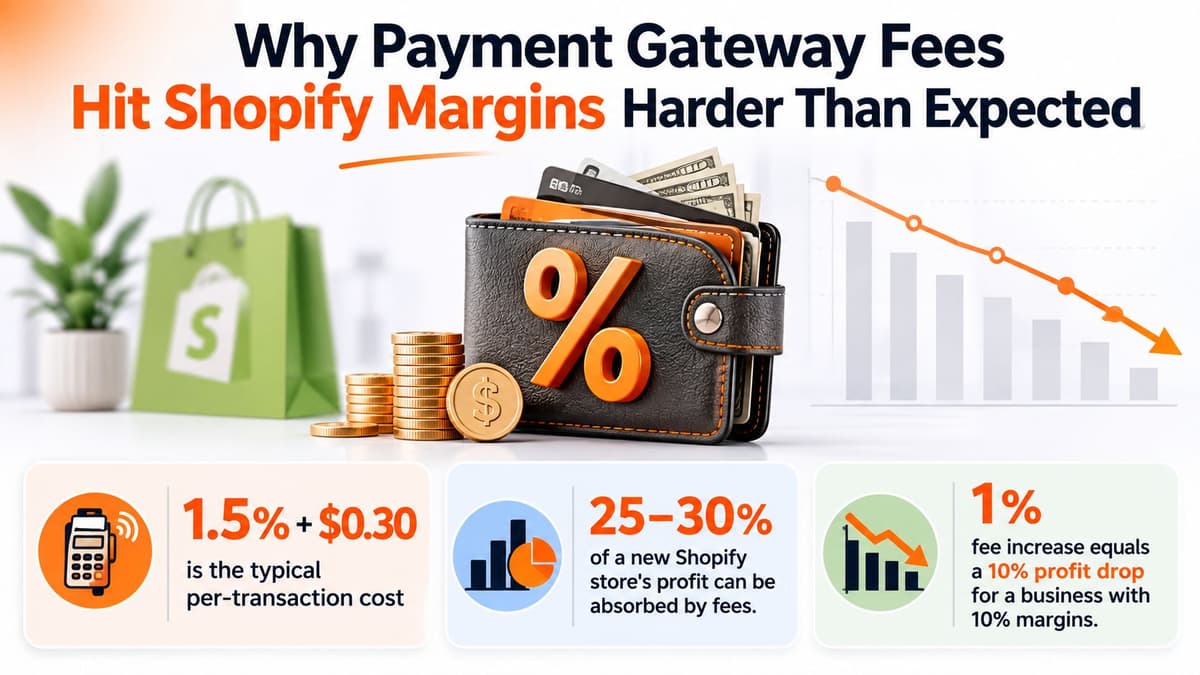
#Why Payment Gateway Fees Hit Shopify Margins Harder Than Expected
A founder usually notices the problem in a boring place, the payout report. Revenue looks healthy, refunds are explainable, and then the card processing lines take a bigger bite than the mental model allowed for. That's because payment gateway fees aren't one clean fee, they're a stack of charges that shows up inside the same payout and makes a healthy store look less healthy than it is.
#The number on the page is never the whole number
Across major markets, gateway pricing commonly combines a variable fee of about 1.4% to 3.5% with a fixed charge of roughly $0.20 to $0.30 per transaction, and monthly, setup, and authorization fees can sit on top of that (Stripe resources on payment gateway fees). A $100 order can therefore carry a direct payment cost that's meaningful before chargebacks, refunds, or cross-border surcharges ever enter the picture. On a smaller basket, the fixed fee can make the effective rate look ugly fast.
Practical rule: if your store sells small baskets, stop looking at the headline percentage alone. The fixed fee is what turns a “reasonable” pricing page into a margin problem.
The scale matters too. U.S. merchants paid $187.20 billion in card processing fees in 2024, about $1.57 for every $100 accepted in card payments (Business Solutions US). That alone tells you the industry isn't dealing with a rounding error. It's dealing with a cost base that can swallow a meaningful share of every order.
#This is why checkout optimization isn't enough
Teams often treat the gateway as a conversion tool, which is fair, but incomplete. Approval rates matter, checkout UX matters, and payment trust matters. Still, if the economics are wrong, a prettier checkout only helps you process more orders at a cost structure you didn't control.
You need a margin lens, not just a checkout lens. That means comparing the effective fee burden against gross margin, ad spend, shipping, and refund drag, not just against the rate on the pricing page. In practice, that's the difference between saying “payments cost us around 2.5%” and saying “payments are taking enough margin to change how much we can afford to spend on acquisition.”
The sharpest operators run that analysis alongside broader ecommerce KPIs. If you want a clean performance lens for that kind of review, the analytics framework in this ecommerce KPI guide fits naturally with payout reconciliation. The point isn't more dashboards. It's fewer surprises.
#The Three Core Fee Types Every Gateway Charges
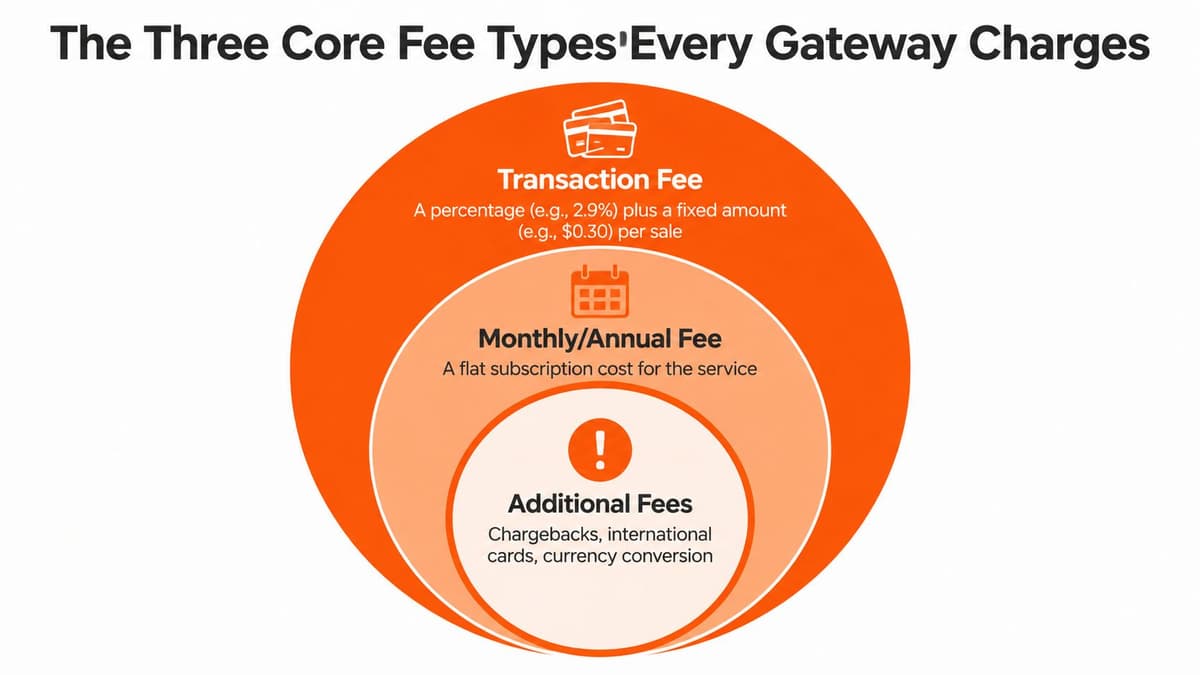
Most founders only notice one fee line, the per-transaction charge. That's a mistake. Gateway pricing usually has three layers, and each one affects your margin differently. If you can read those layers correctly, you can compare providers without getting fooled by a low headline rate.
#Transaction fees take the biggest visible bite
The transaction fee is usually a percentage plus a fixed amount, and published gateway pricing commonly sits around 1.4% to 3.5% plus $0.20 to $0.30 per sale (Stripe resources on payment gateway fees). That fixed amount pays for routing, authentication, fraud tooling, and the mechanics of getting the payment from customer to merchant.
A simple way to think about it is this. On a small order, the fixed fee matters more because it's a larger share of the basket. On a larger order, the percentage matters more. That's why two stores can use the same provider and feel completely different pain.
#Monthly fees and standalone gateway fees stack on top
Some gateways charge a flat monthly access fee. A merchant-cost guide notes an example standalone gateway, such as Authorize.Net, at $25 per month plus $0.10 per transaction, with a daily batch fee of $0.10 to $0.25 for settlement (Spark Money research on merchant payment acceptance costs). That doesn't sound dramatic until you add it to your order volume and see how the fixed costs behave when sales are soft.
Useful filter: if your volume is low or inconsistent, monthly fees can hurt more than a slightly higher per-transaction rate. If your volume is strong and stable, the monthly fee may be worth paying for lower marginal cost.
#Extra fees are where the story gets messy
Merchants can also face setup fees, batch fees, PCI non-compliance fees, refund-handling fees, chargeback fees, representment fees, instant-settlement fees, and taxes on fees in some markets. Gateway pricing pages often look clean because they're built to sell you the visible rate, not the full cost stack.
A better reading is to separate gateway-only fees from total payment cost. The gateway layer is one part of the stack, but the processor and card network layers sit underneath it, which means the cheapest-looking quote may not be the cheapest real-world bill.
| Fee Category | What It Covers | Typical Range |
|---|---|---|
| Transaction fee | Authorization, routing, fraud tooling, settlement | Percentage plus fixed amount |
| Monthly access fee | Platform access or account maintenance | Flat recurring fee |
| Additional fees | Chargebacks, PCI non-compliance, batch settlement, refunds | Varies by provider and usage |
If you want to evaluate the operating impact of all this the way a finance-minded team would, the KPI lens in this ecommerce metrics guide pairs well with fee review because it keeps you focused on contribution, not just revenue.
#Reading Your Shopify Payouts the Way an Operator Would
Most founders don't need more payment theory. They need a cleaner way to read a payout statement and know what to fight over. That starts with one habit, calculate the effective fee rate, not just the listed rate. Effective fee rate is total payment fees divided by total sales, and it's the number that tells you what the gateway actually costs.
#Start with the lines that quietly distort the bill
Look for the obvious items first, the percentage fee and the fixed per-order charge. Then scan for currency conversion markups, refund handling fees, chargebacks, and instant-settlement surcharges. Independent merchant guides note that international card acceptance often adds about 1% to 3% on top of domestic gateway pricing for foreign-currency conversion and cross-border processing (PhonePe business guide on payment gateway charges).
That's where many operators misread their statement. They see a rate that looks manageable on paper, then cross-border orders, refunds, and dispute lines push the final cost higher.
#Break the statement into a monthly reconciliation
Here's the operating sequence I'd use.
- Pull gross sales. Use the same period across sales, refunds, and fees.
- Sum every payment-related charge. Include card fees, gateway fees, settlement charges, and dispute charges.
- Divide fees by gross sales. That gives you your effective rate.
- Tag by order type. Separate domestic, cross-border, subscription, and refund-heavy orders.
- Compare to the headline rate. The gap is where your margin leak lives.
Operator rule: if you can't explain the difference between headline rate and effective rate, you don't know your true payment cost.
A useful internal benchmark is to look at the fee stack by line item rather than as one blended number. That helps you see whether the problem is basket size, cross-border traffic, card mix, or provider pricing.
| Typical Shopify Gateway Fee Line Items | What It Covers | Typical Range |
|---|---|---|
| Percentage fee | Core payment processing | Percentage of order value |
| Fixed per-transaction fee | Routing and settlement overhead | Flat amount per order |
| Currency conversion markup | Foreign currency settlement | About 1% to 3% |
| Chargeback fee | Dispute handling | Provider-specific |
| Instant payout fee | Faster settlement option | Provider-specific |
If you're already using a reporting layer to monitor store behavior, the analytics workflows in Arlo's ecommerce reporting article are a sensible reference point for how to structure the review. The important part isn't the tool. It's the discipline of treating fees as data, not noise.
#How Gateway Fees Change Your Contribution Margin
Gateway fees hurt because they sit inside the same order economics as product cost, shipping, and ad spend. If your margin is tight, even a small payment cost can change the entire decision tree on discounts, acquisition, and international expansion. A store that thinks in gross revenue alone will miss this. A store that thinks in contribution margin won't.
#The fixed fee punishes low baskets first
Take a $40 AOV apparel store and a $12 AOV subscription starter. If both pay the same per-transaction structure, the smaller basket bears a much heavier effective rate because the fixed fee consumes more of the order value. That's why low-AOV brands often feel like they're working harder for less cash.
The logic is simple. The percentage fee scales with order size, but the fixed fee doesn't. That makes the per-order cost disproportionately painful for small baskets and especially painful for brands that rely on repeat purchases with tight margins.
#Cross-border traffic changes the math again
International growth adds another layer of drag. Independent merchant guides note that cross-border card acceptance can add about 1% to 3% through foreign-currency conversion and cross-border processing (PhonePe business guide on payment gateway charges). That means a brand selling globally may face a different payment cost profile by region, even if the storefront and AOV stay the same.
For a founder, the question isn't “Are fees bad?” It's “Which order types are costing me the most margin, and which traffic sources create them?”
Margin rule: fee reduction matters most when it protects contribution margin you'd otherwise have to rebuild with higher prices or better conversion.
A basic formula helps here. Take your effective fee rate, multiply it by order value, and compare the result to gross margin per order after product cost, shipping, and ad spend. If fees consume more than you thought, that's not a payment issue anymore. It's a pricing and channel mix issue.
#Two practical scenarios to model
- Scenario one, domestic and high-AOV: fees usually matter, but they're easier to absorb.
- Scenario two, low-AOV or cross-border heavy: fees become a major line item and should be treated like a negotiable input cost.
That's also why payment decisions belong in the same room as acquisition decisions. If you're also tracking order economics through a KPI framework, the ecommerce AOV guide is worth pairing with payout review because basket size changes your effective fee burden fast.
#Five Tactics to Reduce Payment Gateway Fees
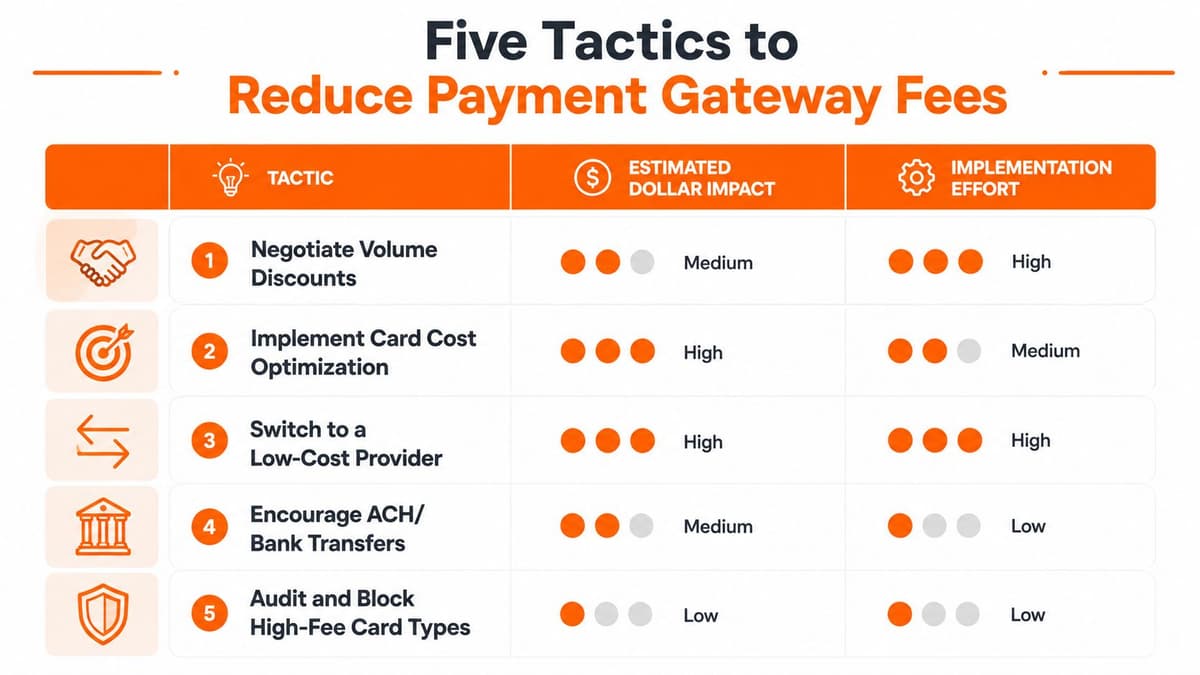
There's no magic lever here, just a set of trade-offs. If you want less payment cost, you either change the mix of payment methods, change how often you pay certain fees, or change the provider economics. I'd rank the options by dollar impact first, then effort. That's how founders should think about it.
#The five levers, ranked by real-world usefulness
| Tactic | Dollar Impact | Effort |
|---|---|---|
| Negotiate volume discounts | Medium | High |
| Implement card cost optimization | High | Medium |
| Switch to a low-cost provider | High | High |
| Encourage ACH or bank transfers | Medium | Low |
| Audit and block high-fee card types | Low | Low |
Implement card cost optimization means routing more volume toward lower-cost payment paths where you control the mix. Encourage ACH or bank transfers shifts some volume away from card rails entirely, which can materially change cost structure for the right customer base. Switching providers can lead to a lower blended rate, but migration risk is real and should be justified by the numbers.
#What each tactic actually does
Negotiating volume discounts helps when your processing volume is large enough that the provider wants to keep you. It's not glamorous, but it's a classic merchant move. The trade-off is time and influence.
Encouraging ACH or bank transfers is operationally easier and often lower effort. It can reduce cost, but it may also change buyer behavior, so the upside depends on how your customers pay today.
Auditing and blocking high-fee card types sounds tidy, but it can be too blunt. You can save money and still damage conversion if you get aggressive.
#What I'd prioritize first
Start with the levers that protect margin without creating a new operational headache. That means payment mix, settlement timing, and provider renegotiation before you get fancy with custom routing. If you need a broader benchmark for order economics while you do that math, the average order value guide helps you see where small basket sizes make fee drag worse.
The core lesson is this: a one-point improvement in payment cost can matter more than many minor optimizations elsewhere, as it applies to every paid order, not just a subset of traffic.
#Executing the Highest-Impact Fee Reductions on Shopify
Don't start with negotiation. Start with the changes you can ship inside Shopify this week. The fastest wins are usually the least dramatic ones, and they're the easiest to verify in your next payout cycle.
#Ship the low-friction changes first
Open your Shopify Payments settings and make sure lower-cost payment methods are enabled where they make sense for your customer base. That can include Shop Pay, Apple Pay, Google Pay, and local wallets. Then check whether you've turned on instant payouts, because faster settlement often comes with an extra cost that most founders can live without.
After that, review the last three months of chargebacks. You're looking for patterns, not just totals. If a product, traffic source, or geography keeps triggering disputes, that's a fee problem and a revenue protection problem at the same time.
#Use routing and geography when the platform supports it
If your gateway supports smart routing or multi-acquirer logic, test it with care. The goal is to direct traffic through the cheapest path that still keeps approval rates healthy. Review cross-border surcharge exposure by country, especially if one region is generating a lot of international card volume.
That's where many merchants miss money. They assume all card volume is equal, but geography and payment method mix change the actual cost.
#Renegotiate when you have leverage
At scale, the question becomes contractual. Ask your processor for volume-based pricing, compare settlement speed and approval performance, and revisit terms at renewal instead of accepting the same stack forever. If you split traffic across two gateways, do it because the blended economics justify the added complexity, not because the pricing page looked prettier.
Arlo is one option for merchants who want to keep payment and store performance inside a broader analytics layer. It provides payment gateway integrations through Shopify-connected setups and doesn't charge to set up the gateways it supports, which makes it easier to review fee impact alongside sales and customer signals in one place.
#A 30-Day Plan to Quantify and Prioritize Fee Reductions
Start with measurement, not action. In week one, pull three months of payout statements and calculate your effective fee rate, then tag every cross-border, chargeback, and refund line. In week two, remove avoidable cost by enabling low-cost wallets, turning off instant payouts, and tightening checkout so domestic cards aren't getting buried by unnecessary friction.
Week three is the negotiation pass. Benchmark your current terms against alternatives, ask your processor for a volume tier, and model the savings against contribution margin so you can see whether the change is worth the operational lift. Week four is monitoring, set a monthly fee review, define the effective rate you want to hold, and decide whether savings go straight into margin recovery or back into growth.
Here's the checklist I'd use:
- Measure first: pull statements, calculate effective rate, tag fee drivers.
- Cut easy waste: remove premium payout options and favor cheaper payment paths.
- Negotiate with evidence: go into renewal with your own payout math.
- Track monthly: don't let fees drift back up unnoticed.
A founder doesn't need perfect payment strategy to win here. You need a habit, a benchmark, and the discipline to treat fees like a controllable input cost instead of an unavoidable tax.
If you want a clearer read on where payment costs are hitting your store, install Arlo and use it to connect sales, payment mix, and margin signals in one weekly report. It's a practical way to spot where fees are compounding, and to decide what to fix before the next payout cycle rolls over.