Shopify vs Amazon: Which Is Right for Your Brand in 2026?
By Arthur Falcone · Founder of Arlo
You're probably in one of two situations right now.
Either you have a product that's ready to sell and you want revenue fast, so Amazon looks like the obvious move. Or you've already sold enough to realize the bigger question isn't where you can get your next order. It's where you can build a business that still has an advantage three years from now.
That's the core Shopify vs Amazon decision.
One path gives you access to a giant audience immediately. The other gives you control over your brand, your customer relationship, and your economics. Founders get this wrong when they treat it like a feature comparison. It isn't. It's a business model choice.
If you choose Amazon, you're plugging your product into someone else's demand machine. That can work very well, especially when speed matters more than brand depth. If you choose Shopify, you're building an asset you control, but you're also accepting the hard part: traffic is now your job.
Both paths can make money. Only one helps you own the customer relationship from day one.
#Table of Contents
- Introduction Choosing Your Path
- The Core Difference Rented Land vs Owned Property
- Comparing Costs and Profitability Scenarios
- Traffic Customers and Data Ownership
- Branding Conversion and User Experience
- Fulfillment and Logistics A Head to Head
- The Final Verdict A Decision Framework for Founders
#Introduction Choosing Your Path
Most founders start with the wrong question.
They ask, “Which platform is better?” The better question is, “What kind of company am I building?” If you're building a product-first business that needs fast access to buyers, Amazon is attractive for obvious reasons. If you're building a brand with repeat purchase potential, upsells, email retention, and long-term customer value, Shopify usually gives you the stronger foundation.
That difference affects more than your launch plan. It affects how you think about margin, marketing, retention, packaging, product pages, and even what your company is worth later. A business that owns customer relationships behaves differently from a business that depends on marketplace visibility.
Practical rule: If your strategy depends on repeat customers, merchandising, bundles, subscriptions, or post-purchase marketing, treat platform choice as a core financial decision, not an operations decision.
Some founders should start on Amazon. That's the truth. If your offer is simple, your category already has demand, and you don't have the team or budget to build traffic, Amazon can get you moving. But understand the trade. You're gaining reach by giving up control.
Others should skip Amazon entirely and build on Shopify from the start. That's usually the better call for differentiated products, premium positioning, or any founder who wants to build an audience they can reach without asking a marketplace for permission.
Use this article to make the decision like an operator, not a tourist. Look at customer ownership, fee structure, fulfillment, conversion environment, and the second-order effects that show up later when growth gets harder.
#The Core Difference Rented Land vs Owned Property
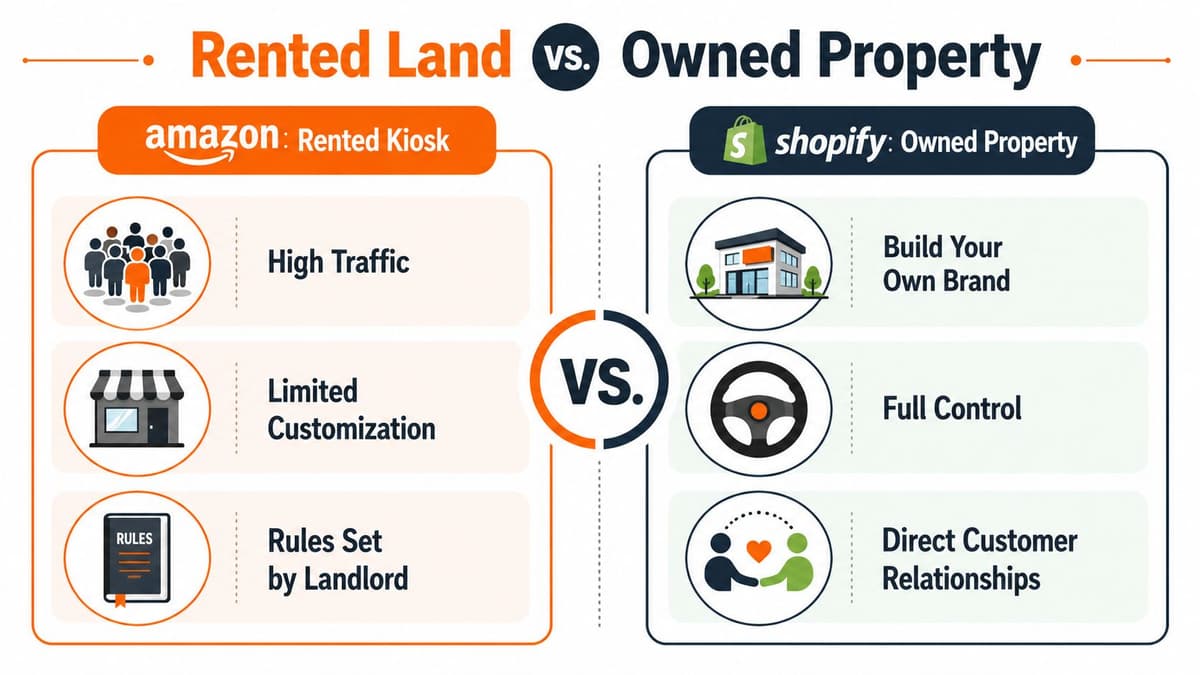
The cleanest way to understand Shopify vs Amazon is this: Amazon is rented land. Shopify is owned property.
On Amazon, you set up shop inside one of the biggest commerce environments on earth. According to RedTrack's Amazon vs Shopify comparison, Amazon has 310+ million active users, $790 billion in gross merchandise volume, and 2.54 billion visitors in September. The same comparison notes Shopify's full-year 2024 revenue was $8.88 billion, which makes the distinction obvious. Amazon is a marketplace. Shopify is infrastructure.
#Amazon gives you foot traffic, not ownership
Amazon solves a painful problem early. It puts your product in front of buyers who are already shopping. That's powerful. It's why founders get pulled in quickly.
But the platform relationship matters. You sell inside Amazon's interface, under Amazon's rules, in Amazon's customer environment. Your product may win the sale, but the platform owns the shopping context.
That changes your posture as an operator:
- You optimize for platform visibility: Listings, reviews, pricing, and marketplace rank matter more than story.
- You compete side by side: Your alternatives sit inches away from your product page.
- You inherit constraints: Brand presentation, customer communication, and checkout behavior sit inside a fixed system.
#Shopify makes you earn attention, then lets you keep it
Shopify is harder at the start and better later for the right business.
You don't get marketplace demand by default. You have to build traffic through paid media, organic search, creators, affiliates, community, or retention loops. But once a shopper enters your store, the relationship can become yours.
That's the key difference. Shopify lets you build a business around brand equity, not just transaction volume.
Selling on Amazon is often a demand-capture play. Building on Shopify is a demand-creation play.
If your long-term plan includes customer retention, premium positioning, cross-sells, product education, or content-led growth, owned property matters more than borrowed traffic. Founders who ignore that usually wake up later with sales but no durable brand.
#Comparing Costs and Profitability Scenarios
Run the math on a $50 product and the platform decision gets clearer fast. One path charges you heavily at the point of sale. The other leaves more room in the order, then asks you to earn the customer.
That is the actual profitability split.
Founders waste time comparing entry plans because monthly software fees are rarely what damages margin. The bigger question is where the business pays its tax. Amazon takes it through marketplace, referral, and fulfillment costs attached to each order. Shopify usually keeps platform costs lower per transaction, but you must fund traffic and retention yourself. Analysts at Onramp Funds and Easy Apps Ecom outline that pattern clearly.
#A fast comparison table
| Cost Component | Amazon (FBA Seller) | Shopify (Basic Plan + Shopify Payments) |
|---|---|---|
| Platform access | Professional seller account with a monthly subscription | Basic plan with a lower monthly starting cost |
| Core fee structure | Referral fees, fulfillment fees, storage fees, and often ad spend to hold rank | Subscription, payment processing, apps, and your own customer acquisition costs |
| Fulfillment costs | Usually baked into the FBA model and charged per unit | Depends on your warehouse, 3PL, carrier rates, and packaging setup |
| Estimated total cost per sale | Higher take rate per order in exchange for marketplace demand | Lower platform take rate per order before paid acquisition |
| Margin pressure as volume grows | Fees scale with every unit sold | Store costs stay more controlled, but marketing efficiency decides profit |
The second-order effect matters more than the fee line item. Amazon can produce revenue faster, but it also caps how much of that revenue becomes durable profit because the platform keeps collecting on every sale. Shopify puts more pressure on you upfront, but if you improve conversion, retention, average order value, and repeat purchase rate, more of that gain stays in your business.
Here is the rule I would use.
- Choose Amazon if you need fast validation, simpler operations, and immediate access to active buyers.
- Choose Shopify if you want margin control, stronger lifetime value, and a business that gets more efficient as retention improves.
- Use both if Amazon is your demand capture channel and Shopify is where you build your primary asset.
A lot of founders call Amazon traffic "free" because shoppers are already there. It is not free. You pay for that demand inside every order. On Shopify, acquisition is explicit. You can see it, test it, cut it, improve it, and build systems around it through email, bundles, subscriptions, upsells, and better attribution. If your team is building that engine, this guide on SEO and Google Ads for startups is a useful reference point.
One more point gets missed. Profit is not just what remains after fees. Profit is what remains after fees and what you can earn again from the same customer. That is why good ecommerce analytics discipline matters so much on Shopify. You are not just measuring CAC. You are measuring whether your store is becoming more efficient with each cohort.
Amazon is often the faster channel.
Shopify is usually the better business.
#Traffic Customers and Data Ownership
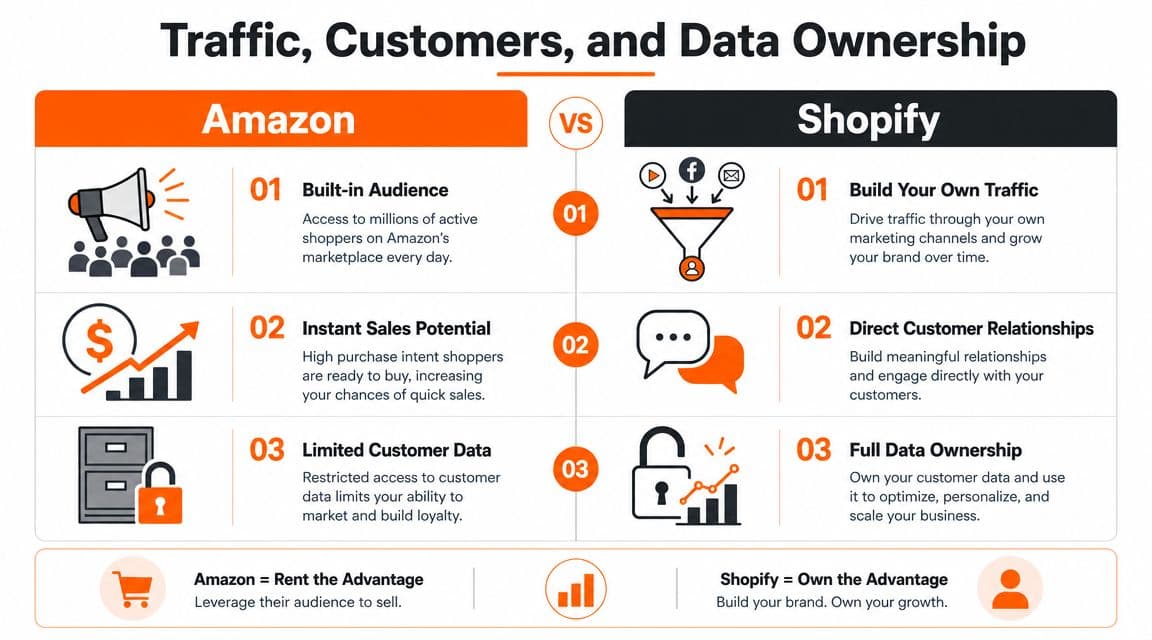
Amazon wins the traffic argument. Shopify wins the ownership argument.
If all you need is access to buyers with intent, Amazon is hard to beat. You can get demand without building an audience from scratch. For many founders, that's enough reason to start there.
#Borrowed demand versus owned demand
Amazon gives you exposure to shoppers already in buying mode. That's why commodity products, simple problem-solution items, and low-story categories can work well there. The platform is built for convenience.
Shopify is different. You have to create the visit before you can create the sale. That usually means some mix of search, paid social, Google Ads, creators, email capture, content, or partnerships. If you need help thinking through that mix, this practical guide to SEO and Google Ads for startups is a useful place to sharpen your acquisition plan.
The founders who succeed on Shopify understand one thing early: traffic is not a one-time launch task. It's an operating function.
Before you commit, answer these questions truthfully:
- Can you generate demand? If nobody on the team can run paid media, build content, or manage lifecycle marketing, Shopify gets harder.
- Does your product need explanation? The more your product benefits from education and story, the more your own site matters.
- Is repeat purchase part of the model? If yes, traffic acquisition only makes sense if retention follows.
A smart store doesn't just buy clicks. It turns first purchases into a customer file you can market to again. That's one reason operators spend serious effort on advertising in e-commerce with a retention mindset, not just a first-order mindset.
#Why customer data changes the whole business
Shopify takes the lead.
According to Proactive AI's Shopify vs Amazon analysis, Shopify gives merchants full customer email and purchase-history access and supports custom checkout, upsells, and email and SMS flows. Amazon does not provide direct customer email access and keeps checkout and communication inside its marketplace layer.
That changes everything after the first sale.
On Shopify, you can build welcome flows, win-back campaigns, replenishment reminders, post-purchase cross-sells, and segmented offers. You can learn which products create the best repeat behavior. You can improve lifetime value because you know who bought.
On Amazon, the sale is often the end of the usable relationship.
The platform that gives you the customer record gives you the better chance to build a business, not just a sales channel.
If your brand depends on retention, subscriptions, community, or product ecosystems, this part of Shopify vs Amazon isn't close. Shopify is the stronger choice.
#Branding Conversion and User Experience
Amazon and Shopify optimize for different kinds of trust.
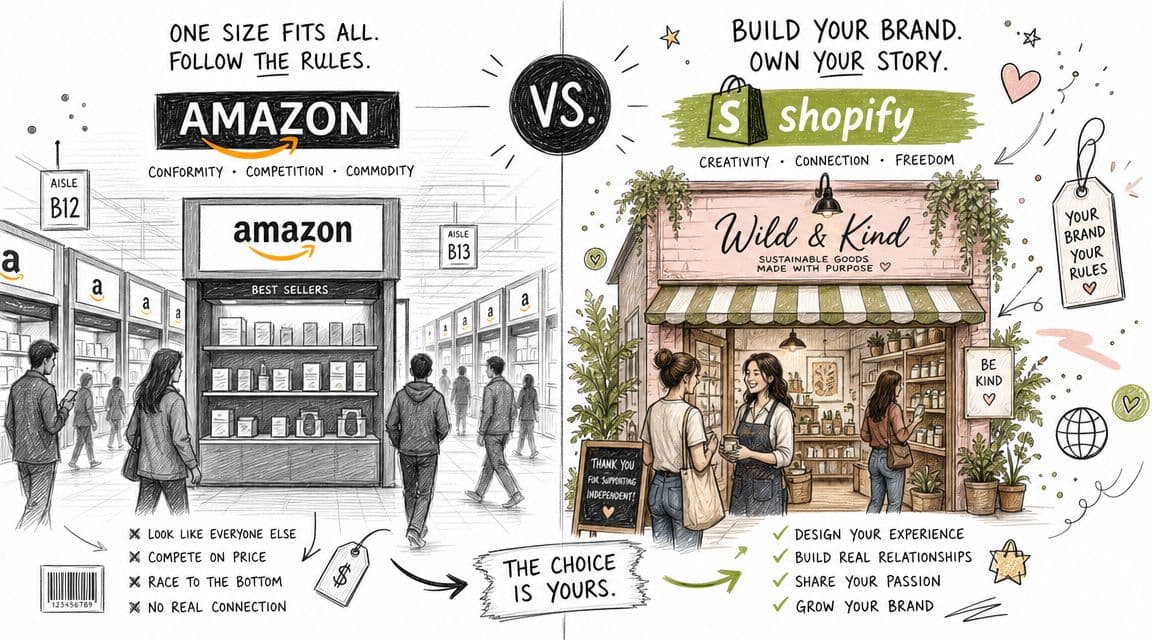
Amazon builds trust through familiarity. Shoppers know the layout, the checkout flow, the review system, and the delivery expectations. That consistency removes friction. It also flattens your brand.
#Amazon converts for convenience
Amazon's product pages are restrictive, but that restriction has an upside. Buyers don't need to learn a new site every time. The environment is standardized and familiar.
That makes Amazon especially effective when your product fits one of these conditions:
- It's straightforward: The shopper understands the value quickly.
- It's price-comparable: Reviews and delivery speed can close the deal.
- It's not heavily story-dependent: The product doesn't require much education, identity, or differentiation through design.
For founders selling practical, low-emotion purchases, that can be enough. You may not need a rich branded experience if the customer just wants the item fast and trusts the platform already.
The limitation is obvious once you want to do more than convert the click. Your store experience doesn't really feel like your store. It feels like a listing.
#Shopify converts through control
Shopify gives you the opposite environment. You can shape the page structure, navigation, merchandising, bundles, upsells, cart experience, and post-purchase flow around your brand and customer.
That flexibility matters when the product needs context. Apparel, beauty, wellness, premium food, gifting, subscription products, and design-led categories usually benefit from a storefront that can carry story, trust, and positioning beyond bullet points.
Ask yourself:
| Founder question | If the answer is yes | Better fit |
|---|---|---|
| Does the product need storytelling to justify the purchase? | You need room for content, education, and positioning | Shopify |
| Is visual identity part of why people buy? | Design and feel influence conversion | Shopify |
| Is the item mostly a utility purchase? | Familiar marketplace UX may be enough | Amazon |
| Do you want post-purchase upsells and tailored flows? | You need more control over the customer journey | Shopify |
Good Amazon listings sell products. Good Shopify stores sell products and strengthen brand memory at the same time.
That's the hidden advantage. On Shopify, every page can improve conversion and reinforce why the customer should come back to you specifically. On Amazon, convenience belongs to the marketplace first and your brand second.
If you're building something distinctive, generic UX becomes a tax.
#Fulfillment and Logistics A Head to Head
Choose your fulfillment model the same way you choose your sales channel. Ask who owns the customer experience after the order is placed.
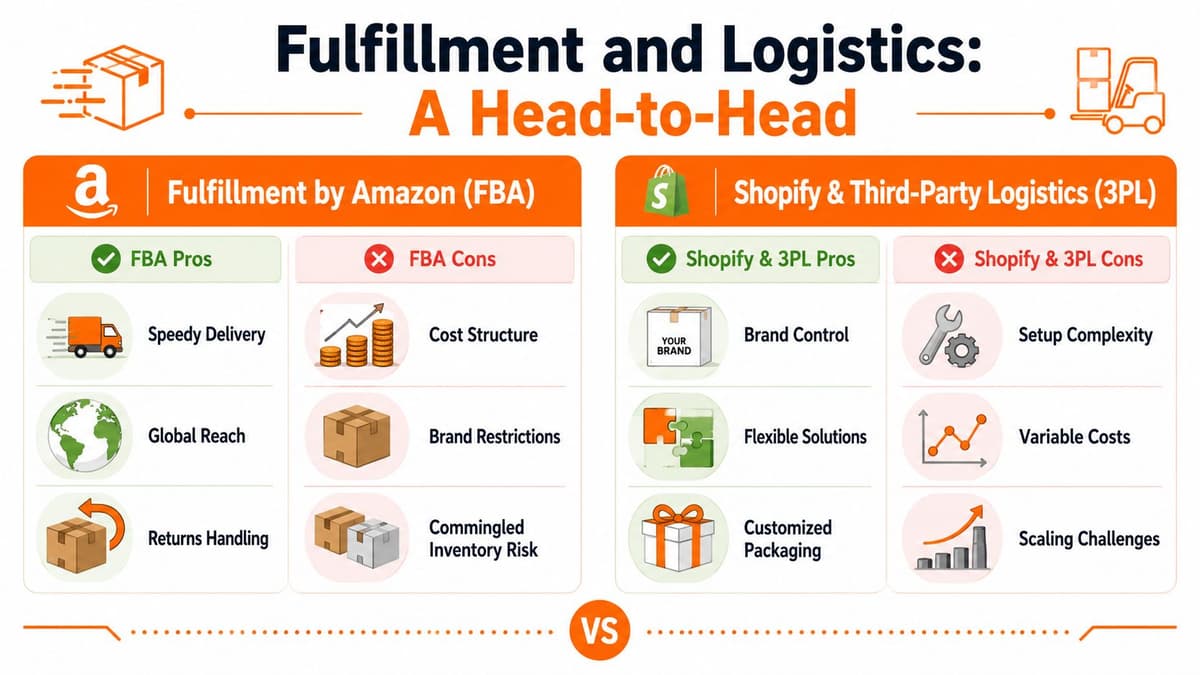
Amazon FBA wins on convenience. You send inventory in, Amazon picks, packs, ships, and handles a delivery experience shoppers already trust. If you need operational simplicity fast, that matters.
#When FBA is the right answer
FBA is the right call when fulfillment should be invisible. Your product is standardized, easy to ship, and bought for function more than presentation. In that setup, speed and consistency usually beat customization.
Use FBA if these are true:
- Prime shipping helps close the sale
- Your team does not want to build warehouse and shipping operations
- Packaging is not part of the product value
- You care more about volume than post-purchase brand experience
The trade is simple. FBA removes work, but it also turns fulfillment into another layer of rent. Fees stack up. Packaging is generic. The shipment feels like Amazon's order, not yours.
That second-order effect matters. A generic box does not build memory, trust, or affinity. It gets the product there, then the relationship stops.
#When Shopify and a 3PL win
A Shopify store paired with a 3PL is better when fulfillment is part of the brand. You control the box, inserts, sequencing, bundle logic, return rules, and the small details that turn a first order into a second one. That control supports retention, which is where owned commerce gets stronger over time.
If you are building for repeat purchase, premium positioning, gifting, subscriptions, or category education, read this guide to ecommerce growth strategy. Fulfillment is not a back-office function in those businesses. It is part of the offer.
A 3PL also gives you flexibility Amazon does not. You can switch partners, set custom kitting rules, support fragile or unusual products, and design an unboxing experience that feels deliberate. That is hard to value on a spreadsheet and expensive to lose in the market.
Use this rule:
- Pick FBA if logistics simplicity is your advantage
- Pick Shopify plus a 3PL if the customer experience continues after checkout
Founders often underrate that last point. The package is one of the few physical moments your brand gets. If it feels generic, you gave away another chance to be remembered.
#The Final Verdict A Decision Framework for Founders
You don't need a platform. You need a clear answer to what kind of advantage you want.
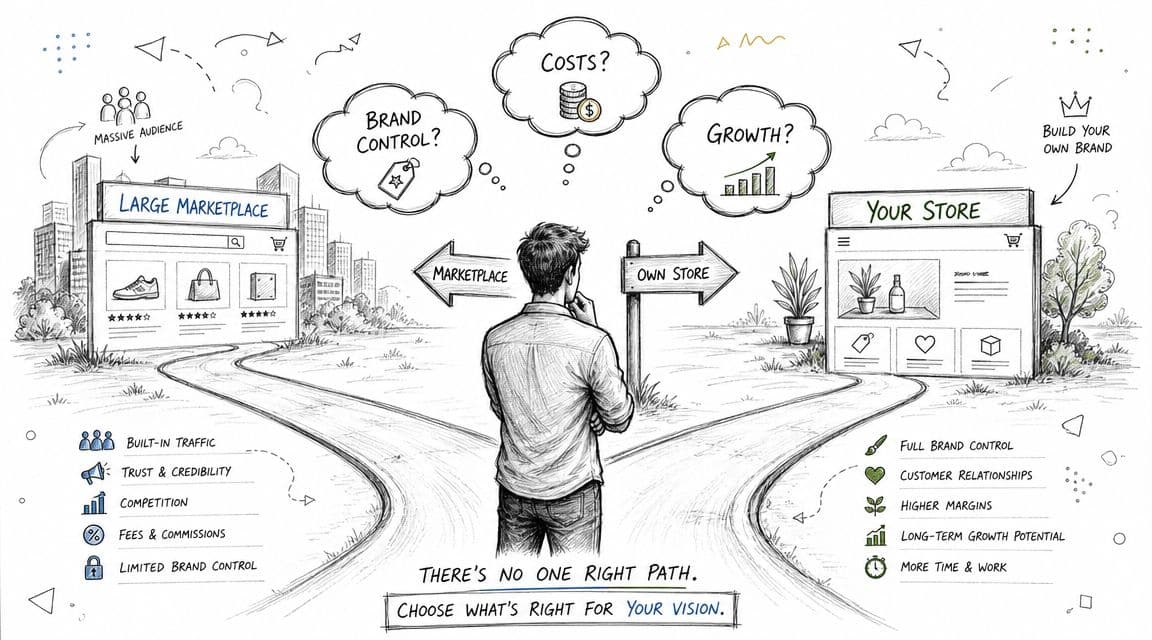
If you choose Amazon, you're buying access to demand and accepting lower control. If you choose Shopify, you're choosing harder acquisition upfront in exchange for stronger ownership later. That's the trade. Don't overcomplicate it.
#Choose Amazon if
Amazon is the better answer when speed matters more than ownership.
Pick it if these statements sound like your business:
- You need sales faster than you need brand depth
- Your product is simple, utilitarian, or easy to compare
- You don't have the team to build traffic yet
- You want a lower-lift launch path operationally
- You're validating demand before investing in a full DTC brand
This is not a bad choice. It's a practical one. Many founders should start here. Just don't confuse channel success with brand ownership.
#Choose Shopify if
Shopify is the better answer when you want to build an asset, not just process orders.
Pick it if these statements fit:
- You want to own the customer relationship
- Your product benefits from story, education, or positioning
- You care about email, SMS, upsells, bundles, and retention
- You want better control over margin structure
- You're building a brand with repeat purchase potential
For most founder-led DTC brands, this is the stronger long-term decision. It forces you to build demand, but it also gives you something worth keeping once that demand arrives.
One more practical note. You don't have to treat this as ideology. Some brands start on Amazon for validation and move harder into Shopify as brand and retention become more important. What you should not do is drift into Amazon by default and then realize too late that you rented your growth.
If you're building on Shopify, the next discipline is execution. You need to read your store data clearly, decide what matters, and act before problems compound. A solid e-commerce growth strategy only works if your team can turn signals into decisions every single week.
If you run a Shopify brand and want clearer direction from your numbers, Arlo turns your store data into a concise weekly action plan. Instead of bouncing between dashboards, you get plain-English guidance on what changed, why it matters, and what to do next so you can grow revenue with less guesswork.