About Us of a Company: How to Write One That Converts
By Arthur Falcone · Founder of Arlo
The most repeated advice about the About Us page of a company is to "tell your story" and "be authentic." That advice produces pages nobody acts on. A visitor who lands there isn't looking for a memoir. They're deciding whether a small brand they've never heard of deserves their card number.
Treat the page as a decision page and the writing gets easier. Every block earns its place by removing one specific doubt: what you sell, who it's for, whether the claims hold up, who's accountable, and what to do next. Below is the structure I'd use, with copy templates, worked Shopify examples, and a test you can run on each block before you hit publish.
#Table of Contents
- The Five Blocks Every About Us Page Needs
- How to Define Purpose and Audience Before Drafting
- Write the Headline, Origin Story and Founder Voice
- Write Team, Values and Call to Action Copy
- Turn Claims into Proof and Data Trust
- Fix Common Mistakes and Publish This Week
#The Five Blocks Every About Us Page Needs
One rule shapes every block: each part of the page answers one question a buyer is already asking. If a paragraph doesn't answer a question, it's decoration.
Run the finished page through five questions, in the order a skeptical reader asks them:
- What does this sell? The product category should be obvious from the first line, not inferred from a lifestyle photo.
- Who is it for? A named type of person, not "everyone who cares about quality."
- Why should I trust it? Something checkable: a name, a number, a date, a link.
- Who is behind it? A real person with a face and a name attached to the promises.
- What do I do next? One obvious action, not a menu of six.
#The blocks in reading order
| Block | Question it answers | Example opener |
|---|---|---|
| Headline | What do you sell, and to whom? | Hand-poured candles for people who get headaches from synthetic scent |
| Origin story | Why does this brand exist? | After three years of buying candles that gave me headaches, I started pouring my own |
| Social proof | Can I believe the claims? | Maya in Austin says her headaches stopped within a week of switching |
| Team and values | Who is behind it, and what do they stand for? | Two founders, one kitchen, and a rule that we never add fragrance we cannot name |
| Call to action | What should I do next? | Shop the bestseller or read the full ingredient list |
Keep the headline between 8 and 15 words, the origin story around 150 to 250 words, and the proof block to three to five items. Those limits aren't arbitrary. They force you to pick the strongest evidence instead of listing everything you have.
A logo wall of press mentions doesn't do the work founder-led brands need it to do. A press logo says a publication mentioned you once. A founder's face and name say a specific person will answer the email when the order goes wrong, which is the actual risk a first-time buyer is weighing.
Score your current page against the five questions before you rewrite a word. Mark each answer present, vague, or missing, and rewrite only the vague and missing ones first.
Most pages I'd audit score three out of five. The two failures are almost always the same: no named customer, and no next step.
#How to Define Purpose and Audience Before Drafting
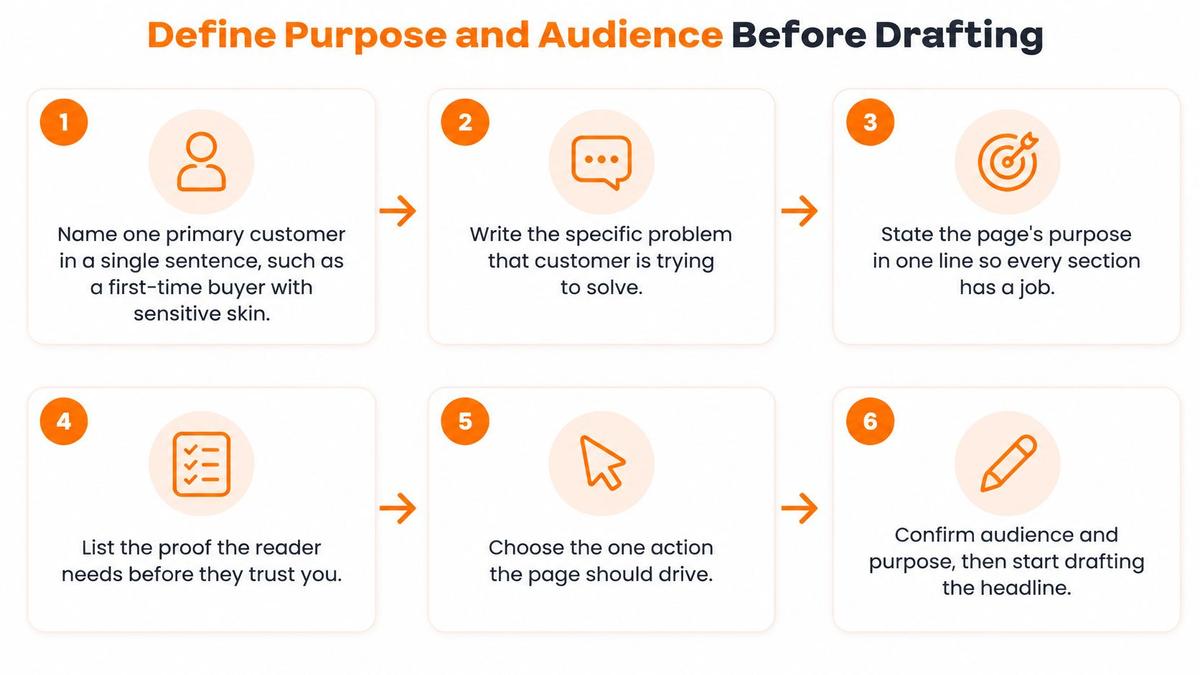
Everything downstream depends on one decision: who this page is for. Write for "anyone who might buy" and you'll produce the mush that fills most About Us pages. Work these six steps on paper before you open the theme editor.
#Work the six steps in order
-
Name one primary customer in a single sentence. Not a demographic range. Something like "a first-time buyer with sensitive skin who's been burned by a 'natural' label before," or "a repeat buyer who reorders every 60 days and wants to know the formula hasn't changed." Pick one. The other customer gets a different page.
-
Write the problem in that customer's words. Open your product reviews, your support inbox, and the first ten answers from any post-purchase survey. Copy phrases verbatim into a document. If three people wrote "it doesn't sting around my eyes," that phrase belongs on the page, not your paraphrase of it.
-
List the three objections that stop the purchase. For a small brand they're usually price, trust in an unknown company, and whether the product works for the buyer's specific situation. Write each objection as a question in the customer's voice, then assign it to a block. Objection three is why the ingredient list link matters more than another paragraph about passion.
-
Write the core message as one sentence. We make [product] for [customer] so they can [result]. Example: we make fragrance-free cleanser for adults with reactive skin so they can wash their face without a flare-up. If you can't fill the brackets, you don't have positioning yet, and our guide to competitive positioning for small brands is the better place to spend an afternoon.
-
Pick three adjectives for the voice, then delete the ones a competitor could also claim. "Premium," "passionate," and "sustainable" survive on every Shopify store in your category. "Blunt," "clinical," and "funny" constrain how you write a sentence.
-
Test the message on someone outside the business. Say it once, then ask them to repeat it back. If they can't do it in ten seconds, the sentence is too long or too abstract, and rewriting it is cheaper than rewriting the whole page later.
#A scenario worth copying
Say a founder runs a two-person skincare brand and assumes her founding story is the hook. She reads her reviews properly and finds that the phrase appearing most often is a dermatologist's recommendation. That recommendation becomes the headline proof, and the founding story drops to a supporting paragraph. The customer told her what the page was about.
Before drafting, you should have three things written down: the customer sentence, the core message, and the three objections. Nothing else is required to start.
#Write the Headline, Origin Story and Founder Voice
Founders get these two blocks wrong in the same way: they write about themselves. The headline describes a feeling ("crafted with intention") and the story describes a journey. Neither tells a buyer what's in the box.
#The headline formula
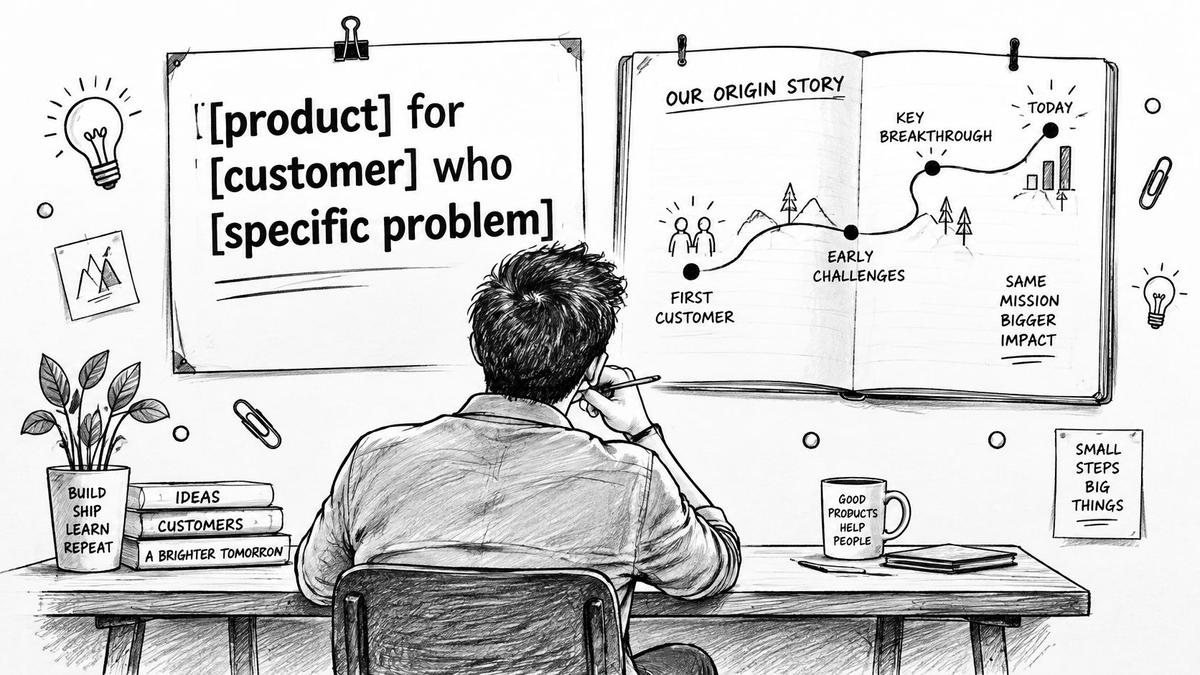
Use [product] for [customer] who [specific problem], and keep it under fifteen words.
- Supplement brand: "Magnesium glycinate for shift workers who can't fall asleep at 9am."
- Homeware brand: "Linen sheets for hot sleepers who wake up damp at 3am."
Both name a product, a person, and a problem in one line. If you want more variations to work from, the patterns in our headline writing examples transfer directly to this block.
#Five beats, not an essay
Write the story as five short beats. Each has a job and a length guide.
- The everyday frustration that started it. One or two sentences. "Every candle I bought gave me a headache by hour two."
- The alternatives that failed, and why. Two sentences, naming the category rather than a competitor. "The 'clean' ones listed 'fragrance' and nothing else. I couldn't find out what I was breathing."
- The first decision you made differently. Two or three sentences, with a concrete detail. "I started pouring my own in a rented kitchen in Portland and wrote every material on the label."
- What changed for the customer. One or two sentences, in their terms. "You can read the full list before you buy, and light it in a small room without opening a window."
- The commitment you won't break. One sentence. "We never use a fragrance we can't name."
That structure lands near 200 words and reads in under a minute. It also gives you natural paragraph breaks, which matters more than most founders think on a phone screen.
#Why operational detail beats inspiration
Nielsen Norman Group's research on About Us content found that users are skeptical of corporate jargon, stock photography, and selectively curated testimonials, and that they check a company's claims against third-party information before judging credibility. The gap in most pages is a plain explanation of how the company creates value for a specific customer.
That's an argument for showing your reasoning, not just your mission. If you sell software, show what the product does with a customer's inputs. We built Arlo for founders who don't have a marketing background, so everything is written in plain language rather than jargon and acronyms, and that sentence does more work on an About Us page than any claim about being "AI-powered." A capability claim without visible reasoning invites doubt.
#Founder voice and microcopy
Write in the first person. Use short sentences. Name a real place, a real number, or a real cost, because those are the details a competitor can't copy. Then read the draft aloud, and any sentence you'd be embarrassed to say to a customer gets rewritten.
Put the founder's name beside the first paragraph, not in a footer. End the story with a button that names an action, such as Shop the bestseller, rather than "Learn more."
The cut-it rule: if a sentence could appear on any competitor's About Us page unchanged, cut it or make it specific.
#Write Team, Values and Call to Action Copy
Four short blocks, four templates. Fill them in and stop editing.
- Team. Template: name, role, one specific thing they do to the product. Example: "Priya Shah, co-founder, tests every batch of our bamboo sheets herself before it ships." The specific action is the proof, not the job title.
- Values. Template: "We [decision], even though [cost]." Example for a hypothetical bedding brand: "We refuse discounts deeper than 20 percent, even though it costs us Black Friday volume, so prices stay the same and we say so on every product page." A value without a visible cost is a slogan.
- Social proof. Template: customer first name, city, specific result with a timeframe. Example: "Dana, Denver: my sleep mask cut my nap time in half within two weeks." Ask permission, keep the wording close to what they wrote, and link the review.
- Call to action. Action verb plus outcome: "Shop the bestseller," "Read the ingredient list." Never "Learn more" or "Submit." Place one button after the story and one after the proof, and make both point at the same collection so you're not splitting the decision.
For sentence-level polish, the before-and-after pairs in our examples of good sentences show how much weight a single concrete noun carries.
A worked page for a two-person skincare brand, in reading order: headline (11 words), origin story (within the 150 to 250 word range), three proof items (60 words total), team and values (80 words), closing button (4 words). Roughly 350 words, one scroll and a half on mobile, and every block answers a question.
#Turn Claims into Proof and Data Trust
Adjectives are cheap and buyers know it. "Ethically made," "premium quality," and "customer-obsessed" cost nothing to write and nothing to verify, which is exactly why they persuade no one. Build a proof inventory instead, and let each claim point at something a stranger can check.
#The proof inventory
- Named reviews. First name and city, with a link to the review on your product page or a third-party platform. Anonymous quotes read as invented.
- One result with a number and a timeframe. A single specific outcome beats five vague ones. State the timeframe and don't generalize one customer's experience into a promise.
- A real photo of the founder in the workspace. Kitchen, garage, warehouse, whatever it is. The messy version outperforms the studio version because it's harder to fake.
- One third-party mention or certification, linked. Link to the actual article or registry entry, not to your own press page.
- Values written as decisions with a visible cost. Refusing deep discounts, publishing every supplier name, or accepting returns past a normal window. Each one is a claim a buyer can hold you to.
#Answer the four data questions
Trust isn't only about product claims. In the Thales Digital Trust Index, 63% of consumers said too much responsibility for data protection is placed on them, and separate 2025 research in the same report found only 49% were satisfied with companies' data-transparency practices. A small brand that answers data questions plainly is doing something most of its competitors avoid.
Publish a short block with four answers, in this order:
- What you collect. Name the fields: email, shipping address, order history. Say whether you store payment details or whether your payment processor does.
- Who can see it. Name the roles and the tools. "Two founders and our email platform" is an answer. "Trusted partners" isn't.
- How long you keep it. Give a period or a rule, such as keeping order records for as long as returns are accepted.
- How to request deletion. One inbox, one sentence, one promise you can keep. We publish a privacy contact at privacy@meetarlo.ai for exactly this reason, because a customer shouldn't have to hunt for a way to ask.
Skip the badge collage. A row of security logos tells a buyer nothing about what happens to their address.
For every claim on the page, ask what evidence would convince a skeptical buyer. Then either show that evidence or delete the claim.
Trust grows from specifics. It doesn't grow from adjectives, and no amount of warm copy substitutes for a name, a date, or a link.
#Fix Common Mistakes and Publish This Week
The most common failure is a story about the founder with no customer in it. The reader learns where you went to school and never learns whether the product suits them. Everything else on this list is a variation of that same mistake.
| Symptom | Likely cause | Fix |
|---|---|---|
| Reads like a founder bio | Story is about the founder, not the buyer | Start each paragraph with what the customer gets |
| Visitors leave without clicking | Headline names no product or customer | Rewrite the headline as product for customer who has this problem |
| Claims feel empty | Adjectives with no proof behind them | Swap each adjective for a number, a name or a date |
| Team photos look generic | Stock images used in place of real people | Replace them with photos of the founders at work |
| Nowhere to go next | Story ends with no button | Add one button after the story and one after the proof |
| Long, dense blocks | Story written as one essay with no beat structure | Cut to five beats with short paragraphs |
Two quick rules cover most of the table. Write every button as an action with an outcome. If the story runs past 250 words, cut it back to the five beats rather than trimming sentences at random.
A revision looks like this: "We started in 2019 with a lot of passion" becomes "We make sleep masks for shift workers who cannot nap in daylight." The customer sentence moves above the founding date, and the date survives as one clause lower down.
#The publishing checklist
- Read the page aloud and time it. Aim for under three minutes. Anything longer is a page buyers skim, and skimmers miss your proof.
- Run the five-question test. Fix any question the page doesn't answer before you touch the wording of the ones it does.
- Replace stock photos with real founder or team photos. Phone photos in the actual workspace are fine.
- Click the call-to-action button yourself. Confirm it lands on a product or collection page, not the homepage.
- Set a 30-day check in Shopify analytics. Track sessions on the About Us page, the share of those visitors who reach a product page, and add-to-cart rate for visitors who came through it. Most merchants don't look at this: in a 2025 survey of 500 established Shopify merchants across six English-speaking markets, 77% said they track total revenue while fewer than half track conversion rate, as Shopify reported.
- Schedule a quarterly review. New reviews and product changes date old proof, and a page that named last year's bestseller sends people to the wrong product.
If you'd rather see which pages move revenue without building the report yourself, Arlo is an AI marketing analyst for Shopify stores built for founder-led DTC brands, and our weekly report ranks actions by dollar impact so the About Us page competes for your attention against checkout and email fixes. The checklist works in Shopify analytics alone.
Publish this week even if the page is imperfect. A live page with four solid answers beats a draft with five perfect ones, and a month of data tells you which block to rewrite next.
Rewriting your About Us page is one decision among dozens, and the hard part is knowing whether it deserves this week's hours. Arlo turns your Shopify data into a weekly plain-language report that explains what changed, why it matters, and what to do next, with each action ranked by urgency and dollar impact. Visit Arlo to see how your store's pages and funnels stack up before you spend another evening guessing.