How to Write Headlines That Drive Clicks
By Arthur Falcone · Founder of Arlo
You've got a headline that sounds sharp, maybe even clever. Then the numbers come in. The Meta ad earns attention, but the product page stalls. The email subject line gets opened, but few people click. A different headline feels perfect for the homepage, yet says almost nothing to a shopper who's already comparing variants and shipping details.
That's the central problem with learning how to write headlines for ecommerce. There isn't one universal winner. The strongest headline matches the customer's intent, the channel's job, and the proof available behind the promise.
#Table of Contents
- Research the Benefit Before You Write a Single Word
- Proven Headline Formulas for Ecommerce
- Adapting Headlines Across Email Ads and Product Pages
- Templates and Swipe Examples You Can Use Today
- Testing Headlines with Real Data
- Common Headline Mistakes That Kill Conversions
#Research the Benefit Before You Write a Single Word
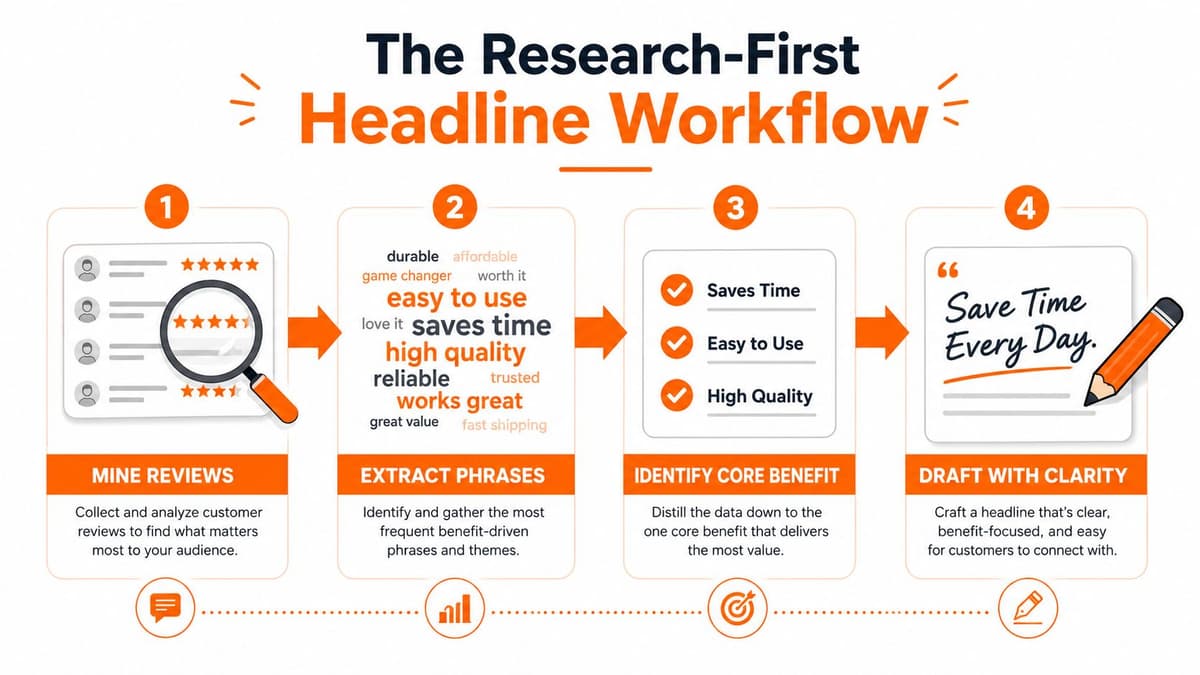
Most founders open a blank headline field and start polishing language. That's backwards. Before writing, find the customer outcome people already care enough to describe in their own words.
Start with reviews, support tickets, survey responses, product questions, and social comments. Look for repeated phrases, especially the ones that describe frustration before purchase or relief afterward. A bedding brand might discover that shoppers rarely talk about fabric composition first. They talk about waking up overheated, fighting with a partner over blankets, or wanting a bed that feels comfortable without looking messy.
#Turn customer language into ranked benefits
Collect the phrases without rewriting them immediately. Then group them into jobs-to-be-done, such as:
- Prevent a recurring problem: Stop overheating, leaking, pilling, or running out.
- Create a desired experience: Feel supported, sleep comfortably, or make a routine easier.
- Reduce purchase anxiety: Know the product won't be too firm, too strong, too complicated, or difficult to return.
- Signal identity: Choose a product that reflects a customer's values, taste, or lifestyle.
Score each benefit on three qualitative dimensions: emotional intensity, specificity, and evidence. “Premium quality” is broad and weakly differentiated. “Stay cooler through the night without changing your bedding routine” is more concrete, while reviews, product demonstrations, or a clear guarantee can make it credible.
A skincare brand might begin with an ingredient-led headline such as “Bakuchiol Serum for Daily Skincare.” After reviewing more than 200 Sephora reviews, the stronger direction could become “Smoother-Looking Skin Without a Complicated Routine.” The second version leads with the experience customers describe, not the internal product specification.
Practical rule: If a headline sounds intelligent but doesn't tell the shopper what changes for them, it hasn't earned the space.
#Find the gap competitors leave open
Read competitor homepages, paid ads, collection pages, and reviews. Don't copy their claims. Identify what they avoid saying, what customers still complain about, and which benefits appear repeatedly without meaningful proof.
For product-description research, the guide on how to write bedding product descriptions that convert is useful context because it treats product copy as a customer-outcome problem rather than a list of specifications. Your headline should make one primary promise, then let the supporting copy explain features, proof, and objections.
Write five to ten benefit statements before drafting headlines. Rank them by customer urgency and your ability to substantiate them. The winning benefit is usually the one that is both emotionally meaningful and specific enough to distinguish your offer.
#Proven Headline Formulas for Ecommerce
Formulas help when the research is solid. They provide structure, but they shouldn't replace customer language or turn every brand into the same collection of polished clichés.
Headline length has measurable performance implications. A BuzzSumo analysis of 100 million articles found that the most-shared stories had an ideal headline length of 11 words and 65 characters (BuzzSumo's headline study). The same source reports average lengths of 11.2 words for PR Newswire headlines and 8.6 words for The New York Times, a 37% difference. The American Press Institute has also summarized guidance favoring web headlines of 8 words or fewer for quick comprehension.
Here are five structures worth testing:
- Specific outcome promise: “Sleep Cooler Without Replacing Your Entire Bedding Set.” This works when the result is easy to understand and the product can support it.
- Curiosity with proof: “The Coffee-Brewing Change Our Customers Keep Mentioning.” Curiosity earns attention, but proof in the next line must resolve the gap.
- Objection-handling opener: “Supportive, Not Too Firm.” This is particularly useful for mattresses, footwear, skincare, and supplements where perceived risk blocks purchase.
- Social proof anchor: “The Daily Face Serum Customers Keep Reordering.” The structure uses social validation, but only works when the page makes the evidence visible.
- Urgency plus benefit: “Get Your Cold-Brew Starter Set Before the Seasonal Offer Ends.” Urgency should clarify a real condition, not manufacture panic.
The HubSpot analysis summarized in its data-driven title and headline research found that bracketed clarifications produced a 112% higher conversion rate than headlines without them. It also found that 81–100 character headlines produced the highest click-through rate, while 21–40 character headlines produced the best post-click engagement and conversion. That points to a funnel-stage trade-off. Longer headlines can earn the click by adding context, while shorter on-page headlines can reduce friction after arrival.
| Formula Type | Avg. CTR Lift | Best Use Case | Psychological Trigger |
|---|---|---|---|
| Specific outcome promise | Test rather than assume | Product pages and landing pages | Cognitive ease |
| Curiosity with proof | Test rather than assume | Meta ads and editorial content | Information gap |
| Objection handling | Test rather than assume | Product pages and retargeting | Risk reduction |
| Social proof anchor | Test rather than assume | Email and product pages | Social validation |
| Urgency plus benefit | Test rather than assume | Promotions and recovery flows | Loss aversion |
For more examples of how structure and clarity shape commercial copy, review good advertising copy. Treat every formula as scaffolding. Replace generic variables with the exact audience, outcome, proof point, and buying context you found during research.
#Adapting Headlines Across Email Ads and Product Pages
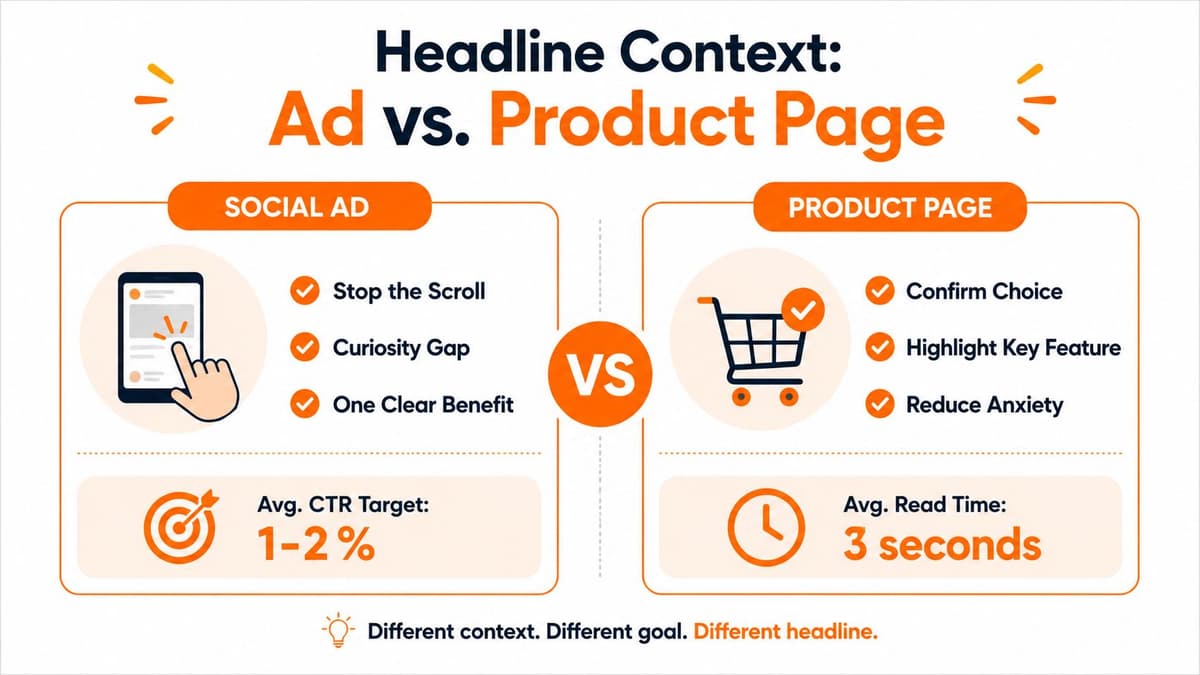
A Meta ad headline has one immediate job: earn attention and motivate the click. A product-page headline has a different job: confirm that the visitor has arrived at the right offer and make the next decision easier. Reusing the same sentence across both surfaces often creates a mismatch.
Consider a premium coffee brand with one core value proposition, better-tasting coffee with less effort:
- Meta ad: “Café-Quality Coffee Without the Barista Routine”
- Email subject line: “Your easier morning cup is ready”
- Product page title: “Single-Origin Coffee Pods for Rich, Café-Style Flavor”
The ad uses contrast and aspiration to stop the scroll. The email subject line feels personal and leaves room for preview text to supply the product detail. The product title becomes more explicit because the shopper needs confirmation, not another tease.
#Match the message to intent
Use the channel to decide what information belongs in the first line:
- Paid social: Lead with one benefit, a recognizable problem, or a curiosity angle. The creative carries visual proof, so the headline can stay compact.
- Email: Write for the inbox context. The subject line must work without reliable visual support, while preview text can complete the thought.
- Product page: Name the product and its most important differentiator. Shoppers need reassurance that the click delivered what the ad promised.
- Collection page: Help visitors choose between products. Emphasize the shared category benefit, then use product cards to introduce differences.
Search display adds another constraint. NPR's guidance recommends headlines that are clear, conversational, keyword-aware, and able to stand alone for readers and Google, with 50–60 characters often recommended for SERP display (NPR's digital headline guidance).
Don't optimize every channel for click-through rate alone. A provocative ad may win the click but create a weak product-page conversion rate if the visitor expected a different benefit. The best workflow keeps the core promise consistent, then changes the emphasis, specificity, and emotional temperature for each surface. A practical guide to the ad-specific version of this work is Facebook ad copywriting.
#Templates and Swipe Examples You Can Use Today
A swipe file is useful when it captures the mechanism behind a headline, not just the wording. Store the audience, benefit, proof, objection, channel, and result beside each example. Otherwise, you'll collect attractive sentences without learning when they work.
| Template Formula | Example | Best Channel |
|---|---|---|
| Outcome without objection | “Comfortable Support Without the Too-Firm Feel” | Product page |
| Proof-led curiosity | “Why Customers Keep Packing This in Their Carry-On” | Meta ad |
| Launch benefit | “Meet the Easier Way to Make Your Morning Coffee” | |
| Seasonal urgency | “Your Cooler Summer Sleep Starts Before the Offer Ends” | Email and landing page |
| Abandoned-cart reassurance | “Still Thinking About a Better Night's Sleep?” | Recovery email |
| Upsell benefit stack | “Add More Comfort, Protection, and Convenience to Your Order” | Cart and post-purchase flow |
#Adapt the variables before publishing
For a product launch, replace a vague announcement with a customer result. “Our new moisturizer is here” becomes “Meet the daily moisturizer for softer-feeling skin without a heavy finish.” The formula is benefit plus a meaningful product distinction.
For abandoned-cart recovery, address uncertainty rather than repeating the product name. “Forgot something?” is easy to ignore. “Still deciding? See why this fit works for sleepers who dislike a firm mattress” gives the reader a reason to return.
Numbers can add precision when they're truthful and relevant. One headline guideline recommends specific numerals and notes that odd numbers can outperform even ones, with examples such as 101 or 99 outperforming 100, and 65 outperforming 75 (guidance on numbers in headlines). Use that principle for real product quantities, shipping promises, timeframes, or discounts. Don't add a number just to make a line look more engineered.
Before using any template, check four things:
- Core benefit: Does the first phrase state what the shopper gets?
- Specificity: Can you replace a broad adjective with an actual feature, outcome, or timeframe?
- Emotional fit: Does the emotional trigger match the buyer's concern?
- Channel fit: Would this line make sense in an ad, inbox, or product comparison?
Templates accelerate drafting. Customer evidence decides the final version.
#Testing Headlines with Real Data
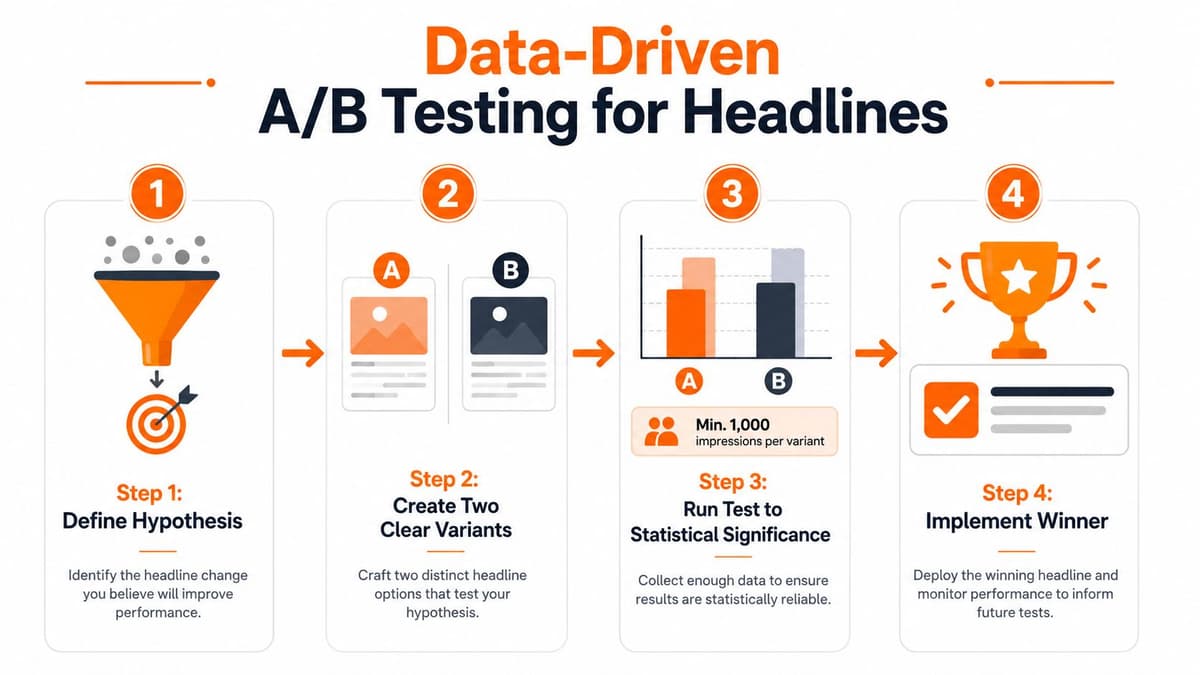
Headline testing fails when teams change the headline, image, offer, audience, and landing page at the same time. You may see a better result, but you won't know which change caused it. A clean test starts with one hypothesis, such as, “A direct cooling benefit will outperform an ingredient-led message for warm sleepers.”
#Choose the right metric
Measure the action the headline is supposed to influence:
- Ads: Click-through rate, then downstream conversion quality.
- Emails: Open rate as an initial signal, followed by click-through rate and revenue.
- Product pages: Conversion rate, add-to-cart rate, and checkout progression.
- Landing pages: Revenue per visitor when traffic volume supports that decision.
The headline research summarized by Flint describes digital newsrooms testing as many as a dozen headlines per article, using algorithms to converge on the version with the strongest click-through rate. It also reports that question headlines earned 23.3% more social shares, while 14–17 word headlines earned 76.7% more shares than shorter ones. Those findings don't create a universal ecommerce rule. They show why format, length, channel, and the final business metric must be tested together (headline testing statistics).
Run the test long enough to capture normal buying behavior, including weekday and weekend patterns when they matter. Keep the audience, offer, creative, placement, and page experience stable. Record the hypothesis, variants, primary metric, audience, test dates, and decision in a testing log.
A headline can win the click and lose the sale. Another can produce fewer clicks but better revenue per visitor. Choose the version that improves the metric tied to the commercial objective, not the one that generates the most flattering screenshot.
For broader measurement context, analytics in ecommerce can help operators connect traffic behavior with store outcomes. The headline is only one input, so examine what happens after the click.
#Common Headline Mistakes That Kill Conversions
Cleverness is one of the most expensive distractions in ecommerce copy. A pun may sound memorable in a team review while leaving a cold shopper unsure what the product does. The headline that feels obvious after testing usually wins because it communicates value without asking the reader to decode it.
#Replace clever language with a clear promise
Weak: “Wake Up on the Right Side.”
Stronger: “A Supportive Mattress for Cooler, More Comfortable Sleep.”
The rewrite sacrifices wordplay and adds the outcome. It also gives the product page a job. The supporting sections can explain materials, construction, firmness, and delivery details.
Vague benefit statements create a different problem:
- Weak: “Better Skincare Starts Here”
- Clearer: “A Simple Daily Serum for Smoother-Looking Skin”
- Weak: “Quality Coffee, Elevated”
- Clearer: “Rich Coffee Flavor Without a Complicated Brew Setup”
The stronger lines still need proof. Specificity doesn't mean making an unsupported promise. It means naming the customer experience accurately enough that the shopper can decide whether it matters.
#Don't confuse clicks with commercial success
A large-scale analysis cited in the supplied research found that a one-standard-deviation headline change moved click-through rate modestly, from a 3.1% decrease to a 3.1% increase (the cited headline-change analysis). That's a useful corrective to the belief that a more dramatic headline will automatically transform performance.
The same research summary notes that online headlines became longer, more negative, and more click-driven over the past 20 years. Emotional framing can attract attention, but it can also create a trust deficit when the page doesn't deliver the implied drama.
Weak: “You Won't Believe What This Mattress Does.”
Stronger: “Pressure-Relieving Support for Side Sleepers.”
The first line withholds the value and overplays curiosity. The second gives the shopper a reason to continue and establishes a clearer expectation.
#Respect awareness and context
A first-time visitor may need a problem or outcome. A returning shopper may need shipping reassurance, a comparison point, or an objection answered. The same headline across a cold ad, welcome email, product page, and cart recovery message ignores those differences.
A headline should make the next step feel safer, not merely more tempting.
Before publishing, ask whether the line uses customer language, names a real benefit, fits the awareness stage, and accurately predicts what follows. Remove keyword stuffing, inflated urgency, and claims the page can't substantiate. Then test the revised version against a clear alternative instead of judging it by how polished it sounds.
Arlo gives Shopify merchants a concise weekly marketing analysis that connects sales, traffic, customer, and product signals to prioritized actions, including headline and conversion opportunities. Visit Arlo to turn store data into plain-language decisions you can act on.