Good Advertising Copy: Principles & Examples for DTC
By Arthur Falcone · Founder of Arlo
You can feel it the moment an ad starts underperforming. The targeting looked right, the creative looked clean, and the offer wasn't weak, yet the comments are quiet and the spend keeps climbing. Most founders assume the problem is the media plan. More often, it's the copy, because the message didn't sound like the customer's own reason for buying.
Good advertising copy doesn't begin with a clever headline. It begins with the words customers already use when they describe the pain, the hesitation, and the outcome they want. When you mine that language first, the rest of the ad becomes easier to write, easier to test, and easier to improve with data.
#Table of Contents
- The Five Core Principles of Good Advertising Copy
- Find Your Message Before You Write a Single Word
- From Bad to Better Ad Copy Real Examples
- How to Measure and A/B Test Your Ad Copy
- Your Pre-Launch Ad Copy Checklist
#The Five Core Principles of Good Advertising Copy
A flat ad account can make you question everything. You may have a decent product, but the hook misses, the promise feels vague, and the CTA asks for action before trust exists. The fix is usually not more adjectives. It's a tighter sequence that moves the reader from curiosity to conviction.
#Build the ad in the right order
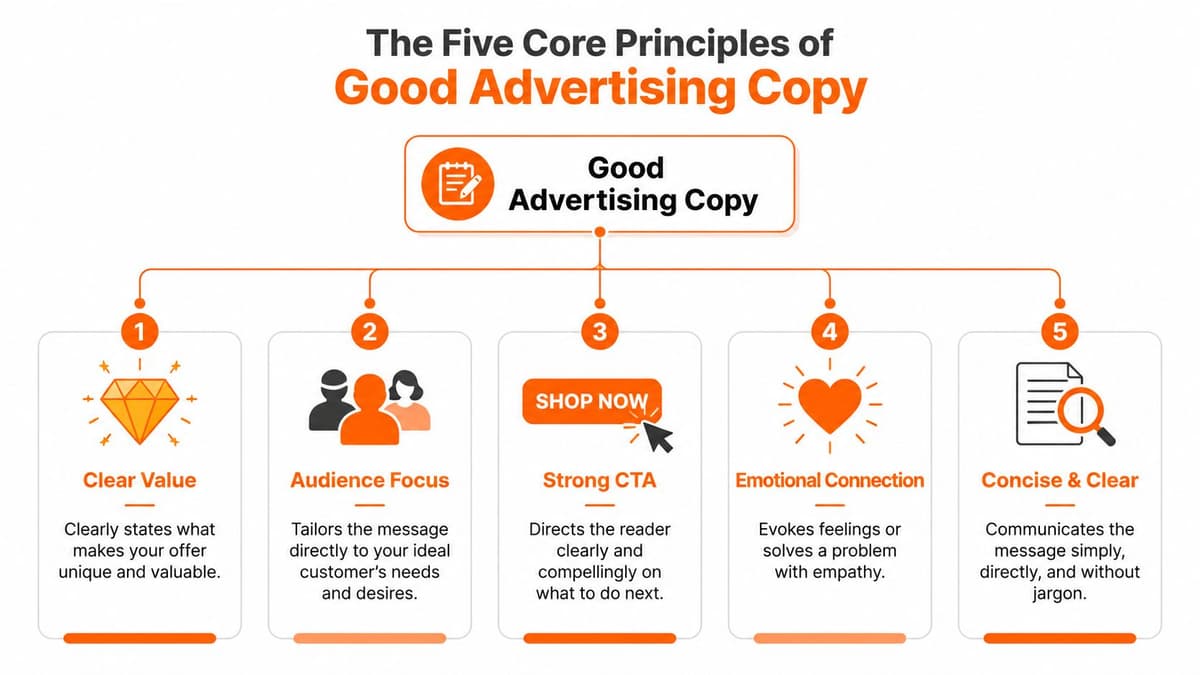
Good advertising copy works as a chain. A hook earns attention in the first 1 to 3 seconds, the value proposition makes a specific promise, social proof lowers risk, and the CTA names the action and sets expectation, and each step creates the condition the next one needs, as outlined in this ad copy structure guide. If you reverse that order, the reader has to do too much work.
The five core principles are clear value, audience focus, strong CTA, emotional connection, and concise and clear language. They sound simple because they are. The hard part is not knowing them, it's making each one earn its place in a crowded feed.
Practical rule: if your hook could fit five competitors, it's too generic.
#What each principle actually does
Clear value tells the buyer why this offer matters now. Audience focus makes the copy feel written for one person, not for a category. Strong CTA removes ambiguity about the next step. Emotional connection gives the offer human relevance, while concise and clear language keeps the message from collapsing under its own jargon.
For social proof, it helps to look beyond generic testimonial placement and think about how proof changes risk perception. A useful resource on strategies for social proof can help you decide whether to use customer quotes, user counts, or outcome-based proof near the offer. The point isn't decoration. The point is credibility.
A founder should critique every ad with one question at a time. Does the first line earn attention? Does the second line make the promise believable? Does the copy answer the buyer's hidden objection before the CTA appears? If one part is weak, the whole ad feels harder to trust.
#Find Your Message Before You Write a Single Word
The strongest ad copy usually isn't invented in a brainstorming doc. It's extracted from the business itself. That means reviews, support tickets, sales calls, and post-purchase feedback matter more than a blank page full of “creative” ideas.
#Start with the before moment
The fastest way to sharpen messaging is to look for the moment before someone bought. That's where the anxiety, frustration, and unfinished alternatives live. Practitioner guidance on ad copy angles recommends reading 4-star reviews and also 1-star to 3-star feedback because complaints reveal the pain points and objections generic advice misses.
Don't just skim for compliments. Look for the phrases customers use when they explain why they were shopping in the first place. A support transcript might show the exact friction point. A sales call might reveal the word they used when they described a bad prior solution. A review may show the result they were hoping for but didn't know how to ask for.
Start by sorting customer language into four buckets:
- Pain language: what they hated, avoided, or kept fixing.
- Outcome language: what they wanted instead.
- Objection language: price, shipping, complexity, trust, fit, timing.
- Comparison language: what they tried before and why it failed.
That's enough to build a first draft without reaching for copywriting clichés.
Practical rule: if a customer says it three different ways, that phrase probably deserves a place in the ad.
#Use the raw language, not the polished version
A lot of teams ruin good insights by “cleaning up” the words too early. The customer might say “I was sick of dealing with leaks” while the brand wants to say “engineered for leak prevention.” The second version sounds more polished, but the first one is more alive. It sounds like a person with a problem, which is what your future buyer is likely to be.
That's also why message discovery matters before positioning work gets too abstract. If you want a practical framework for turning those phrases into a sharper market stance, the internal resource on competitive positioning is a useful companion. It pairs naturally with customer-language mining because it helps you turn raw objections into a clearer market angle.
Here's the process I use. Read the negative feedback first, then the mid-tier reviews, then the sales and support transcripts. Mark recurring phrases, repeat nouns, and repeated comparisons. Once you see the same pain in multiple channels, you've found a message worth testing. That message is usually better than the one you thought sounded clever.
#From Bad to Better Ad Copy Real Examples
Generic copy sounds safe, which is exactly why it underperforms. It explains the product category, not the buying reason. The fix is usually not “more benefits,” it's more specificity, more proof, and a cleaner path from attention to action.
#Skincare
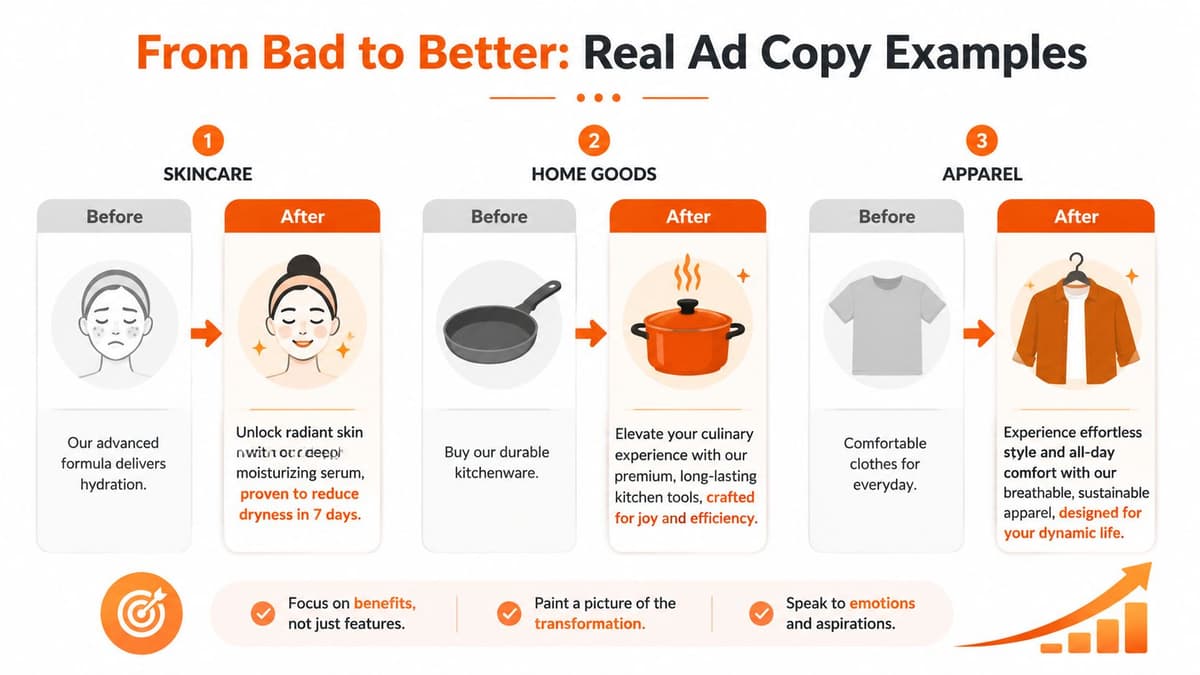
Before: “Our advanced formula delivers hydration.”
After: “Reveal radiant skin with our richly moisturizing serum, proven to reduce dryness in 7 days.”
The second line works because it's more concrete. It also gives the reader a reason to believe the claim, not just admire the wording. That's the difference between product language and buying language. One describes, the other persuades.
#Home goods
Before: “Buy our durable kitchenware.”
After: “Enhance your culinary experience with our premium, long-lasting kitchen tools, crafted for joy and efficiency.”
The weak version sells durability, which is a feature. The stronger version adds context around use and outcome, so the product feels less like inventory and more like a better daily experience. For home goods, that shift matters because buyers usually picture a routine, not a spec sheet.
#Apparel
Before: “Comfortable clothes for everyday.”
After: “Experience effortless style and all-day comfort with our breathable, sustainable apparel, designed for your dynamic life.”
This one improves because it speaks to identity and use case, not just comfort. It also feels more directional. That said, don't confuse polished language with effective language. If a phrase sounds nice but doesn't reflect what customers say, it won't hold up in testing.
A practical rule for ad copy is to address objections before they arise and pair claims with proof, including concerns like price, shipping, or complexity, plus social proof like testimonials or user counts, as noted in this guide to writing ad copy. In real campaigns, that often means the body copy should answer the biggest hesitation before the CTA appears.
The video below is worth watching if you want to see how copy choices change when the goal is conversion rather than applause.
If you want another hands-on reference while you rewrite headlines, the internal guide on Facebook ad copywriting fits naturally here because it pushes the same discipline, make the message specific, credible, and easy to act on.
#How to Measure and A/B Test Your Ad Copy
Copy only matters if it changes business results. That's why ad testing can't stop at “this one got more clicks.” You need to know whether the winner brought in better customers, not just more curiosity.
#Test one idea at a time
The cleanest test isolates a single variable. Change the hook, keep the offer, keep the creative, keep the CTA. If you change everything at once, you won't know what caused the lift or the drop. That discipline matters because the modern standard is to write, test, measure, and refine with real conversion tracking rather than relying only on platform-reported numbers, as explained in this training on ad-copy optimization.
The logic is simple. A good variant should compete like a contender, not like a remix. If one hook consistently outperforms another while the rest of the setup stays steady, you've learned something reusable. If not, you've at least ruled out an idea without guessing.
#Measure the right business outcomes
Founders often overrate CTR because it's easy to see. CTR can help, but it doesn't pay salaries. The better question is whether the copy drives profitable new customers and improves the economics of the account over time. If you already track internal KPIs, the ecommerce KPI guide is the right place to anchor that review.
Practical rule: judge copy by the customer it attracts, not by the applause it gets in-platform.
The best measurement habit is to connect the message to the money. If a headline promises clarity, does it lower friction after the click? If the CTA feels more direct, do more qualified buyers move forward? If the proof is stronger, does the offer attract people who stick around longer? Those are the questions that matter inside a real DTC business.
Arlo is one option for founders who want a plain-language weekly readout that turns Shopify store data into prioritized actions, but the principle stays the same no matter what tool you use. The copy has to be judged against business impact, not vanity. Once you treat testing like a selection process instead of a one-off launch, your ad account starts teaching you what to say next.
#Your Pre-Launch Ad Copy Checklist
Before you spend on a new ad, run it through a hard preflight check. A surprising amount of wasted spend comes from skipping the basics because the copy “felt good” in draft form. That feeling isn't the test. The reader is.
#Check the message against the buyer's actual problem
Ask whether the first line sounds like something a real customer would say. Ask whether the offer names a specific outcome instead of hiding behind category language. Ask whether you've used the exact phrase from reviews or support tickets that revealed the need in the first place. If the answer is fuzzy, keep working.
Then check the friction points. Did you answer the price question, the shipping question, or the “why this instead of the last thing I bought?” question? Those objections don't belong only on the landing page. Good copy handles them before the reader has to go hunting.
#Make the CTA do real work
The CTA should be simple enough to act on and honest enough to trust. A vague prompt leaves the buyer guessing. A clear prompt tells them what happens next and why clicking makes sense. That's especially important in short-form ads, where every word has to carry weight.
Use this checklist before launch:
- Clear USP defined? The offer should be easy to explain in one sentence.
- Target audience addressed? The copy should sound like it knows who it's for.
- Strong CTA present? The next step should be unmistakable.
- Benefit-driven language? The buyer should see the outcome, not just the feature.
- Concise and readable? Jargon should be cut before launch.
- Grammar and spelling checked? Errors can break trust fast.
- Mobile-friendly formatting? Short lines and clean structure matter on small screens.
- Emotional connection made? The message should feel relevant, not robotic.
The best CTAs are specific, low-friction, and honest about what happens next, which is why this CTA guidance from Invesp fits the final review so well. It's a good reminder that the job is to remove doubt, not add drama.
When the ad passes this checklist, publish it, measure it, and keep the winners. When it doesn't, fix the message before you fund the media. That one habit will save you from paying to scale weak copy.
If you want a weekly view of what changed in your store and what to do about it next, install Arlo and use the report to turn ad performance, customer signals, and product data into the next set of copy decisions.