Attribution Marketing Software: A Shopify Founder's Guide
By Arthur Falcone · Founder of Arlo
You open Meta Ads Manager and it says your campaigns are healthy. Shopify feels softer than it should. Google Analytics claims it assisted the sale. Klaviyo says the email closed it. Each platform tells a clean story where it deserves more credit than everyone else.
That's the daily mess for a lot of Shopify founders.
At some point, this stops being a reporting problem and becomes a cash problem. If you trust the wrong dashboard, you keep spending on channels that look good inside their own walls and cut channels that do the hard work upstream. The result isn't just confusion. It's bad budget decisions, weak forecasting, and a team that can't answer the simplest question in ecommerce: what's driving profitable growth?
The same issue shows up offline too. If you run events, pop-ups, or wholesale outreach, even small execution choices muddy performance. A founder ordering booth giveaways might discover essential event merchandise and realize the hard part isn't just picking the items. It's knowing whether those touches led to later revenue. That's attribution in a nutshell.
#Table of Contents
- Your Marketing Reports Are Lying to You
- What Is Attribution Marketing Software Really
- Decoding Common Attribution Models
- Why Your Attribution Data Is Broken in 2026
- How to Evaluate Modern Attribution Software
- An Actionable Checklist for Better Measurement
- Beyond Dashboards From Data to Decisions
#Your Marketing Reports Are Lying to You
A founder checks reports on Monday morning. Meta says paid social is printing money. Google says branded search is harvesting demand efficiently. Klaviyo says flows are carrying the store. Shopify says total revenue didn't move enough to justify any of that confidence.
Nobody's necessarily lying on purpose. Each tool is grading its own homework.
#Why the numbers never line up
Ad platforms want to show influence. Analytics tools try to reconstruct sessions. Email tools grab conversion credit when a customer clicks late in the journey. Shopify records the sale, but it doesn't automatically explain every step that pushed the buyer there.
That's why one order can get claimed three different ways.
A clean-looking dashboard can still produce a bad decision if it can't tell you which touchpoints mattered together, and which one merely showed up last.
For a founder, the practical consequence is brutal. You don't need another chart. You need one version of reality that helps you decide whether to raise spend, cut spend, fix conversion leaks, or leave a winning channel alone.
#What this looks like in real operations
Here's the common pattern:
- Meta gets credit for demand capture: A shopper sees an ad, leaves, comes back later through search, and buys. Meta counts the view or click. Search takes the last click. You feel like both channels are indispensable, but you still don't know the right budget split.
- Email steals late-stage credit: Klaviyo often catches the final click because the shopper was already interested. That doesn't mean the email created the demand.
- Shopify shows the consequence, not the cause: Revenue is the scoreboard. It isn't the replay.
The founder mistake is treating platform reporting like truth instead of evidence.
Attribution marketing software matters because it tries to unify that evidence into a customer journey you can effectively use. Not perfect truth. Better truth. In practice, that's enough to stop flying blind.
#What Is Attribution Marketing Software Really
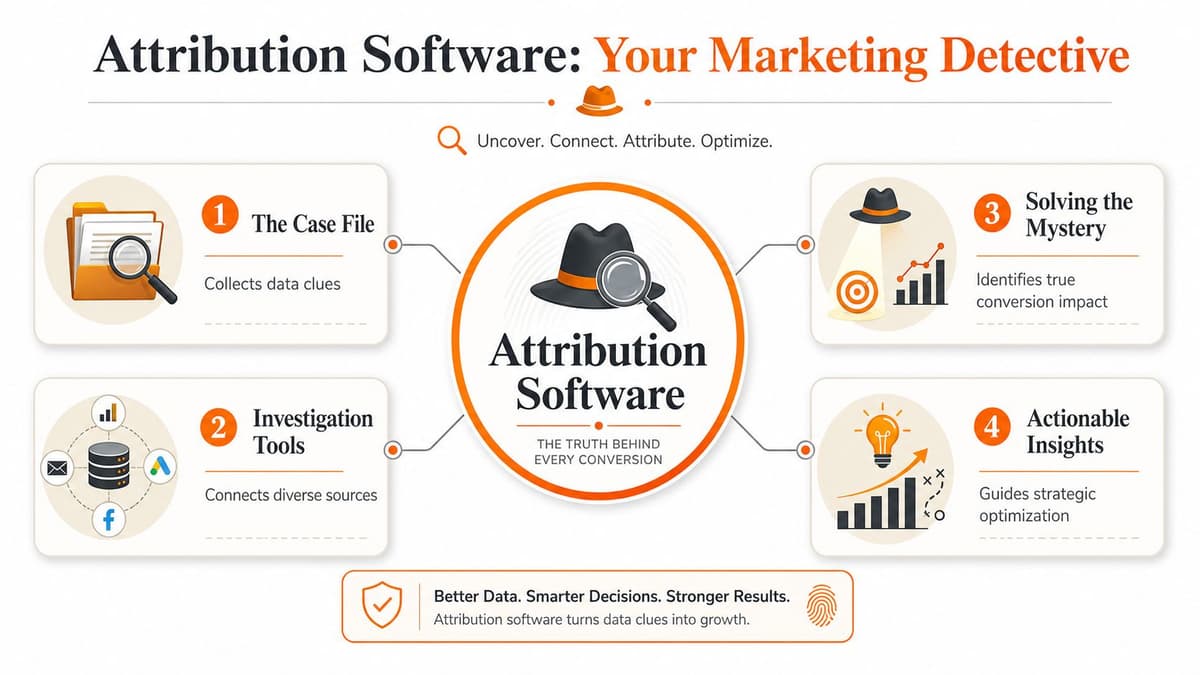
Attribution marketing software is a customer journey detective. It gathers clues from your store, ad platforms, CRM, and marketing tools, then tries to answer one question: which interactions helped create revenue, and how much credit should each one get?
That sounds abstract until you picture an actual buying path. A customer sees a Meta ad on Monday, reads a review on Tuesday, clicks a branded Google search on Thursday, abandons cart, then buys after an email on Friday. If you only look at the final click, you miss the setup. If you only look at the first touch, you miss the close.
#The real job of the software
Good attribution marketing software does four jobs:
- Collects touchpoints: Ad clicks, site visits, emails, purchases, and CRM events.
- Connects identity where possible: It tries to recognize that the same person touched multiple channels before buying.
- Assigns credit using a model: First-click, last-click, linear, time-decay, or more advanced approaches.
- Turns the story into decisions: This is the part most tools handle poorly.
A lot of founders think attribution software exists to make dashboards prettier. It doesn't. Its real purpose is to connect spend to outcomes in a way that helps you act.
#Why this category keeps growing
The category is getting bigger because the problem is getting harder. The global marketing attribution software market is projected to grow from $5.4 billion in 2026 to $10.10 billion by 2030, and 57% of companies now use some form of attribution, according to this market analysis of attribution software growth.
That lines up with what operators already feel. Stores don't grow through one channel anymore. A customer might discover you on Instagram, validate you through search, and convert through email or direct traffic. Without a system connecting those pieces, budget decisions become educated guesses dressed up as reporting.
#A better way to think about it
Think of your revenue like a solved case. The order happened. The detective work is figuring out what evidence led there, what mattered most, and what to repeat next week.
Practical rule: If your software only tells you what happened yesterday, but not what to change this week, it's reporting software with an attribution label.
That distinction matters more than the features list.
#Decoding Common Attribution Models
Every attribution model answers the same question differently: who gets credit for the goal? The easiest way to think about it is soccer. One player scores, but several players helped create the chance. The model decides whether the scorer gets all the glory, the first passer gets it, or the whole sequence shares it.
#The five models most founders run into
First-click gives all the credit to the channel that introduced the customer. If a shopper first found you through a Meta prospecting ad, that ad gets the entire sale.
Last-click gives all the credit to the final touch before purchase. If branded search closed the sale, search gets everything.
Linear spreads credit across each touchpoint in the path. Every pass gets some recognition.
Time-decay favors the touches closest to the sale. The final sequence matters most, but earlier assists still count.
Data-driven or algorithmic models try to estimate contribution based on actual observed patterns rather than rigid rules.
#Comparing Common Attribution Models
| Model | How It Works | Best For | Biggest Flaw |
|---|---|---|---|
| First-click | Gives full credit to the first known touchpoint | Brands focused on awareness and top-of-funnel testing | Ignores what actually closed the sale |
| Last-click | Gives full credit to the final touch before purchase | Stores with short buying cycles and simple funnels | Overvalues closers like email or branded search |
| Linear | Splits credit evenly across touches | Teams that want a balanced basic view | Assumes every touch mattered equally |
| Time-decay | Gives more credit to later touches | Journeys where closing touches genuinely matter more | Still relies on a rule that may not fit your store |
| Data-driven | Uses observed path data to assign credit | Brands with enough clean data and cross-channel complexity | Harder to audit, explain, and trust when data is incomplete |
#Which model is least wrong for DTC
For many Shopify brands, last-click is convenient but misleading. It tends to over-credit channels like email, SMS, direct, and branded search because those often appear near the finish line. First-click swings the opposite way and can make prospecting look better than it is.
Linear is often more fair than either extreme, but it can flatten reality too much. Not every touch deserves the same applause. A casual ad impression and a cart recovery email don't carry the same weight.
Data-driven sounds ideal. Sometimes it is. Sometimes it's a black box built on incomplete signals. If the underlying tracking is weak, the math just makes the error look more convincing.
#What strong operators look at beyond the model
The model matters less when you add context. Operators need to analyze channel interaction effects and time to conversion, because isolated channel reporting misses how channels work together over time, as explained in this guide to attribution modeling.
That means asking practical questions like:
- Which channels assist each other: Does paid social lift branded search and email response?
- How long does the path usually take: Do shoppers buy the same day, or after several sessions?
- Which model best matches buying behavior: A store selling impulse buys won't need the same lens as a repeat-purchase brand with a longer consideration window.
If your attribution model makes one channel look heroic in isolation, check whether another channel did the hard work earlier in the journey.
The right model isn't perfect. It's the one that helps you make fewer dumb budget decisions.
#Why Your Attribution Data Is Broken in 2026
A lot of founders assume the reporting problem is just a model problem. It isn't. Even if you picked the best model, the raw input is often damaged before it ever reaches the dashboard.
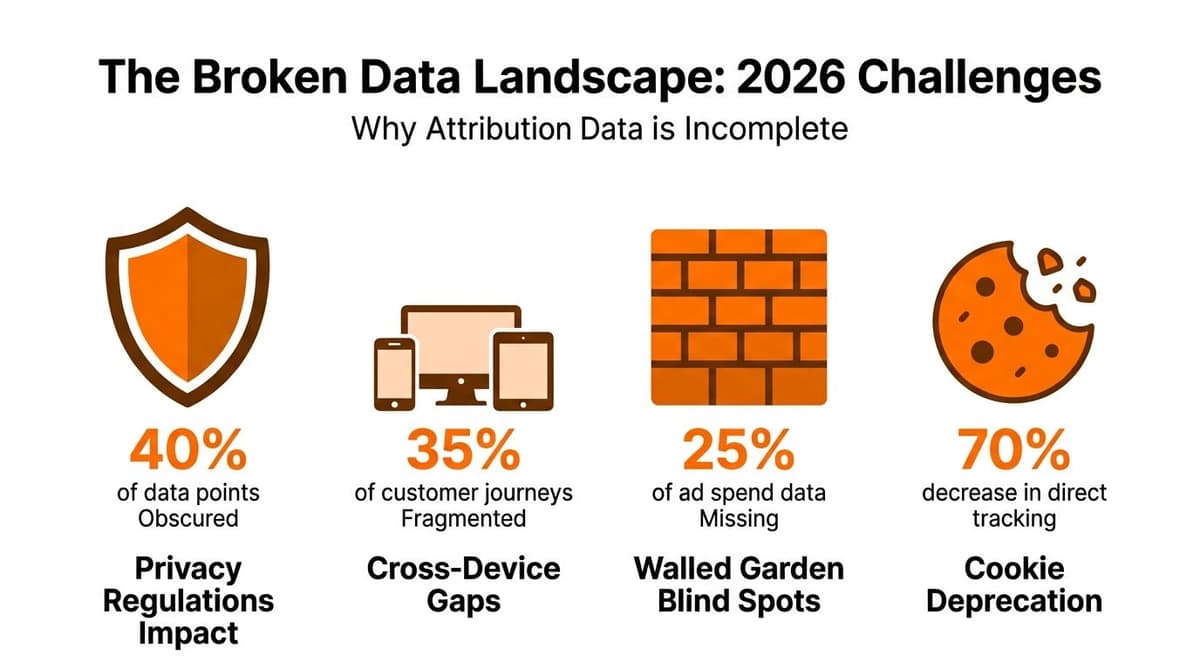
For post-launch Shopify DTC brands, the attribution problem is especially sharp because 60-70% of conversion data is now lost due to privacy restrictions and cookie deprecation, according to this discussion of the Shopify attribution gap. That means many reports are trying to tell a precise story from partial evidence.
#Why old tracking methods fail
Client-side pixels used to do more of the job. They depended heavily on browsers, cookies, and front-end scripts firing correctly. That environment got less reliable as privacy rules tightened, browser restrictions expanded, and mobile ecosystems changed.
The result is familiar:
- Missing conversions: The ad platform shows modeled outcomes instead of directly observed ones.
- Broken journeys: The same shopper appears as separate users across sessions or devices.
- Inflated confidence: Dashboards still look polished, even when the source data is incomplete.
A founder sees a neat chart and assumes the plumbing works. That assumption is dangerous.
#The hidden damage to decision-making
When the data gets weaker, teams often react in one of two bad ways. They either trust platform-reported ROAS too much, or they stop trusting all reporting and start making budget calls by feel.
Neither approach scales.
Running a modern DTC brand on outdated tracking is like steering with a compass that points somewhere near north, some of the time.
The hardest part is that broken attribution doesn't fail loudly. It fails subtly. You keep spending. You keep reporting. You keep reviewing numbers in weekly meetings. But the signal gets fuzzier, and the cost of misreading it compounds through budget allocation, forecasting, and inventory planning.
This is why founders need to judge software by how it handles bad data conditions, not by how pretty the dashboard looks when conditions are perfect.
#How to Evaluate Modern Attribution Software
Most attribution tools are sold like luxury dashboards. Founders should buy them like measurement infrastructure.

#The non-negotiables
Effective attribution software must handle long sales cycles, track lifetime value, offer flexible attribution windows, and use server-side tracking to preserve data integrity across the customer journey, as outlined in this breakdown of modern attribution requirements.
That sentence sounds technical, but the buyer's guide is simple.
- Server-side tracking: This is the new baseline. If a platform still leans mostly on browser pixels, treat it like old plumbing.
- LTV visibility: If you sell subscriptions, bundles, replenishment products, or anything with repeat purchase behavior, first-order revenue can mislead you.
- Flexible attribution windows: Your store might convert quickly or slowly. The software has to match how customers buy, not force a default window that flatters one channel.
- Journey coverage: If the tool can't connect key store, ad, and customer systems, you'll get fragmented reporting with a premium price tag.
A good companion read is this overview of an ecommerce analytics platform because it highlights a broader truth founders often miss. Measurement tools shouldn't just collect numbers. They should support decisions.
#What to ask on the demo
Founders get trapped when they ask feature questions instead of operating questions. Ask things like:
- How does your platform recover lost signal in a privacy-first environment?
- What data comes from server-side events versus client-side scripts?
- Can I analyze first order and lifetime value separately?
- Can I adjust attribution windows for different products or buying cycles?
- What actions do merchants usually take from the reports?
If the salesperson answers with chart types, color-coded dashboards, or generic AI claims, keep pushing.
Here's a useful walkthrough on what modern teams look for in measurement platforms:
#The real trade-off
The strongest tools are rarely the easiest to understand on day one. The easiest tools are often simplified to the point where they're less useful once your store grows. Founders need to decide what kind of pain they prefer: slight setup complexity now, or recurring budget mistakes later.
That's the actual buying decision.
#An Actionable Checklist for Better Measurement
You don't need a data team to improve attribution. You need cleaner inputs and a repeatable review process.
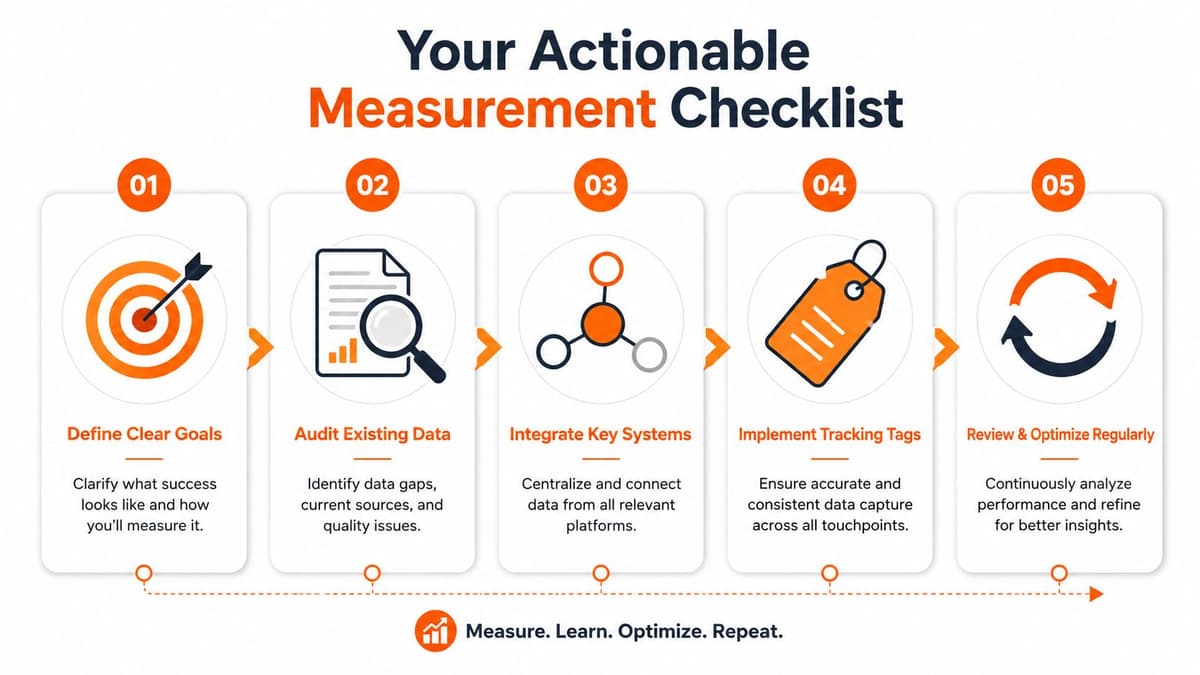
#Five moves to make this week
Start with campaign structure. To get precise data, operators must create one ad group per strategy, tactic, or creative and apply attribution tags directly into the destination URL for each tactic, including posts, ads, and links, according to Amazon's attribution setup guidance.
That sounds tedious. It's worth it because messy structure creates messy reporting.
-
Separate your tactics clearly
Don't lump prospecting, retargeting, creator whitelisting, and offer testing into one bucket. If different ideas live inside the same ad group structure, you can't tell what worked. -
Tag every destination consistently
Use campaign naming and URL tagging rules that your future self can read without guessing. If your team changed agencies twice and nobody knows what “spring_v2_final_final” means, fix that first. -
Review more than ROAS
Use a weekly review that includes revenue, conversion path quality, repeat purchase signals, and whether assisted channels are doing setup work. A founder who wants sharper benchmarks can use this guide to KPIs for ecommerce to tighten what gets reviewed each week.
#The weekly operating rhythm
A useful first 30 minutes each week looks like this:
- Check tracking health: Look for broken links, missing tags, or obvious gaps between platform claims and store outcomes.
- Scan path changes: Did branded search or email suddenly absorb more last-touch credit? That can mean upper-funnel channels weakened, or just that a closer got there last.
- Find one waste pocket: Pause, trim, or rework something underperforming instead of spreading attention across everything.
- Find one protect-worthy win: If a channel, flow, or product is carrying the week, defend it before you chase experiments.
Operator note: Better attribution starts with disciplined setup, not advanced math.
#The maintenance founders skip
Quarterly model refinements matter. Teams need to revisit attribution logic on a quarterly cadence so reporting stays aligned with current buyer behavior, as described in this attribution measurement article. Customer journeys change. Offer strategy changes. Creative mix changes. Your model can drift even when your reporting still looks stable.
This same discipline helps during launches. If you're planning new collections or campaign pushes, a practical guide for successful product launches can help tighten operational prep around measurement, messaging, and rollout timing.
Founders don't need perfect instrumentation. They need a system that gets cleaner every quarter and sharper every week.
#Beyond Dashboards From Data to Decisions
The biggest attribution mistake isn't using the wrong chart. It's stopping at the chart.
Plenty of software can show you revenue by channel, assisted conversions, and model comparisons. That's useful, but it still leaves one hard question unanswered: what should you do on Tuesday morning? Pause a campaign? Shift budget? Fix a broken flow? Push a winning product harder? Most dashboards don't help enough at that moment.
#Why dashboard-only thinking stalls growth
Industry analysis puts it plainly: “attribution without action is wasted”, and 90% of marketing leaders report that attribution data is not actionable enough to drive immediate strategy changes, according to this review of attribution software limitations.
That rings true in founder-led ecommerce. Small teams don't struggle because they have zero data. They struggle because they have too much disconnected data and not enough time to interpret it.
A dashboard can tell you that paid social influenced revenue. It usually won't tell you whether the better move is to cut weak creatives, raise budget on one audience, fix a leaking email sequence, or leave the channel alone because the actual problem is site conversion.
#What better attribution looks like in practice
Good decision-making systems do three things well:
- Prioritize the next move: They don't dump twenty charts on your desk and call that insight.
- Connect metrics to money: Founders need to know what matters for revenue and profit, not just what changed.
- Respect limited time: A small team needs clarity fast.
This applies outside paid acquisition too. Someone trying to sharpen content or creator performance might compare reporting tools and use a practical guide to social media metrics for creators as a shortcut to better signal. The same principle holds. Metrics matter only when they change action.
#The shift that actually helps founders
The useful frame is simple. Attribution marketing software shouldn't exist to help you admire your funnel. It should help you make better weekly calls with less hesitation.
If you want a broader lens on how data becomes operating guidance, this overview of business intelligence reporting is useful because it points toward the right end state. Not more dashboards. Better decisions.
Founders don't need perfect certainty. They need a system that is reliable enough to make confident trade-offs, week after week, without drowning in tabs.
Arlo gives Shopify operators that kind of decision support. Instead of asking you to stitch together reports from multiple tools, it turns store, traffic, customer, and product data into a concise weekly analysis with clear priorities, estimated revenue impact, and specific next steps. If you want analytics that help you act, not just inspect charts, Arlo is worth a look.