Channel Strategy in Marketing: How DTC Brands Choose Right
By Arthur Falcone · Founder of Arlo
Adding another channel is the most popular advice in marketing. It's also one of the fastest ways for a founder-led DTC brand to lose control of its budget.
I've watched flat ROAS trigger the same reaction repeatedly. The team launches TikTok, adds SMS, hires a creator, opens a marketplace, and builds another dashboard. A few months later, creative production is slower, attribution is noisier, and nobody can explain which combination caused more purchases.
A better approach to channel strategy in marketing starts with restraint. Pick two or three channels, give each a distinct job, sequence them around the customer journey, and judge them by incremental lift rather than platform-reported ROAS. That model is less exciting than “be everywhere,” but it's far more workable for a small Shopify team.
#Table of Contents
- The Real Problem With Channel Strategy in 2026
- What Channel Strategy Actually Means for DTC Brands
- Mapping Channels to the Customer Journey
- A Prioritization Framework to Pick the Right Channels
- Measuring Channels With Attribution and Incrementality
- A 90-Day Testing and Rollout Roadmap
- Your First Week With a Working Channel Strategy
#The Real Problem With Channel Strategy in 2026
More channels don't automatically solve a flat ROAS curve. They often make the curve harder to interpret.
Dashboard-watching is the problem. A founder sees Meta reporting conversions, Google claiming revenue, Shopify showing a different path, and email taking credit for the final click. Instead of asking whether total purchases increased because of the spend, the team shifts budget toward whichever dashboard looks most flattering.
That's dangerous because channel-level reporting breaks down when customers move between touchpoints. Industry analysis identifies attribution distortion, efficiency illusion, and the gap between insight and action as structural problems in modern omnichannel measurement, especially when marketers evaluate channels independently instead of assessing the system (Digital Remedy's analysis of omnichannel integration).
My rule: A channel earns more budget only when it creates additional demand or improves the journey around demand you already have.
Operational complexity compounds quickly:
- Creative production: Every platform wants different formats, hooks, landing pages, and refresh cycles.
- Attribution noise: Retargeting, branded search, email, and direct traffic often touch the same buyer.
- Team bandwidth: A founder can't give five channels thoughtful strategy, testing, creative direction, and measurement at the same time.
- Message fragmentation: Customers may see an acquisition promise, a discount email, and a product page that tell three different stories.
The benchmark evidence points toward coordination, not channel accumulation. One industry benchmark reported that campaigns using three or more channels achieved a 287% higher purchase rate than single-channel campaigns, but independent work across 373 brands and 74 touchpoints found an average performance score of only 38%, suggesting that presence alone isn't enough (Amra & Elma's omnichannel benchmarks).
For most founder-led Shopify brands, the mix needs to cover four jobs: acquire new demand, convert intent, retain customers, and re-engage people who went quiet. That turns channel strategy into a focus problem. The rest of the work is deciding which channels deserve those jobs, in what order, and under what evidence.
#What Channel Strategy Actually Means for DTC Brands
A channel strategy is a deliberate operating plan for where your brand appears, what each channel does, how channels hand customers to one another, and how you'll measure the result.
That definition matters because many brands confuse strategy with presence. They maintain a Meta account, Google Ads, TikTok profile, email platform, SMS tool, marketplace listing, and occasional retail activity. That's a multichannel footprint. It becomes a strategy only when each channel has an assigned role and a defined relationship with the others.
A Shopify brand usually controls four practical stages:
- Reach: Put the product in front of people who don't know the brand or haven't shown clear buying intent.
- Acquire: Turn attention into a qualified visit, subscriber, lead, or first-party audience.
- Convert: Remove hesitation and capture the first purchase.
- Retain: Create a reason to return, reorder, recommend, or re-engage.
Paid, owned, organic, partner, marketplace, and retail channels can all contribute. The mistake is asking every channel to perform every job. Meta is often useful for discovery and demand creation. Google Search can capture existing intent. Email and SMS can continue the relationship after the first purchase. Organic content and creators can build trust that paid impressions struggle to provide.
The simplest test is this: If a channel has no job, it has no budget.
#Strategy versus multichannel presence
A channel strategy also defines sequencing. A customer might discover a product through a creator, revisit through Google, read reviews on the site, receive an abandoned-cart email, and purchase after a product education message. The channels aren't separate campaigns in that journey. They're connected steps.
That connection becomes even more important for higher-value shoppers. HubSpot's global omnichannel survey reported that 52% of shoppers are omnichannel shoppers, rising to 66% among shoppers spending $3,500 to $4,999 online per year, compared with 48% among shoppers spending under $500 online per year (HubSpot's omnichannel report). The commercial implication is straightforward. Your most valuable customers may need a connected experience across web, email, social, customer service, and physical touchpoints.
If local discovery or in-person selling matters, a resource on how to start selling locally online can help connect local demand with your ecommerce operation. The important point isn't adding another destination. It's making the destination support a clear stage in the journey.
#Mapping Channels to the Customer Journey
A useful DTC mix performs four jobs, and each job has different economics.
Acquire new demand with Meta and TikTok when the product can be demonstrated, styled, or explained through visual creative. Creator partnerships can make the message feel native to the audience, while SEO and educational content compound more slowly. A focused brand partnership playbook can help structure creator work around audience fit, deliverables, and a measurable next step.
Convert existing intent with Google Shopping, branded search, product pages, reviews, merchandising, and lifecycle recovery. Paid search shouldn't be forced to create demand it wasn't designed to create. Its strongest role is often capturing people who already know the category, product, or brand and need a final reason to act.
Retain customers with email and SMS flows tied to purchase behavior, replenishment timing, education, loyalty, and new product relevance. These owned channels should receive useful signals from Shopify, not generic broadcasts sent to everyone.
Re-engage lapsed buyers with a different message from the one used for acquisition. A lapsed customer may need a new use case, product reminder, service recovery, or relevant offer. Sending the same discount to every inactive customer trains the audience to wait.
The customer path is rarely linear. A shopper might see TikTok, search Google, visit a product page, leave, open email, and return directly. Map that behavior before assigning credit. A practical guide to the customer digital journey can help your team document the sequence instead of treating every visit as an isolated event.
| Journey Stage | Primary Channels | Role in Mix | Example KPI |
|---|---|---|---|
| Reach and discovery | Meta, TikTok, creators, SEO, organic content | Introduce the product and create qualified attention | Qualified new visitors |
| Acquisition | Paid social, creator landing pages, lead capture | Build first-party audiences and generate consideration | New customer rate |
| Conversion | Google Shopping, branded search, product pages, email recovery | Capture intent and remove purchase friction | Conversion rate |
| Retention | Email, SMS, loyalty, post-purchase content | Increase second purchases and customer value | Repeat purchase rate |
| Re-engagement | Email, SMS, win-back campaigns, community | Bring inactive customers back with relevant reasons | Reactivation rate |
| Local or assisted selling | Marketplaces, retail pop-ups, community partnerships | Add trust, trial, and local availability | Contribution margin by source |
Overlap needs active management. Exclude recent purchasers from acquisition campaigns when the goal is new customer growth. Suppress customers from promotional SMS when an email sequence already covers the same offer. Separate branded search from non-branded search so you can see whether paid search is creating demand or harvesting it.
Channel count is a weak proxy for performance. Fit to job, timing, audience logic, and suppression rules are what turn a collection of channels into a revenue system.
#A Prioritization Framework to Pick the Right Channels
Founders don't need a complicated planning exercise. You can rank a channel shortlist in one afternoon using four criteria, each scored from 1 to 5.
#Score the economic fit
Incremental lift potential asks whether the channel is likely to create purchases that wouldn't have happened without it. Paid social may reach new demand, while branded search may mostly capture existing intent. The score should reflect your hypothesis, not the platform's reported conversions.
Repeat-purchase fit measures whether the channel attracts customers who can plausibly buy again. Email and SMS usually score well for retention. A one-off discount partner may acquire customers with weak long-term fit.
Contribution margin headroom asks how much room exists after product cost, fulfillment, discounts, returns, and channel costs. A channel can produce revenue and still be a poor choice if the order economics leave no room for testing.
Operational cost includes creative, management, technical setup, customer support, reporting, and founder attention. Score low operational cost with a high score, because a channel that consumes the team can become expensive even when media spend is modest.
For an early-stage brand, weight margin headroom and operational cost more heavily. A growth-stage brand with reliable operations can give more weight to incremental lift potential. Never hide the weights. Write them beside the score so the decision can be challenged.
The example below uses editorial scores, not performance claims. Replace them with your own evidence.
| Channel | Incremental Lift (1-5) | Repeat Purchase Fit (1-5) | Margin Headroom (1-5) | Operational Cost (1-5) | Weighted Total |
|---|---|---|---|---|---|
| Meta ads | 4 | 3 | 3 | 3 | 3.4 |
| Google Search | 2 | 3 | 4 | 4 | 3.1 |
| TikTok | 4 | 2 | 3 | 2 | 2.9 |
| Email and SMS | 3 | 5 | 5 | 4 | 4.4 |
| Organic content | 4 | 4 | 5 | 2 | 3.8 |
| Retail pop-ups | 3 | 4 | 2 | 1 | 2.5 |
The weighted total is only useful if you state your stage assumptions. A subscription brand may rank email and SMS first because repeat-purchase fit protects margin. A highly visual product with strong creator assets may rank Meta second and TikTok as the controlled experiment. Retail pop-ups may make sense for trust and sampling, but their operational burden can keep them out of the next-quarter shortlist.
Decision rule: Choose the two highest-scoring channels that can work together, then add a third only when it has a distinct job and a named owner.
For the broader acquisition picture, audit your website traffic sources before scoring. If you don't know where current visitors originate, your first task isn't launching a channel. It's repairing the evidence.
#Measuring Channels With Attribution and Incrementality
Adding channels will not fix weak measurement. For a founder-led DTC brand, choose two or three channels, give each a defined role in the customer journey, and test whether they create demand rather than accepting platform-reported ROAS.
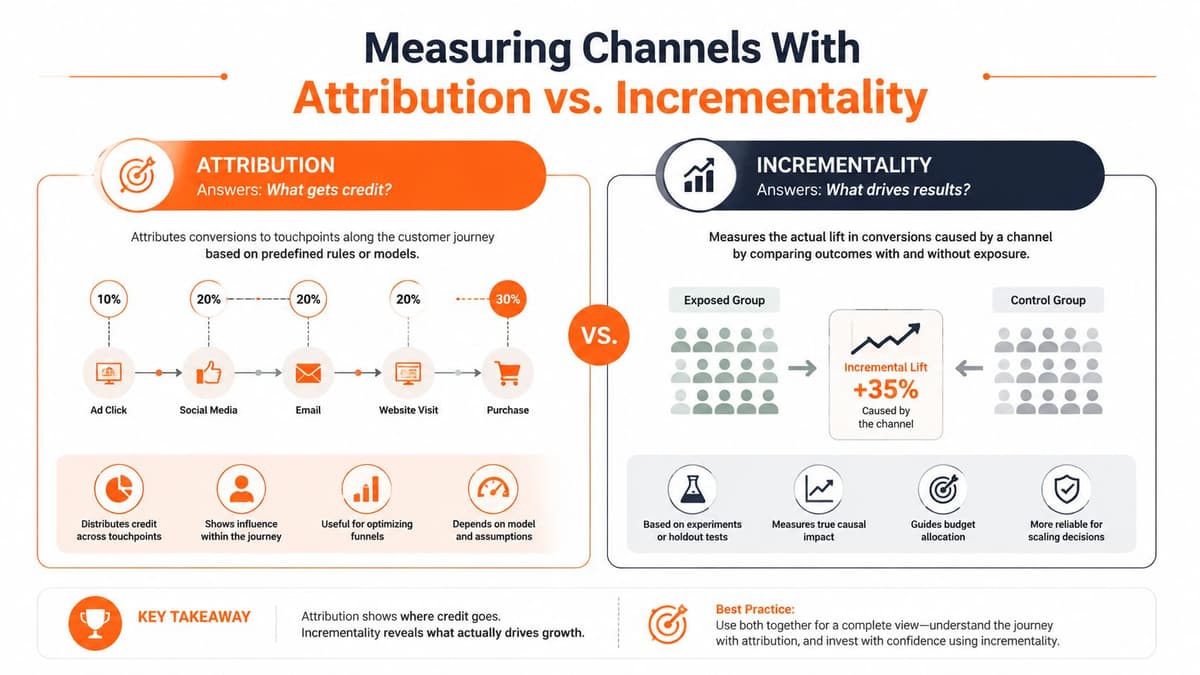
Attribution asks, “Which touchpoints received credit?” Incrementality asks, “Did the touchpoint cause additional purchases?” Those questions require different evidence.
Platform-reported ROAS follows each platform's rules and visibility. Last-click attribution in Shopify or GA4 assigns the conversion to the final measurable interaction. Both tools support daily optimization, but neither proves that a channel created demand.
Paid social can receive credit for customers who already knew the brand. Email may influence consideration without receiving the final click. Branded search can look exceptionally efficient when customers search the brand name after deciding to buy.
Academic work on DTC measurement identifies incrementality as the most effective method for analyzing advertising impact and optimizing spend. It also describes hybrid frameworks that combine marketing-mix modeling with channel-level Bayesian attribution to connect aggregated data with individual customer paths (D2C measurement research).
#The founder-friendly measurement stack
Use three layers. Each layer answers a different operating question:
- Platform reporting for tactical signals: Monitor creative fatigue, audience response, delivery, and directional changes.
- Last-click or multi-touch reporting for path analysis: Review how customers move through Shopify, GA4, email, search, and paid media.
- Incrementality tests for budget decisions: Compare exposed and unexposed groups through geo holdouts, audience holdouts, or public service announcement campaigns.
Run quarterly incrementality tests, annual media mix modeling, and day-to-day data-driven attribution for tactical optimization, following the measurement guidance from Growth Engines.
Budget rule: If a channel ranks among your top revenue sources but its incremental lift remains unproven, cap its budget at a fixed share and run a holdout before scaling.
Set the measurement rules before the next campaign:
- Source definitions: Agree on channel names, campaign names, and the conversion event.
- UTM hygiene: Use consistent source, medium, campaign, content, and audience labels.
- Suppression logic: Exclude recent purchasers, existing subscribers, and overlapping campaign audiences where appropriate.
- Control design: Define the exposed group, control group, test window, primary outcome, and decision rule before launch.
- Margin view: Evaluate incremental revenue after product costs, fulfillment, discounts, returns, and media spend.
- Review cadence: Use daily reporting for anomalies, monthly allocation reviews, and controlled tests for major budget changes.
#A 90-Day Testing and Rollout Roadmap
A channel strategy becomes useful when it changes what the team does on Monday morning. This roadmap keeps the work narrow, measurable, and reversible.
#Weeks 1 and 2
Baseline spend, orders, new customers, repeat purchases, contribution margin, source data, and current platform reporting. Fix broken UTMs, identify duplicated audiences, document the two or three active channels, and lock the scorecard.
#Weeks 3 through 6
Run two structured creative tests per active paid channel. Change one meaningful variable at a time, such as the hook, proof, offer, format, or landing-page match. Run one holdout on the channel you suspect is over-credited. Don't scale a winner because its dashboard improved. Confirm that the broader business moved.
#Weeks 7 through 10
Cut the bottom third of tests or channels against your prewritten criteria. Scale the strongest channel into the next journey stage, such as moving from acquisition into retargeting or post-purchase education. Bring in the next channel from the prioritized shortlist only after you've created capacity.
Use automation for repetitive publishing work, but keep strategic ownership internal. A tool that helps you manage queue and connectors can reduce distribution friction, but it shouldn't decide which channel deserves budget.
#Weeks 11 through 13
Re-score every channel. Reallocate based on incremental evidence, margin, repeat behavior, and operational load. Document what you killed, what you kept, what you learned, and which assumption the next test will challenge.
| Period | Deliverable | Owner | Pause threshold |
|---|---|---|---|
| Weeks 1-2 | Baseline, tracking audit, scorecard | Founder or growth lead | Pause any channel with no reliable source data |
| Weeks 3-4 | First creative test per paid channel | Channel owner | Pause a test that fails the agreed primary KPI |
| Weeks 5-6 | Second creative test and holdout | Growth lead | Pause the over-credited channel if lift remains unproven |
| Weeks 7-8 | Cut weak tests, expand strongest sequence | Founder and channel owner | Pause any channel below its margin floor |
| Weeks 9-10 | Launch next shortlisted channel | Assigned owner | Pause if execution misses the agreed delivery standard |
| Weeks 11-12 | Re-score mix and contribution | Founder or finance owner | Pause channels that remain uneconomic after iteration |
| Week 13 | Decision memo and next-quarter plan | Founder | Pause anything without a clear next hypothesis |
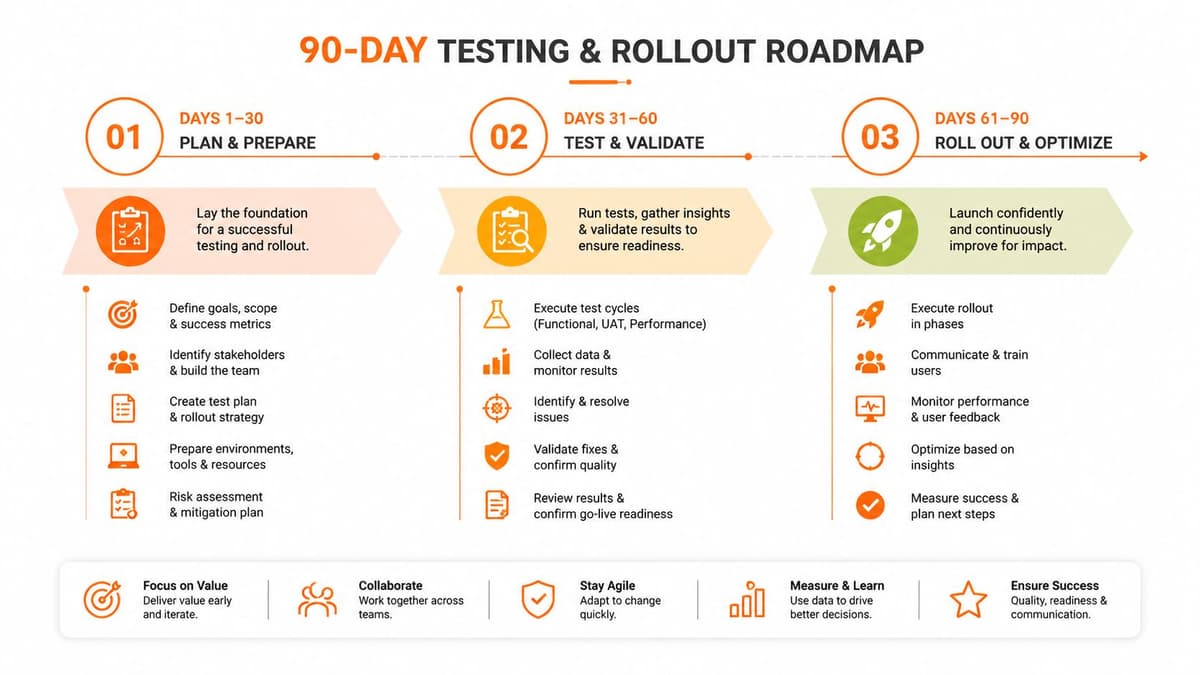
The threshold must be specific before spend begins. “It feels weak” is not a kill criterion. Use your contribution-margin floor, a defined incremental outcome, or a delivery failure your team can verify.
#Your First Week With a Working Channel Strategy
Protect the mix with a 30-minute Monday review. Look at only three numbers first: incremental CAC, repeat rate by source, and channel-level contribution margin. Platform dashboards can provide supporting detail, but they shouldn't determine the weekly decision.
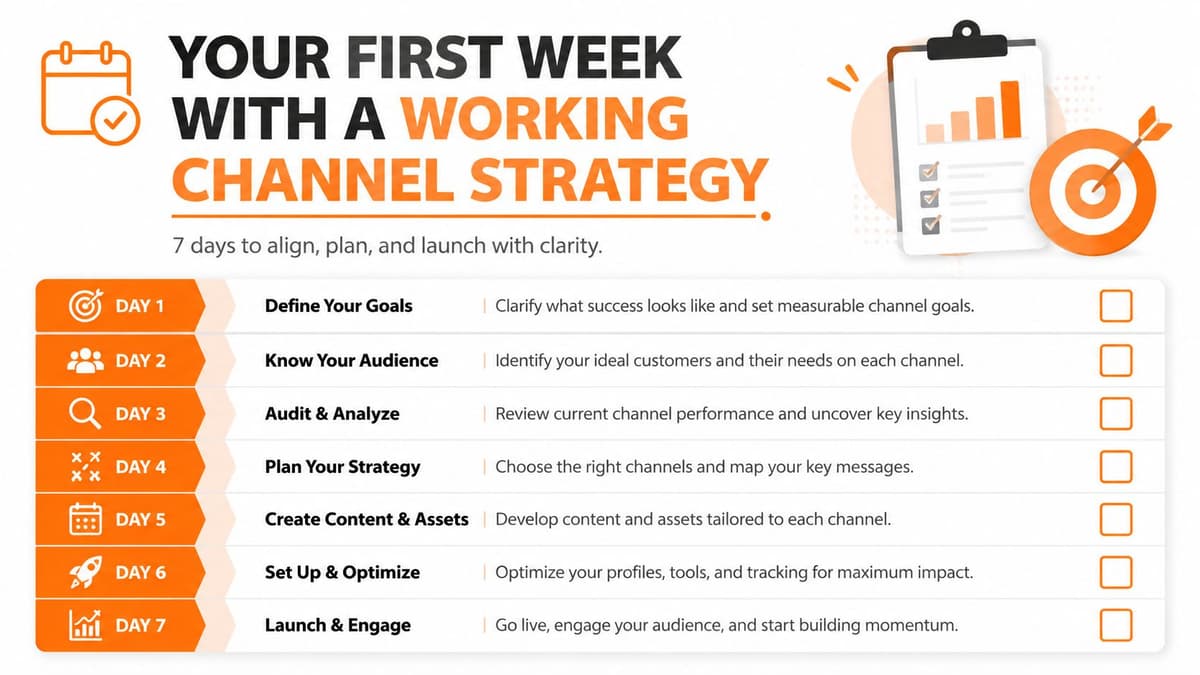
Your first-week checklist is short:
- Choose two priority channels: Use the scoring matrix, not personal preference.
- Pause everything else for 30 days: Keep essential customer-service and transactional programs running, but stop discretionary tests.
- Instrument Shopify properly: Standardize source attribution, UTMs, purchase events, and suppression rules.
- Write a one-page channel mix: Name each channel's job, owner, audience, offer, KPI, and handoff.
- Set kill criteria for any test under $1,000: The threshold should be agreed before the test starts, not after a disappointing result.
- Book a 60-day incrementality checkpoint: Put the review on the calendar while the hypothesis is still fresh.
A lightweight reporting tool can help reduce dashboard drift. Arlo connects Shopify, Meta Ads, and Google Analytics data and produces a weekly “20 Minute CMO” report that explains what changed, why it matters, and what to do next, with action items ranked by urgency and dollar impact.
Channel strategy isn't a quarterly presentation. It's a weekly operating discipline. Write down the hypothesis before spending a dollar, then revisit it on Friday and record what changed, what didn't, and what you'll do next.
Arlo turns Shopify sales, traffic, customer, and product signals into a concise weekly marketing analysis, so you can spot wasted spend and prioritize the next revenue move without juggling disconnected dashboards. Visit Arlo to see how a focused weekly review can support a sharper channel strategy.