Difference Between Agentic AI and Generative AI Explained
By Arthur Falcone · Founder of Arlo
You're running a Shopify store, and two AI tools are sitting in your dashboard. One writes a polished Meta ad variation in seconds. The other checks an order, creates a return label, issues a refund, updates inventory, and sends the customer a message. Both are marketed as AI. They solve very different problems.
That's the practical difference between agentic AI and generative AI. Generative AI creates an output when you ask. Agentic AI pursues a goal by planning and taking actions across connected systems. The labels overlap, but the operational consequences don't. For a lean DTC team, choosing the wrong type can mean wasted setup work at best and an expensive, irreversible mistake at worst.
#Table of Contents
- Why These Two AI Labels Keep Confusing DTC Founders
- What Generative AI and Agentic AI Actually Mean
- How They Compare on the Seven Operator-Relevant Criteria
- Where Each One Earns Its Keep in a Shopify Store
- The Operational Boundary Between a Smart Chatbot and a Real Agent
- Adoption Reality Check Before You Hand Over the Keys
- A Phased Rollout Plan for Founder-Led DTC Brands
#Why These Two AI Labels Keep Confusing DTC Founders
The confusion starts in vendor marketing. A chatbot with a few functions gets called “agentic,” while a copywriting tool gets called generative because it produces text. Founders then assume anything that clicks buttons must be an agent and anything that writes copy must be generative.
That shortcut breaks down quickly. A generative model can draft a support reply, summarize an order history, or suggest a refund policy response. Add permissions, tool access, a planner, and a workflow, and a broader system can use that same model to retrieve order data, make a decision, update Shopify, and notify the buyer.
Operator rule: Don't buy the label. Inspect what the system can access, what it can change, and whether you can reconstruct every action afterward.
The underlying models often overlap. The same large language model can sit behind a one-shot product-description generator or serve as the reasoning and writing component inside a support agent. The difference lies in the surrounding system, not necessarily in the model's brand or architecture.
For a Shopify founder, that means the useful question isn't “Which category is newer?” It's “Does this job need a draft, a recommendation, or a completed workflow?” A product page usually needs a strong draft and human judgment. A refund workflow may need a controlled system that checks policy, order status, payment state, and inventory before acting.
The comparison below stays close to storefront work. It focuses on the moment where a tool stops helping a person think and starts changing customer records, campaigns, stock levels, or cash movement.
#What Generative AI and Agentic AI Actually Mean
Start with two working definitions.
Generative AI produces new content from a prompt. That content can include text, images, video, audio, or code. You provide an instruction and relevant context, and the model returns an artifact such as a product description, email draft, image concept, summary, or code snippet.
Agentic AI is a system that receives a goal, plans multiple steps, and executes actions across tools or APIs with a chosen degree of autonomy. It may inspect information, select a next action, call an external system, evaluate the result, and continue until it completes the workflow or escalates to a person.
That distinction matches the practical framing used by IBM's explanation of agentic AI, which describes agentic systems as using a large language model as a “brain” and applying its outputs toward goals through external tool calls. In plain English, generative AI writes or produces; agentic AI coordinates and acts.
#The model and the wrapper
An agent isn't automatically a different kind of model. Most production agents still rely on generative models for reasoning, language, classification, and drafting. The agentic layer adds the surrounding machinery:
- A goal: For example, resolve a delayed-order ticket within store policy.
- A plan: Check tracking, inspect the order, determine eligible remedies, and prepare the next step.
- Tools: Shopify, a carrier system, a help desk, an email platform, or a returns application.
- State and context: The order history, customer status, previous actions, and current workflow position.
- Controls: Permissions, approval rules, rate limits, logs, and escalation paths.
A copy generator may receive “write three descriptions for this jacket” and stop after returning text. An agent may receive “reduce unresolved returns” and inspect tickets, classify cases, request missing information, issue an approved refund, update the order, and close the loop.
#Stop treating them as rivals
The difference between agentic AI and generative AI is best understood as a spectrum of autonomy wrapped around a generative core. Generative AI is usually prompt-driven and human-reviewed. Agentic AI is goal-driven, tool-using, and capable of continuing through a workflow with less supervision, as described in Google Cloud's overview of agentic AI.
The practical boundary is therefore not “content versus buttons.” A system can generate content inside an agentic workflow, and a generative assistant can use limited functions without becoming a trustworthy autonomous operator. What matters is where decisions happen, where permissions live, and who remains accountable when the system takes an incorrect action.
#How They Compare on the Seven Operator-Relevant Criteria
A Shopify operator feels the distinction in Slack before anyone uses the right terminology. One tool delivers a draft for approval. Another creates a sequence of system events that someone must monitor and potentially reverse.
| Criterion | Generative AI | Agentic AI |
|---|---|---|
| Autonomy | Produces one response after a prompt and waits for the next instruction. | Pursues a multi-step objective and can continue across actions. |
| Decision-making | Synthesizes patterns and offers an answer, draft, or recommendation. | Plans, chooses tools, handles fallbacks, and decides what to do next. |
| Inputs | Prompt, examples, and supplied context. | Goal, live data, tool or API access, memory, and workflow state. |
| Outputs | Copy, images, code, summaries, or analysis. | Changes made in Shopify, Meta, support, inventory, or other systems. |
| Control | Prompt design, model settings, review, and publishing approval. | Permissions, rate limits, approval gates, scoped credentials, and kill switches. |
| Safety | Hallucinated details, incorrect recommendations, and brand-voice drift. | Irreversible actions, data exposure, destructive calls, and a wider blast radius. |
| Infrastructure | A browser tab, app connection, or API key may be enough. | Identity management, webhooks, observability, action traces, and audit logs. |
#What shows up in the operating rhythm
Generative AI creates a quality-control problem. You need to check whether a product description invents fabric details, whether an email sounds like your brand, or whether an ad claim is supportable. The damage is usually visible in the artifact before publication.
Agentic AI creates a control-system problem. You need to know which records it can read, which actions it can perform, what happens when a tool fails, and how quickly you can stop it. A successful workflow can still hide an inefficient or unsafe path, which is why agent evaluation needs both outcome and process measures, as discussed in the review of agent evaluation methods.
The line also blurs in real deployments. An agent may use generative AI to draft a customer message, classify a return reason, or explain a campaign anomaly. The customer doesn't care which part was generative. They care whether the right refund happened, whether the message was accurate, and whether a human can investigate the decision.
#Where Each One Earns Its Keep in a Shopify Store
Assign the system based on the job, not the hype. Generative AI wins when the work ends with a human-approved artifact. A bounded agent wins when the work requires a sequence of checks and actions across connected tools.
| Shopify Job | Best System | Why It Wins | Failure If Misused |
|---|---|---|---|
| Product descriptions | Generative AI | It turns product facts, positioning, and keywords into editable copy quickly. | An agent may publish unsupported claims or alter catalog content without enough review. |
| Lifecycle email copy | Generative AI | It can produce subject lines, previews, and body variants for a marketer to approve. | An agent adds unnecessary complexity when the real bottleneck is message quality. |
| Paid social creative | Generative AI | It generates hooks, angles, scripts, and copy variations without touching spend controls. | An agent can create brand or compliance risk if it publishes unchecked creative. |
| Support replies | Generative AI for drafts, agentic AI for bounded resolution | Drafting is low-risk; order lookup, replacement, refund, and notification require a workflow. | A generator can't complete the case, while an unrestricted agent may overcompensate. |
| Inventory reorder nudges | Generative AI for recommendations, bounded agent for ordering | A recommendation is enough when a buyer still approves the purchase. | An agent may reorder the wrong variant if product data or supplier rules are unclear. |
| Return triage | Agentic AI with human escalation | The workflow can inspect policy, order state, reason, and eligibility before routing. | A generator only writes a reply and leaves the operational work untouched. |
| Meta ad pause rules | Bounded agent or deterministic automation | The system can monitor defined conditions and pause a campaign within explicit limits. | A free-form agent may pause a profitable ad because it misreads context. |
For product content, email copy, and paid social, generative AI is the clear winner. Those jobs reward speed and iteration, but a person still owns the final claim, tone, and publishing decision. Shopify's own framing also places generative AI around content creation and agentic systems around multi-step ecommerce actions in its comparison of agentic and generative AI.
Support sits in the middle. A generator can draft a thoughtful response about a delayed parcel. A bounded agent can retrieve tracking, check eligibility, create the approved remedy, and notify the customer. The moment the workflow changes records or moves money, permissions and logging become more important than prose quality.
Physical-product businesses should also keep the data layer in view. If you're selling apparel, understanding how a clothing fit app works can help you decide whether the right intervention is better content, better size guidance, or an operational workflow that reduces avoidable returns. For broader examples of where agents fit, see AI agent use cases.
Assignment rule: Use generative AI for work you'd publish after editing. Use an agent only for work you can define, limit, observe, and undo.
#The Operational Boundary Between a Smart Chatbot and a Real Agent
A retrieval chatbot that answers “Where is my order?” is still mostly a conversational interface. It may retrieve tracking data, summarize the latest scan, and recommend what the customer should do next. The customer or support representative remains responsible for the actual decision and action.
A true agent crosses the boundary when it can execute the remedy. It checks the order, verifies the return policy, issues the refund or replacement, restocks the SKU, sends the customer notification, and records what happened. The model's intelligence isn't the gate. Permissions, audit trails, and reversibility are the gate.
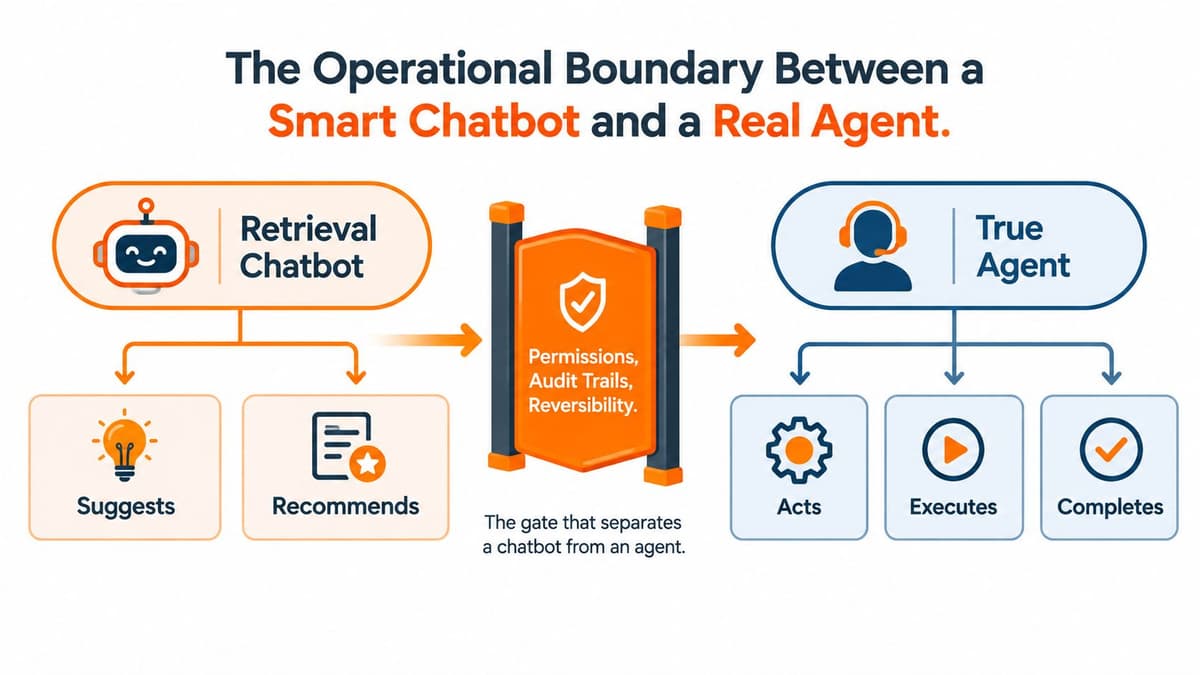
A founder should give autonomy only where four conditions hold:
- The action is bounded: The agent has a narrow job, not an open-ended instruction to “fix customer issues.”
- The permission is explicit: It can access and change only the records required for that job.
- The result is observable: Every tool call, decision, failure, and escalation appears in a ledger.
- The outcome is reversible: You can cancel, restore, refund, or otherwise correct the action without creating a second crisis.
A refund agent with no ceiling, no approval rule, and no action history isn't an efficiency project. It's an unstaffed operator with access to your cash and customer records. Start with recommendations or draft actions, then add execution only after the workflow behaves consistently under real exceptions.
The distinction becomes even clearer in reporting. A system that tells you what changed and recommends what to inspect remains a copilot. A system that changes bids, pauses campaigns, or rewrites a budget needs a stronger control layer. For a useful contrast between interpretation and operational reporting, review business intelligence reporting.
A short visual explainer can make the distinction concrete:
#Adoption Reality Check Before You Hand Over the Keys
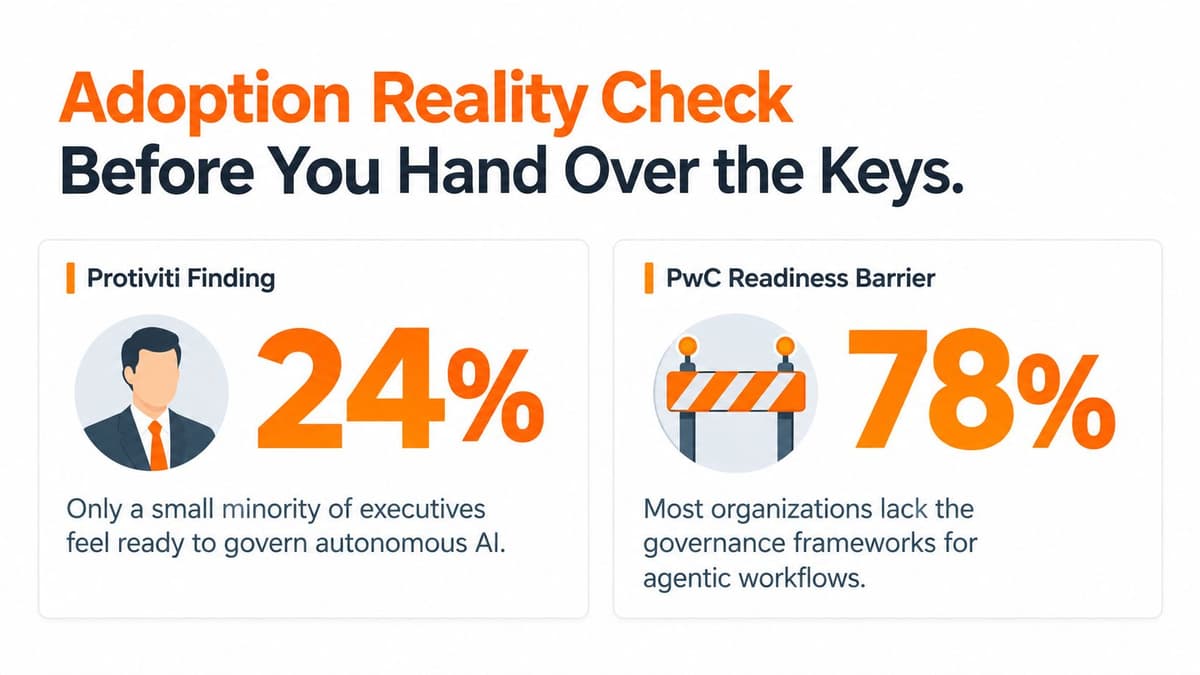
Agentic AI is useful, but the market is ahead of the operating discipline required to run it safely. Recent surveys indicate that adoption is meaningful but not universal. One industry survey reports that nearly one in four organizations have integrated agentic AI, while another reports 29% already using it and 38% planning implementation within a year, as summarized by Protiviti's AI Pulse survey.
That adoption doesn't prove readiness. The same body of research identifies mindset, change readiness, and workforce engagement as major barriers. In other words, many companies are still trying to align people, processes, data, and oversight before autonomous workflows can deliver dependable value.
For most founder-led Shopify brands, the decision is straightforward. Generative AI shipped today often beats a half-built agent shipped later because it improves drafting, analysis, and campaign production without giving an automated system direct authority over refunds, inventory, or advertising spend.
Before an agent receives production access, require four things:
- Clean product and customer data: The agent can't make reliable decisions from conflicting SKUs, missing costs, stale inventory, or unclear policy text.
- A defined success metric: “Improve operations” is not a testable instruction. Specify the workflow outcome and the exceptions that require escalation.
- A kill switch: A person must be able to stop execution immediately, without waiting for a vendor or developer.
- A named owner: One person must review the action ledger, investigate failures, and decide whether the scope expands.
The candid verdict is that generative AI is the right first move for nearly every small DTC brand. Build useful habits around review and measurement first. Add autonomy only when the volume and process stability justify the governance cost.
#A Phased Rollout Plan for Founder-Led DTC Brands
Start with output, then connect workflows, then test one tightly bounded agent. This sequence keeps the risk proportional to the capability you're introducing.
| Phase | Timeline | System Type | Shopify Actions | Guardrail | KPI to Watch |
|---|---|---|---|---|---|
| Foundation | Week one | Generative AI | Draft product descriptions, email subject lines, and paid-social copy using Shopify Magic, Klaviyo AI, or a comparable tool. | One human reviews every output before publishing. | Editor acceptance rate and correction themes. |
| Workflow layer | Month one | Triggered automation with generative steps | Use Shopify Flow for low-inventory, repeat-cart, or refund-requested triggers. | Keep actions rule-based, log every trigger, and route uncertain cases to a person. | Trigger volume, completion rate, and escalation count. |
| Bounded pilot | Quarter one | Agentic AI | Pilot reordering best-selling SKUs or pausing underperforming Meta ad sets. | Explicit permissions, logged approval, narrow scope, and an immediate kill switch. Review the weekly action ledger. | Correct actions, reversals, exceptions, and cost per successful task. |
#Week one
Choose three content jobs that already consume founder or marketer time. Feed the tool approved product facts, positioning, exclusions, and examples of your brand voice. Don't let the system publish automatically. Review every output and record recurring corrections, because those corrections become the operating rules for later automation.
#Month one
Use Shopify Flow to connect known triggers to known responses. A low-inventory trigger might notify the owner and generate a reorder recommendation. A repeat-cart trigger might start a review task. A refund-requested trigger might route the case to the right policy path while generative AI drafts the customer message.
This stage matters because it separates predictable automation from open-ended agency. For practical ideas on connecting marketing tasks to repeatable workflows, see small business marketing automation.
#Quarter one
Pilot one agent where the downside is contained. Reordering a clearly defined SKU or pausing an underperforming Meta ad set can be suitable if the thresholds, exclusions, approval step, and rollback process are explicit. Review the ledger every week before expanding permissions or adding a second workflow.
A marketing analyst such as Arlo can sit on the recommendation side of this rollout by reading Shopify, Meta Ads, and Google Analytics data and producing a weekly report on what changed, why it matters, and what to do next. That keeps decision support separate from autonomous execution while you build the controls needed for agents.
Install Arlo if you want a plain-language weekly view of your Shopify, marketing, customer, and product signals before automating actions. Use its prioritized recommendations to decide which workflow deserves generative assistance, deterministic automation, or a carefully bounded agent.