Multi Touch Attribution Model
By Arthur Falcone · Founder of Arlo
Your Shopify dashboard says things are working. Meta looks efficient. Google says branded search is crushing it. Klaviyo gets the sale at the end and takes the victory lap.
Then you check the bank account and think, something's off.
That gap is where most founder-led brands get stuck. You're not short on data. You're drowning in platform-specific reporting that makes every channel look like the hero. Meanwhile, cash flow gets tighter, inventory decisions get riskier, and you still can't answer the only question that matters: what is driving profitable growth?
A multi touch attribution model helps you get closer to that answer. Not because it gives you perfect truth. It doesn't. But it gives you a more honest picture than the usual last-click nonsense. If you run a Shopify brand and your customer journey includes more than one visit, more than one channel, or more than one nudge before purchase, you've already outgrown simple attribution.
If you need a clean way to think about growth reporting, start by understanding the difference between ROAS and ROI in ecommerce. That distinction alone explains why “good ad performance” can still leave you short on cash.
#Table of Contents
- Your Ad Reports Look Great but Your Bank Account Disagrees
- Why Last-Click Attribution Is Lying to You
- Comparing Common Multi Touch Attribution Models
- The Data You Need to Build a Model on Shopify
- The Two Paths to Implementation A Reality Check
- How to Use Attribution Insights and Avoid Common Traps
- The 20-Minute Path to Smarter Attribution Insights
#Your Ad Reports Look Great but Your Bank Account Disagrees
You've probably lived this already. Your agency sends a tidy weekly report. Meta performance looks healthy. Google branded search appears efficient. Email is “printing money.” Everyone sounds confident.
But payroll still hits hard. Inventory is still a gamble. And your margin doesn't feel anything like the dashboard promised.
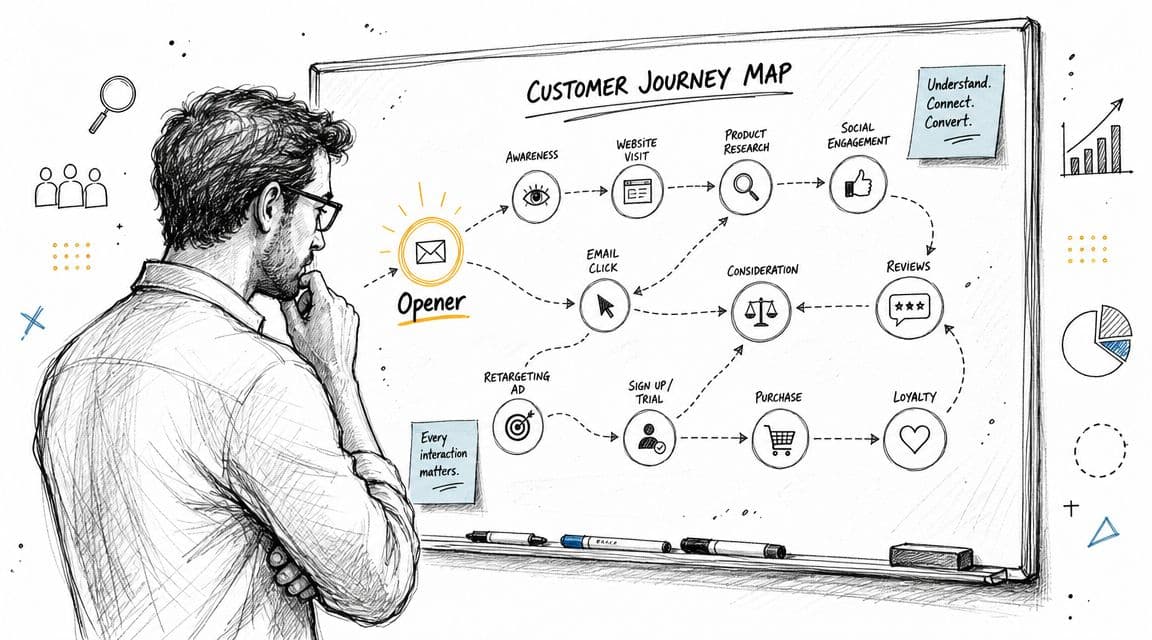
That usually means your reporting is crediting the easiest channel to see, not the full path that caused the sale. A customer might discover you on TikTok, come back through organic search, join your email list, click a retargeting ad, then buy after searching your brand name. If you only credit the final step, you'll keep shoveling money into channels that harvest demand and starve the ones that created it.
#The cash flow problem behind attribution
This isn't a nerdy analytics issue. It's a budgeting issue.
When you misread channel performance, you make bad operating decisions:
- You overfund retargeting because it appears to convert cleanly.
- You underfund discovery because top-of-funnel looks expensive on paper.
- You trust blended revenue more than contribution logic and lose the thread on what moved a shopper toward purchase.
Practical rule: If your ad reports look strong but cash feels tight, don't assume the problem is spend alone. Assume your measurement is hiding the sequence that produced the sale.
A good multi touch attribution model doesn't magically fix marketing. It does something more useful. It shows which channels open the journey, which ones assist, and which ones close. That changes how you allocate budget, how you judge agencies, and how aggressively you scale.
#What changes when you stop buying the platform story
Founders don't need another dashboard. They need fewer bad decisions.
Once you start looking at the whole journey, a lot of “winning” channels shrink back to their real role. Some are closers. Some are support acts. Some are expensive and still necessary because they create future demand. That's a much better lens for a Shopify business than celebrating isolated ROAS screenshots.
#Why Last-Click Attribution Is Lying to You
Last-click attribution is popular for one reason. It's easy.
It's also lazy. It gives all the credit to the final touch before purchase and ignores the work that happened earlier. For a DTC brand, that's like judging your whole marketing system by the shopper's final nudge, not the series of interactions that got them there.
#The striker gets all the credit
Think about a soccer goal. The defender starts the play. The midfielder makes the pass that breaks the line. The striker finishes. Last-click attribution gives the striker all the glory and pretends the other two players were just cardio.
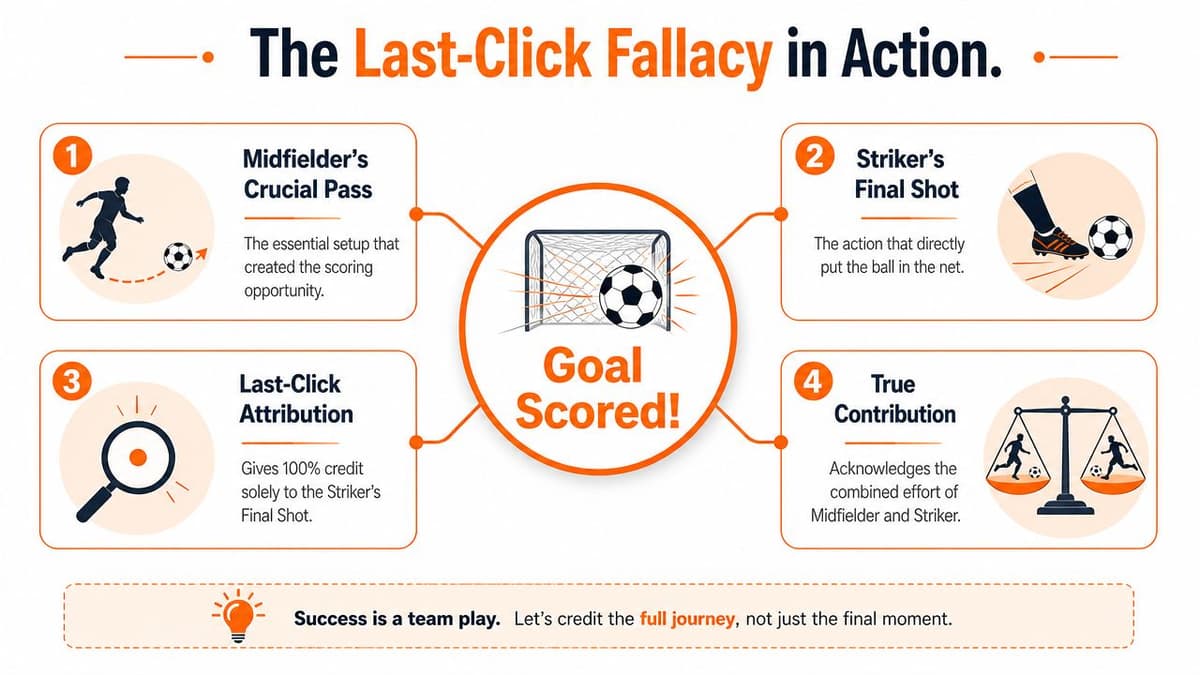
That's exactly what happens in most ad accounts. Branded search and retargeting often get the sale at the end, so they collect the credit. The discovery ad, influencer mention, email signup, or content touch that started the journey gets ignored.
A better model spreads credit across the path. Multi-touch attribution is technically stronger than single-touch models because it assigns fractional credit across the entire path to conversion, which helps you distinguish assist channels from closing channels and understand how channels interact through the funnel.
If you want a better mental model for that path, look at the customer digital journey for ecommerce brands. Most buyers don't move in a straight line, and your reporting shouldn't pretend they do.
#What founders get wrong when they trust platform reports
The first mistake is treating platform reporting as neutral. It isn't. Meta wants to show Meta's value. Google wants to show Google's value. Email platforms love taking credit for the final click.
The second mistake is cutting channels that don't close fast. Discovery channels rarely look pretty in last-click reporting. That doesn't mean they're weak. It means they do a different job.
Here's what last-click usually distorts:
- Retargeting looks stronger than it is because it shows up near the finish line.
- Branded search gets overpraised because shoppers already know who you are when they search.
- Content, social discovery, and upper-funnel creative look weak because they often introduce interest rather than capture it.
- Email gets simplified into “the revenue channel,” when in reality it may just be the final reminder in a longer sequence.
If you only reward closers, you slowly kill the channels that create future customers.
That's why founders who obsess over last-click often hit a ceiling. They get very good at harvesting existing demand and very bad at generating fresh demand. In the short term, reports look efficient. In the medium term, growth stalls.
#Comparing Common Multi Touch Attribution Models
Once you stop trusting last-click, the next question is obvious. How do you split the credit?
You don't need a PhD for this. You need a practical model that reflects how your customers buy.
#A simple Shopify journey
Use a basic four-touch journey:
- A shopper first sees a TikTok ad
- Later they read a blog post
- They subscribe and click an email
- They finally buy after a Google search
That path is common in Shopify. Discovery happens on one channel. Consideration happens somewhere else. The close happens where intent is highest.
For broader ecommerce reporting context, it helps to understand how teams structure analytics in ecommerce. Attribution is one layer of that stack, not the whole thing.
#How the common models split credit
Here's the clean comparison founders need.
| Touchpoint | Linear Model | Time-Decay Model | U-Shaped Model |
|---|---|---|---|
| TikTok ad | Equal credit | Less credit than later touches | High credit as first touch |
| Blog post | Equal credit | Some credit | Shared part of middle credit |
| Equal credit | More credit than earlier touches | Shared part of middle credit | |
| Google search | Equal credit | Most credit as latest touch | High credit as last touch |
Linear is the simplest. Every touchpoint gets equal credit. It's blunt, but it's useful when you want a fast correction away from last-click bias.
Time-decay gives more weight to touches closer to the sale. That makes sense if your buying cycle is short and late-stage reminders matter more than early awareness.
U-shaped is the most practical starting point for a lot of DTC brands. It recognizes the channel that introduced the customer and the channel that closed the deal, while still giving some value to the middle touches. Salesforce describes the common U-shaped split as 40% to the first touch, 40% to the last touch, and the remaining 20% to middle interactions in its guide to multi-touch attribution.
Founder shortcut: If your brand is still working hard to acquire net-new customers, start by paying close attention to first-touch and last-touch together. That usually tells a more useful story than obsessing over the final click alone.
There are also more advanced options. Some teams use deterministic rule-based models like linear, time-decay, and position-based logic. Others use data-driven approaches such as machine-learning weighting, Markov chains, and Shapley-style methods to estimate the marginal contribution of each touchpoint. Those methods can be powerful, but most Shopify brands don't need to start there.
#Which model should a founder start with
My opinion is simple.
- Use linear first if your current reporting is a mess and you need a neutral reset.
- Use time-decay if your purchase cycle is short and repeat touches near the end really do matter.
- Use U-shaped if you care about both customer acquisition and closing efficiency.
If you're busy, don't chase the “perfect” model. Pick one that matches the shape of your buying journey and use it consistently enough to make better budget calls.
#The Data You Need to Build a Model on Shopify
Attribution doesn't fail because the model is wrong. It usually fails because the data is sloppy.
A multi touch attribution model only works if your Shopify stack can capture events, connect identities, and tie those interactions back to actual orders. If those basics are broken, every chart downstream is just dressed-up guesswork.
#The three pieces you actually need
Twilio lays this out clearly in its introduction to multi-touch attribution. A practical implementation needs three systems working together: event-level collection across channels, identity resolution in a central platform, and a modeling layer that computes credit allocation.
For a Shopify founder, that translates into three plain-English requirements:
- Capture interactions properly: Your site, ads, email, and CRM need to record meaningful events.
- Recognize the same shopper over time: If someone clicks on mobile and buys later on desktop, your stack should try to connect those actions.
- Apply consistent attribution logic: The reporting layer needs a clear rule for how credit gets assigned.
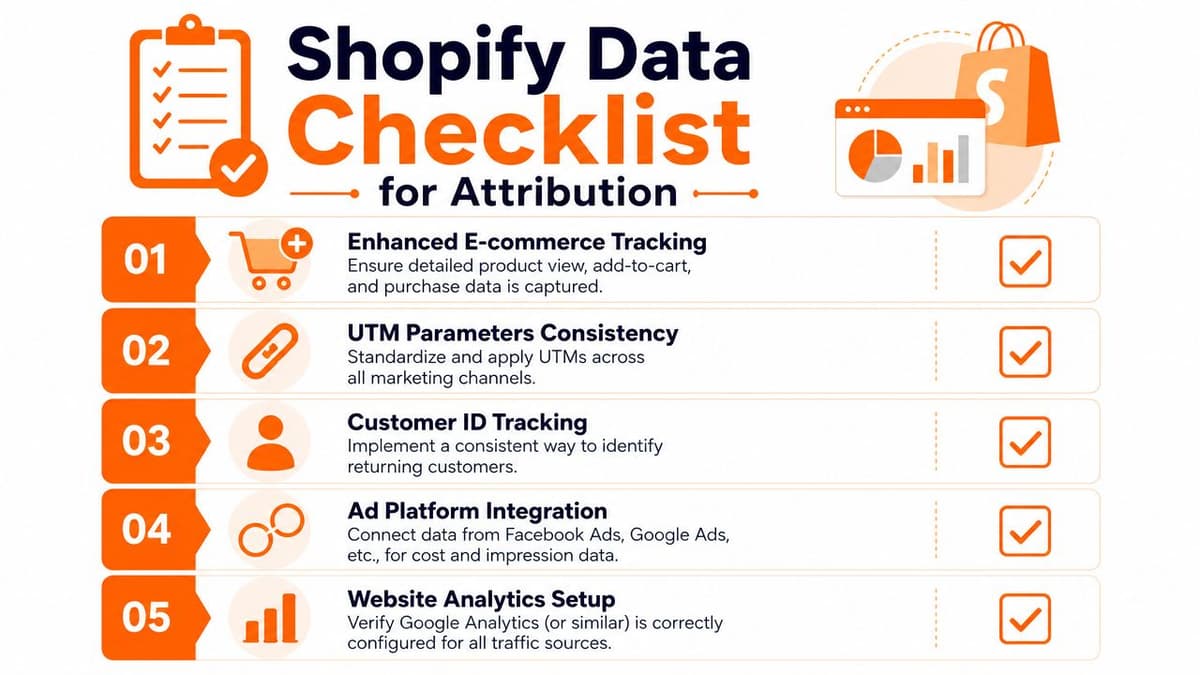
#Your Shopify tracking checklist
Most founders don't need more software first. They need cleaner inputs.
- Get disciplined with UTMs: Every paid ad, email campaign, influencer link, and partnership link should use a consistent naming structure. If one campaign is tagged three different ways, attribution gets muddy fast.
- Track key ecommerce events: Product views, add-to-cart actions, checkout starts, and purchases should be captured reliably. Missing event data breaks the journey.
- Connect ad data to store data: If cost data sits in one place and order data sits somewhere else, you'll keep making partial decisions.
- Use a stable customer identifier where possible: Logged-in behavior, email captures, and CRM records all help stitch the path together.
- Audit channel naming every month: “Meta,” “Facebook,” and “Paid Social” should not show up as separate channels unless you intentionally want them separated.
Cross-device behavior is where reality gets annoying. A shopper might discover you during lunch on Instagram, browse later from a work laptop, then purchase from a tablet at home. Your tools won't capture that perfectly.
That's fine. You do not need perfect identity matching to get useful directional insight. You do need enough consistency to stop lying to yourself.
Messy tracking creates fake certainty. Clean tracking creates useful doubt, which is much better for decision-making.
#The Two Paths to Implementation A Reality Check
At this point, founders usually get sold a fantasy.
The fantasy is that you can “just set up attribution” and suddenly know exactly how every channel contributes. In reality, there are two paths. One gives you control but eats time. The other gives you speed but limits customization.
Neither is wrong. One is usually wrong for your stage.
#Path one is the tool-heavy DIY route
This is the route where you assemble the stack yourself. That might mean combining Shopify data, GA4, ad platform exports, email data, a warehouse, and an attribution tool like Triple Whale or Rockerbox. Or you try to force GA4 into doing more than your team has time to manage.
The upside is obvious. You get more control over naming, logic, windows, and reporting.
The downside is also obvious:
- Setup drags on: Tagging, mapping, validation, and cleanup take real time.
- Someone has to own it: If nobody on your team wakes up excited to debug attribution, the system degrades.
- You can drown in options: More dimensions don't automatically produce better decisions.
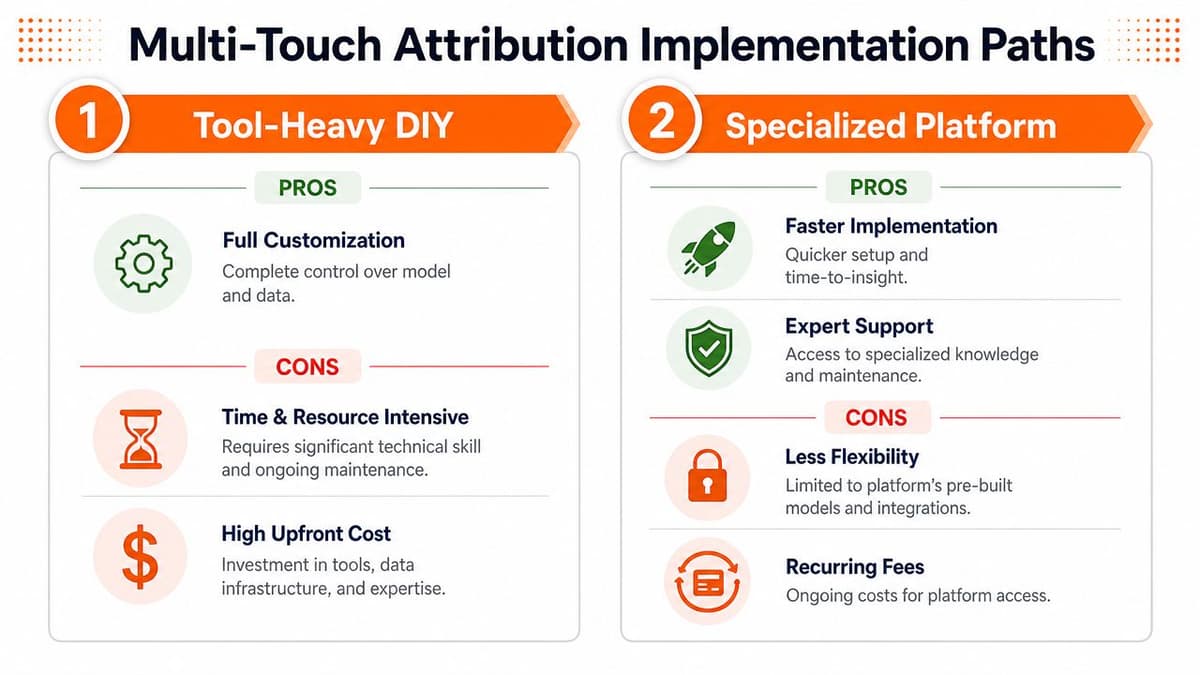
For brands with a strong ops lead or in-house analyst, DIY can make sense. For most founder-led stores, it becomes one more half-built system nobody fully trusts.
#Path two is the simplified insights route
This route matters more for busy operators. Instead of building a custom attribution machine, you use a system that handles the integration, normalization, and interpretation for you.
You give up some flexibility. In return, you get faster answers and less maintenance.
This approach works best when:
- You need decisions, not dashboards
- Your team is small
- You don't want to babysit definitions and event mapping
- You care more about finding waste and channel interplay than publishing a pristine analytics architecture
You're not buying attribution to impress a data team. You're buying it to make better budget calls next week.
#How to choose without wasting a quarter
Ask three questions.
First, who will own the system every week? If the honest answer is “nobody,” don't choose the complex route.
Second, do you need custom modeling or clearer judgment? Most Shopify brands need clearer judgment.
Third, is your current bottleneck data access or decision speed? Founders often think they need more data. What they usually need is a simpler way to understand what the existing data is already saying.
My advice is blunt. If you're under-resourced, don't buy the most configurable attribution setup you can find. Buy the one your team will use. A less flexible system that gets reviewed weekly beats a complex system everyone avoids.
#How to Use Attribution Insights and Avoid Common Traps
Attribution only matters if it changes spend, creative, and channel priorities. Otherwise it's just a more expensive way to stare at marketing.
The smartest use of a multi touch attribution model is simple. Separate the channels that open demand from the ones that close it, then fund each based on its job.
#Separate opener channels from closer channels
Some channels are built to introduce new people to the brand. Others are built to convert people who are already leaning in. Treating them the same is how budgets get distorted.
Look at your channels through this lens:
- Openers: Paid social discovery, creator content, upper-funnel video, non-branded content, awareness campaigns.
- Closers: Branded search, retargeting, SMS reminders, promotional email, high-intent search.
- Assist channels: Blog content, welcome flows, product education emails, review pages, landing pages that move people from curiosity to confidence.
Once you separate roles, budget decisions get cleaner. If an opener channel rarely closes but repeatedly appears early in converting journeys, that's useful. If a closer channel always gets the final click but almost never introduces net-new buyers, that's also useful.
#The traps that wreck attribution decisions
Most founders don't fail because they ignore attribution. They fail because they misuse it.
-
Analysis paralysis
You do not need fifteen views of the same journey. Pick a model, review it regularly, and make one or two budget decisions from it. -
Blind trust in messy data
If tracking is inconsistent, treat the output as directional. Don't make surgical decisions from broken plumbing. -
Forgetting that models are models
Attribution is a decision aid. It is not reality itself. Use it alongside margin, inventory risk, conversion rate, and repeat purchase behavior.
The right question isn't “Which channel won?” It's “Which sequence keeps producing profitable customers, and where are we overspending for credit that was already earned upstream?”
That question tends to cut through the noise fast.
#The 20-Minute Path to Smarter Attribution Insights
Most Shopify founders don't need to build a full attribution lab. They need fast, credible insight they can act on before the week gets away from them.
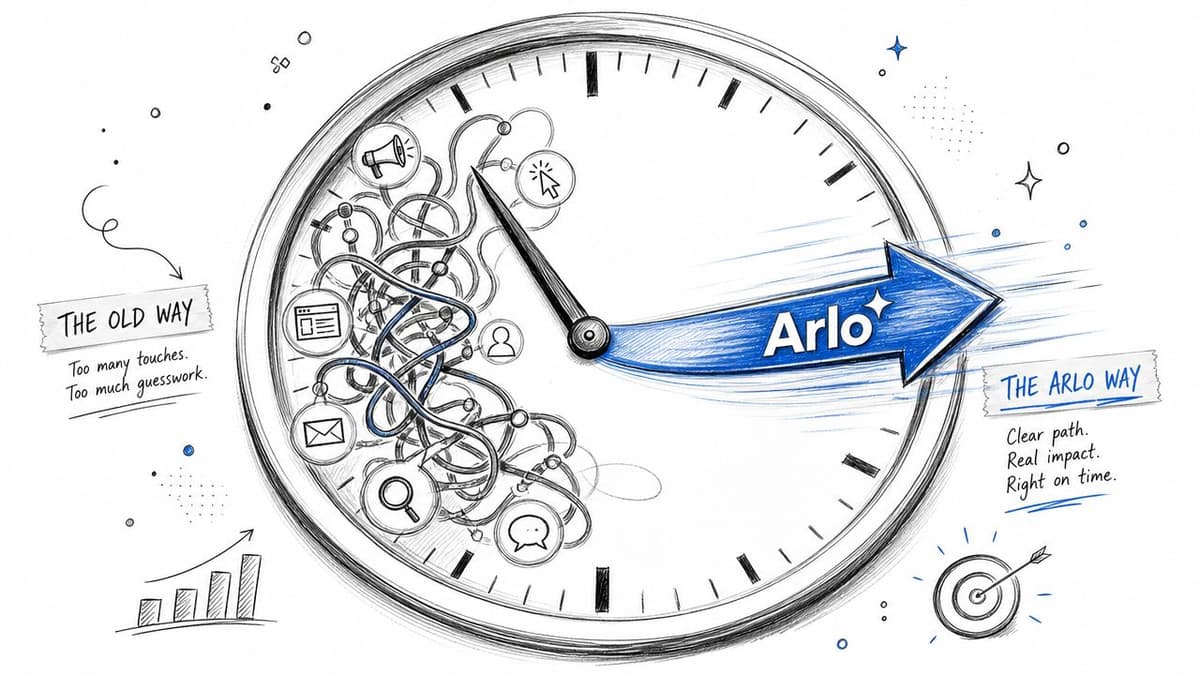
That's the practical gap a lot of analytics software misses. It gives you more charts, more filters, more setup, and more ways to procrastinate. It doesn't give you a plain-English answer to what changed, why it matters, and what to do next.
#What a busy founder actually needs
You need a system that connects to Shopify quickly, reads your sales and marketing signals together, and tells you which channels are acting as openers, closers, and support. You need weekly clarity, not another dashboard archaeology project.
That's why the best attribution-adjacent tools for founder-led brands focus on interpretation. They turn messy cross-channel behavior into a short list of actions. Pause this. Fix that. Protect this win. Investigate that drop. Reallocate budget from a channel that's taking easy credit to the one doing the heavy lifting upstream.
A short walkthrough helps show what that experience should feel like in practice.
If you're spending your Sunday night bouncing between Shopify, Meta Ads Manager, GA4, and Klaviyo, your reporting stack is working for itself, not for you. The right setup should reduce decision time. It should not create a part-time analyst job inside your founder role.
Arlo gives Shopify brands that simpler path. It acts like an AI marketing analyst that turns your store, traffic, customer, and product data into a concise weekly “20 Minute CMO” report. Instead of forcing you to build and maintain a complex multi touch attribution model yourself, Arlo helps you see what changed, which channels are opening and closing demand, where waste is creeping in, and what to do next in plain English. If you want faster insight with less dashboard work, it's worth a look.