What Does a Marketing Analyst Do for DTC Brands
By Arthur Falcone · Founder of Arlo
You've got the tab open, the Shopify dashboard is up, and the weekly numbers are already making you uneasy. Revenue looks flatter than it should, ad spend is still moving, email is doing something, and the problem is obvious enough to sting, nobody on the team is turning all that data into one clean decision for this week.
That's why people search what does a marketing analyst do. They don't really want an org chart answer. They want to know who translates store data into action, what that work looks like in practice, and whether they need a person, a contractor, or a tool to do it.
#Table of Contents
- Why Founders Search This and What They Really Need
- The Actual Role of a Marketing Analyst
- A Typical Week in the Life of a DTC Marketing Analyst
- KPIs That Move a Shopify Brand
- Hiring In-House, Going Fractional, or Using AI
- Real Examples of Analyst Work Paying Off
- Your Next 30 Days as a Founder
#Why Founders Search This and What They Really Need
Tuesday morning often starts the same way. Revenue is flat, the dashboard is full, and the founder can see that the numbers are pointing at something, but nobody has translated them into a decision yet.
That is why this question shows up in search. A founder does not need another definition of a marketing analyst, they need decision support. They need someone who can read campaign performance, store behavior, and retention signals, then say what should change next, not just what happened.
Practical rule: If a report does not change a budget, a test, a message, or a merchandising choice, it is not doing analyst work yet.
A strong analyst turns raw customer and campaign data into a recommendation leadership can act on. That is the value behind the role described in industry summaries, which cover tracking marketing performance, forecasting trends, analyzing competitors, and presenting recommendations to leadership Loyola Sellinger Business, 2025. The spreadsheet is only the starting point. The judgment that follows is what founders are paying for.
The hard question is not whether analysis matters. It is whether you need that translation layer in-house, on a fractional basis, inside your weekly operating rhythm, or through an AI workflow like a data analytics dashboard. A DTC brand usually does not need analysis in the abstract, it needs a clear answer before next Monday, what should change first?
#The Actual Role of a Marketing Analyst
A marketing analyst is the person who turns behavioral, transactional, and channel data into prioritized actions tied to revenue, retention, or acquisition cost. In a DTC setting, that means reading what shoppers did, what campaigns cost, where drop-off happened, and what should change next.
A founder usually feels this gap most clearly after a few weeks of mixed signals. Revenue may be flat while CAC rises, email appears strong while repeat purchase slips, and paid social looks busy without improving margin. The analyst's job is to sort through that noise and point to the one decision that matters this week.
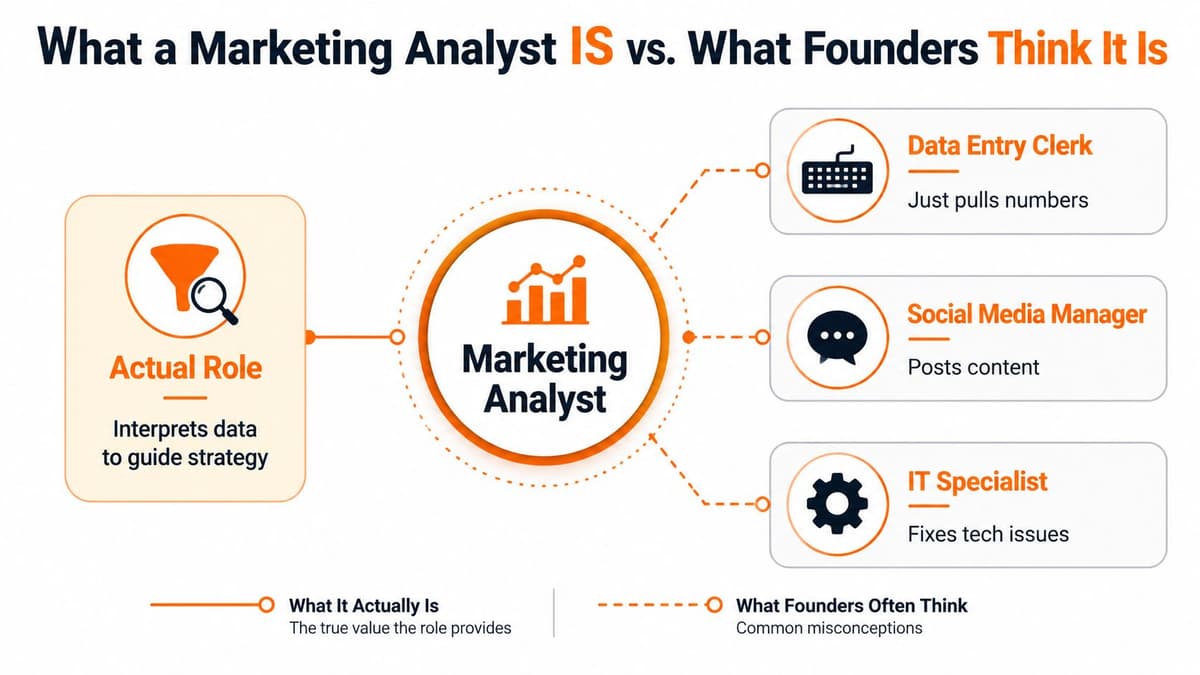
The confusion starts because founders often lump this role together with three other jobs. They are not the same.
#What the role owns
The analyst owns interpretation. That includes market research, statistical analysis, dashboard and report creation, and strategic advice, which is why the role extends beyond a reporting layer Loyola Sellinger Business, 2025. In a modern Shopify business, the work often includes web analytics, A/B testing, paid media data, customer behavior signals, and tools like GA4, Tableau, Power BI, SQL, and statistical testing JobDescription.org.
Rather than admiring dashboards, they identify which lever matters and explain why.
That shift matters because the role used to be much more periodic, with traditional market reporting taking a bigger share of the job. As digital channels expanded in the 2000s and 2010s, the work became more continuous, more operational, and much more connected to live campaign performance. Founder-led brands feel that change fastest because there is no large analytics org to absorb the noise.
#What it is not
A marketing analyst is not a data entry clerk who just pulls numbers. They are not a social media manager who posts content. They are not an IT specialist who fixes tech issues. Those people all matter, but none of them own the translation from data to decision.
For a useful internal example of dashboard thinking, the role sits much closer to a translation layer than a chart wall, which is why a practical view of a data analytic dashboard matters. The best candidate, contractor, or tool should be able to answer a simple founder question, what changed, what does it mean, and what do we do next?
#A Typical Week in the Life of a DTC Marketing Analyst
A good analyst week doesn't look like endless reporting. It looks like a sequence of decisions, each one narrowing the founder's next move.
#Monday through Friday in practice
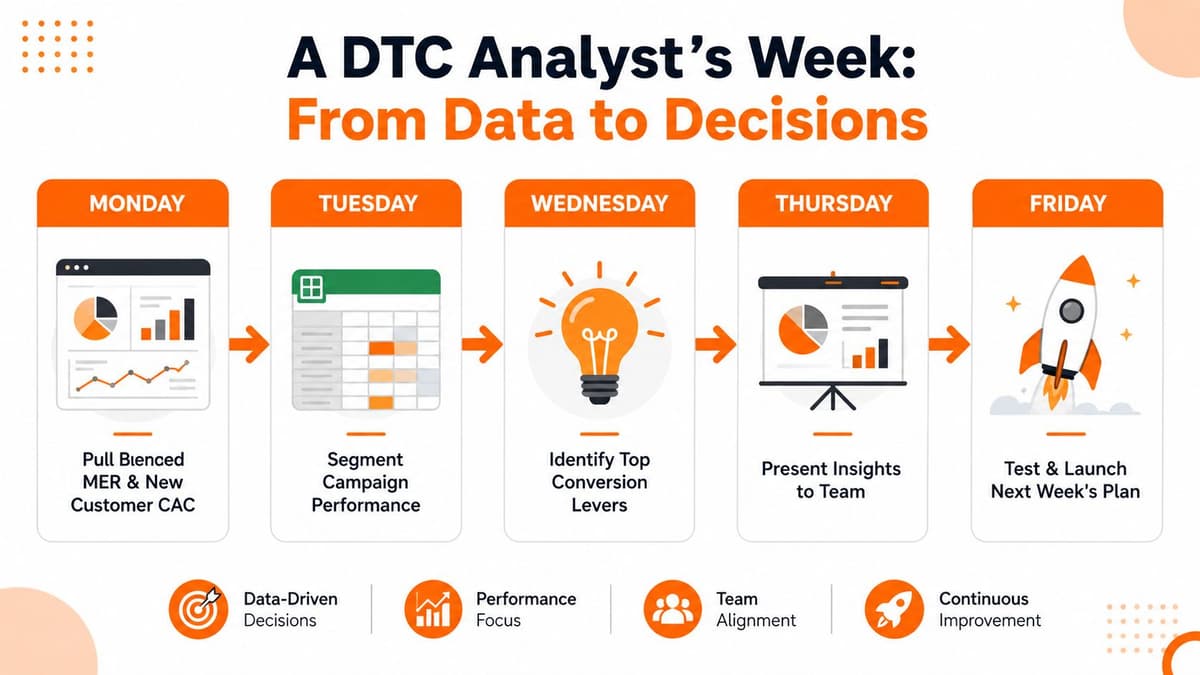
Monday starts with a blended read on revenue efficiency, new customer CAC, and retention against the recent baseline. The analyst isn't looking for drama, they're looking for the one number that moved hardest and whether it points to spend, conversion, or repeat behavior. The decision is usually simple, hold, cut, or test.
Tuesday is where trust gets built or broken. Recent job descriptions call out A/B test analysis, dashboard creation, and troubleshooting tracking or tagging issues that distort the data UpGrad, 2025. If UTM tags are messy or pixel events are broken, the analyst cleans that up before anyone changes budgets, because bad attribution creates confident mistakes.
Wednesday and Thursday are for experiments and readouts. The analyst reviews product page tests, checkout changes, or email flows, then ranks the next actions by likely business impact. That ranking is the point, because founders don't need twenty ideas, they need the top three that deserve capital and attention.
Friday is the synthesis day. The analyst packages the week into a one-page summary, explains the forecast, and makes sure the team knows what to do before the next cycle starts. That weekly rhythm is a quiet advantage in brands that move fast, because the work forces interpretation before reaction.
#The weekly output that matters
A useful analyst doesn't hand you a pile of screenshots. They hand you a short narrative with three things, what changed, why it matters, and what gets tested or fixed next. The best version reads like a plan, not a status update.
#KPIs That Move a Shopify Brand
A DTC analyst can stare at a hundred metrics and still miss the only ones that matter. The useful job is to reduce noise into three buckets, then use the right metric for the right decision.
#The numbers worth watching
| KPI | What it tells you | Healthy range for a DTC brand |
|---|---|---|
| Blended MER | How efficiently total marketing spend is turning into revenue | Qualitatively strong enough to support growth without starving margin |
| Contribution margin | Whether revenue is leaving enough room for operations and growth | Positive and stable enough to fund the next decision |
| New customer CAC | What it costs to acquire a first-time buyer | Stable relative to product margin and payback goals |
| LTV | What a customer is worth over time | High enough that repeat purchases justify acquisition |
| Repeat purchase rate | Whether buyers come back | Strong enough to keep CAC from carrying all the weight |
| AOV | How much each order is worth | Improving through bundles, upsells, or smarter merchandising |
| Subscription retention | How long subscribers stay active | Stable enough that churn doesn't erase acquisition wins |
| Conversion rate by traffic source | Which channels convert | Better on the channels worth scaling |
| Checkout abandonment | Where shoppers leave | Low enough that checkout friction isn't suppressing demand |
| Email revenue share | How much revenue email contributes | Meaningful enough that lifecycle flows deserve attention |
The pattern matters as much as the metric names. You want a small set of numbers that tells you whether the brand can spend, whether it can keep the cash it earns, and whether repeat behavior is strong enough to make acquisition less fragile.
If you want a useful adjacent lens, the metrics for custom apparel business resource is a decent reminder that satisfaction and repeat behavior often show up together in store economics. The metric names differ by brand, but the logic is the same, revenue alone doesn't tell you whether the business is getting healthier.
#What not to chase
Raw session counts can make a weak store look busy. Social follower growth can feel encouraging while sales stay flat. Platform-reported ROAS is especially risky because it counts orders inside the platform's own attribution window, which can make channel performance look cleaner than it really is.
The metric that deserves the most respect is the one that changes a decision. If a KPI doesn't tell you whether to spend more, spend less, fix the site, or change the offer, it's decoration.
For a tighter ecommerce KPI framework, the e-commerce metric lens in Kpis for Ecommerce helps when you want the whole stack to point toward one commercial answer. The analyst's job is to connect the dots into a single commercial answer.
#A simple rule for action
Action rule: If a metric moves and you can't name the business decision it affects, don't react yet.
That one filter saves founders from chasing signals that are visually loud but commercially soft.
#Hiring In-House, Going Fractional, or Using AI
The right setup depends on how much complexity you have. A brand with stable spend and a few key channels needs something very different from a founder still wrestling with attribution, margins, and email flows.
#Four ways to get the work done
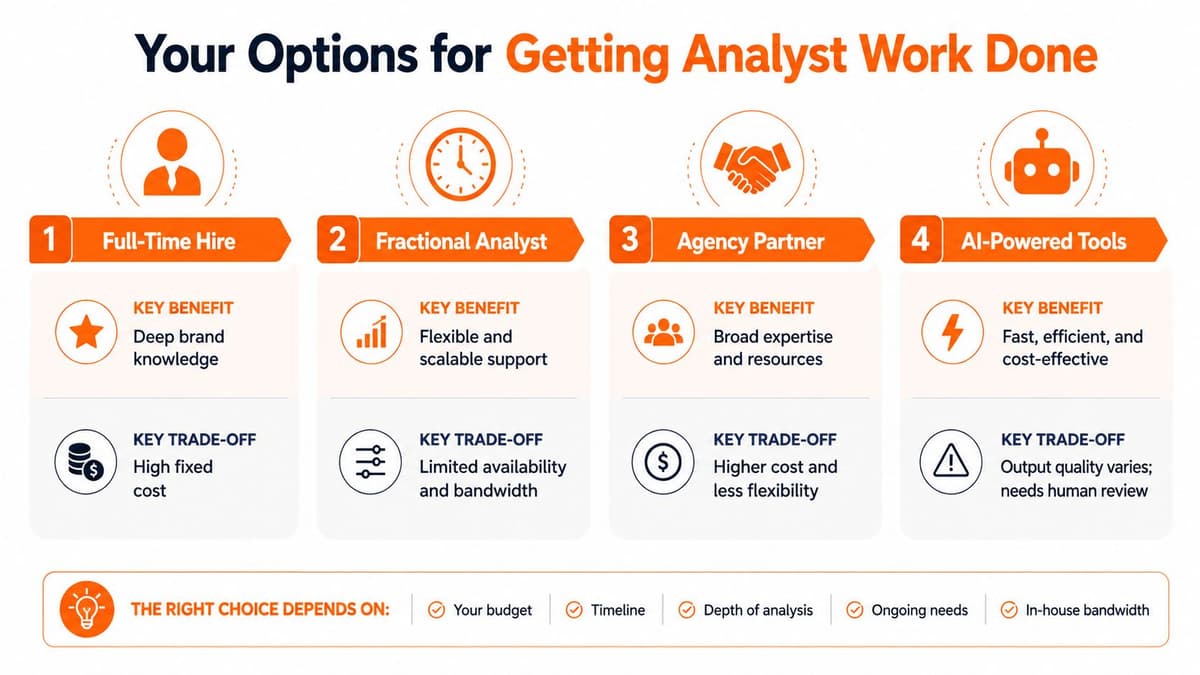
Full-time hire makes sense when the volume of decisions is constant enough to justify a salary. The upside is deep brand knowledge and tighter ownership. The trade-off is obvious, it's a high fixed cost and a slower search.
Fractional or agency support works when you need senior judgment a few days a week. This is often the middle path for a brand that has real data but doesn't need a full analytics seat yet. Quality can be excellent, but continuity varies and context can disappear between meetings.
Founder-led analysis is the cheapest route and sometimes the smartest early move. A structured weekly ritual forces the founder to learn the business numbers directly, which is valuable. The downside is time, because every hour spent interpreting dashboards is an hour not spent on product, merchandising, or brand.
AI analyst tools fit when the data exists but the interpretation bottleneck is human attention. In the Arlo context, that means a weekly “20 Minute CMO” report, prioritized actions, estimated dollar impact, and a five-minute audio brief, all with setup designed to be fast through Shopify. It's the kind of workflow that helps when you need the analysis, not another dashboard to babysit. A related use case for AI-generated business assets shows up in categories like an ai lookbook generator, where the value is speed plus structured output, not more manual assembly.
#How to choose without overthinking it
If you're early and still learning the business, start with your own weekly ritual. If you're past that point and keep stalling on interpretation, bring in fractional help. If your revenue and channel mix justify continuous ownership, hire in-house. If you mostly need a clear weekly readout from existing data, an AI analyst can be enough.
A useful product-side comparison is how AI agents are starting to package repeated analysis into a repeatable brief, which is why the AI agents use cases angle matters for teams trying to replace manual triage with a predictable decision loop. The question isn't whether the machine is clever, it's whether it gives you a decision you would act on.
#A blunt filter
If you can't describe the one question you want answered every week, don't hire yet. Fix the question first, then choose the operating model.
#Real Examples of Analyst Work Paying Off
The difference between a real analyst and a dashboard watcher shows up in the recommendation. The data is only useful when it changes the next move and the founder can connect that move to a commercial outcome.
#An AOV lever that actually matters
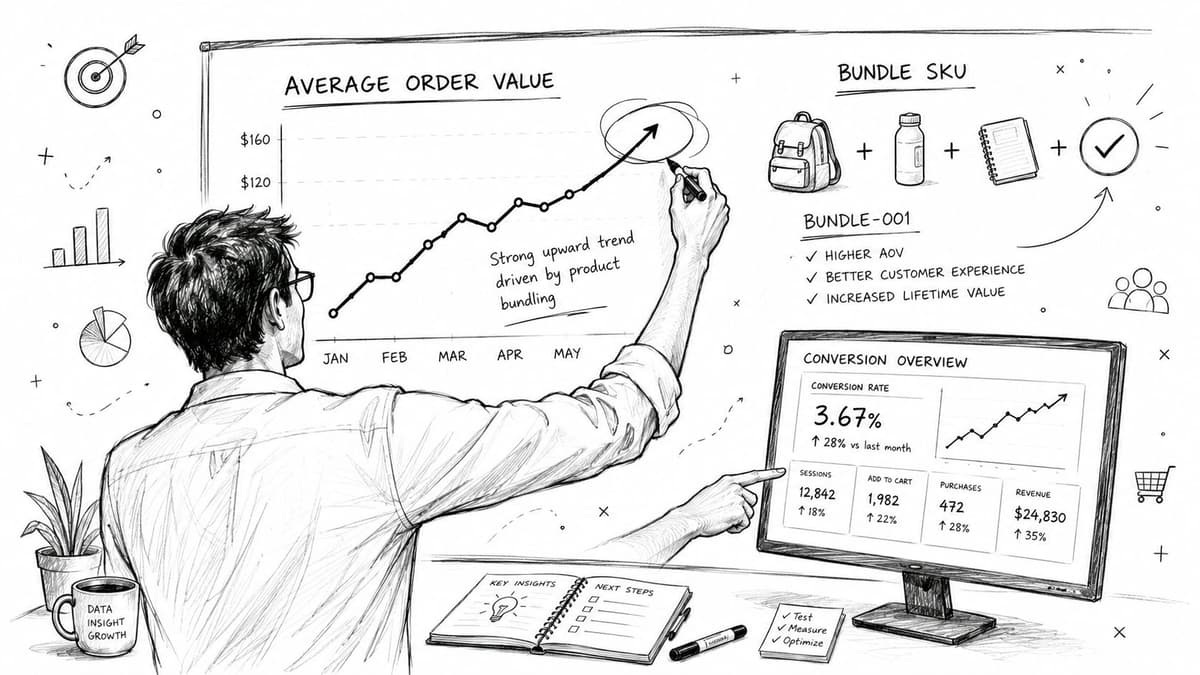
A store sees average order value go nowhere for weeks. The analyst notices that one bundle SKU has become the highest-margin item, then recommends a checkout upsell that pairs it with a low-attach accessory. The logic is simple, increase the attach rate on a product that already proves customers are willing to buy it.
That's the translation step founders pay for. The analyst doesn't stop at “bundle sales are up.” They turn that signal into a concrete merchandising change and estimate the revenue effect based on how often the extra item should attach. The founder now has a test, not a feeling.
#A retention lever that should come before more spend
Another store keeps buying traffic while repeat revenue stays stubborn. The analyst finds that first-purchase customers who receive a follow-up flow within 48 hours are behaving better than the group that doesn't, and the email flow is broken. The right move is not to increase acquisition yet. It's to fix the retention path first.
That's where analyst work earns its keep. A broken retention system can make new spend look weaker than it is, while a fixed flow can raise customer value without adding more traffic pressure. The recommendation ties directly to lifetime value, which is why it matters more than a prettier dashboard.
The best analyst output names the lever, names the decision, and names the downside of waiting.
In both cases, the work is not reporting. It's sequencing. First fix the thing that is leaking value, then spend more once the system can hold it.
#Your Next 30 Days as a Founder
Start with three questions. How many dollars move each week in your store, do you already have a written weekly ritual, and are you personally the bottleneck on interpretation?
If the answer is that the numbers are changing every week, you need a decision rhythm now. Build a five-number weekly template yourself this month if you want speed and context. Interview two fractional analysts if you want senior judgment without a full-time hire. Install an AI analyst tool if you want a fast first read from the data you already have.
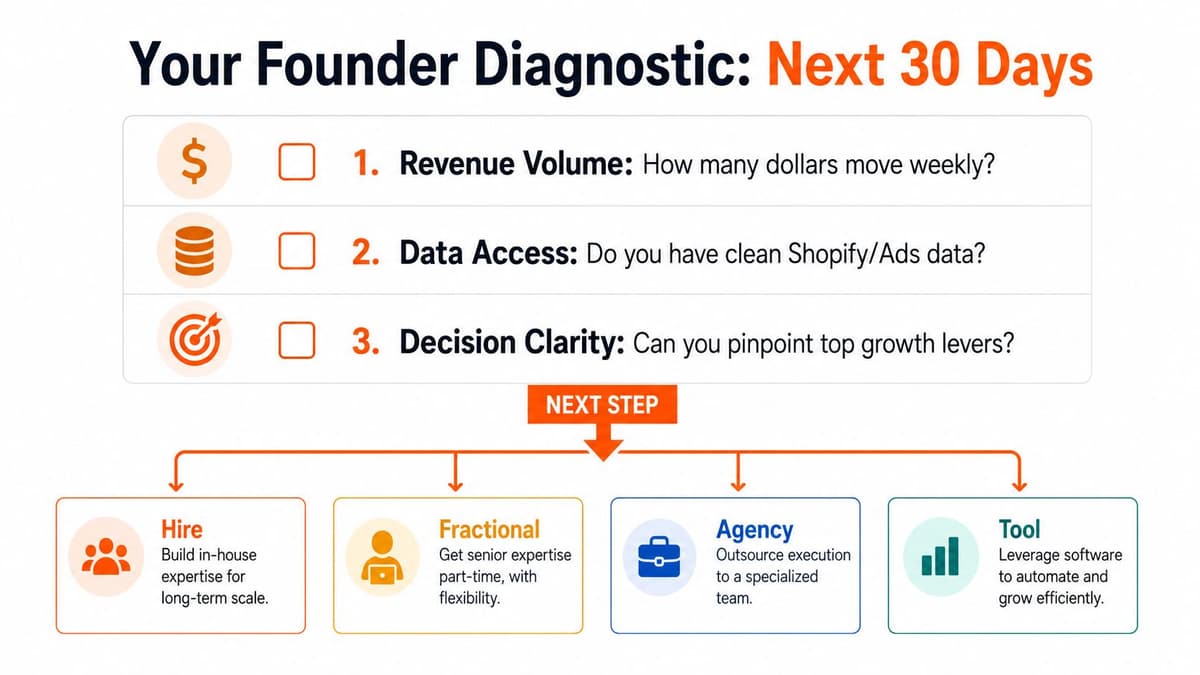
Before any of those paths can work, clean up attribution, set one source of truth for revenue, and write down the three questions you need answered each week. If you do that, the analyst, whether human or software, has something real to translate.
If you want a weekly readout that turns Shopify data into plain-English decisions, Arlo is built for that job. It takes store signals, ranks the next actions by urgency and dollar impact, and gives founders a short report they can use instead of another dashboard to check.