What Does AOV Stand for? a Guide for Shopify Stores
By Arthur Falcone · Founder of Arlo
AOV stands for Average Order Value, and you calculate it by dividing total revenue by the number of orders. If your Shopify store makes $2,000 from 100 orders, your AOV is $20, and pushing that to $22 raises revenue to $2,200 without adding new orders.
If you're running a Shopify store, you already know the grind. Ads get pricier, traffic gets less predictable, and every app promises growth while your margin gets squeezed. That's why busy founders keep asking what does AOV stand for. Not because they need a glossary definition, but because they need a cleaner path to revenue.
Here's the blunt answer. AOV matters because it tells you how much each transaction is worth, and that makes it one of the fastest levers you can pull without chasing more traffic. But most advice on AOV is too shallow. A bigger order isn't automatically a better business. If you force bigger carts in ways that reduce repeat purchases, you can hurt long-term growth.
That's the part most articles skip. You don't want the highest possible AOV. You want the highest healthy AOV, the kind that improves revenue without wrecking conversion or retention.
#Table of Contents
- The Most Overlooked Growth Lever in Your Shopify Store
- What Is AOV and How Do You Calculate It
- Why a High AOV Can Be a Warning Sign
- Five Actionable Tactics to Increase Your AOV Today
- How to Track AOV and Find Hidden Opportunities
- From Metric to Strategy Start Your AOV Plan
#The Most Overlooked Growth Lever in Your Shopify Store
You check Shopify in the morning, see sales are flat, and your first instinct is to buy more traffic. More Meta spend. More Google spend. More creators. That playbook is familiar, but it gets expensive fast, especially when your site already converts and your margins are under pressure.
AOV gives you a cleaner lever to pull. It shows how much revenue each order produces, and that matters because improving order value can raise revenue without forcing you to chase another wave of paid clicks. If you already paid to acquire the customer, your next job is simple. Get more value from the order without making the purchase feel bloated, pushy, or overpriced.
That last part is where founders get sloppy.
A higher AOV is not automatically a win. If you force bigger carts with clumsy bundles, aggressive thresholds, or discounts that train customers to wait for deals, you can hurt repeat purchase rate and weaken CLV. That tradeoff gets ignored in a lot of AOV advice. It should not be ignored in your store.
AOV is useful because it sits between merchandising and profitability. It reflects your product mix, your offer structure, your checkout experience, and your pricing discipline. It also belongs inside a broader eCommerce KPI framework, because order value only matters if it improves the business, not just the current transaction.
#Why founders miss it
Many founders default to a familiar growth playbook: more paid social, more search, more landing page tests, more top-of-funnel work. They do that because traffic is easy to see and easy to report. AOV sits in the dashboard as a ratio, so it gets ignored until customer acquisition costs rise or contribution margin gets squeezed.
Platform setup plays a role here too. If your store makes it hard to test bundles, cross-sells, cart thresholds, or post-purchase offers, AOV stays stuck. If you're comparing infrastructure options, this Shopify, BigCommerce, WooCommerce guide helps clarify how much flexibility you get for merchandising and checkout tests.
#What smart operators do differently
They treat AOV as a profit lever, not a vanity metric. They ask better questions:
- Which product pairings increase basket size without increasing returns
- Which acquisition channels bring buyers who purchase more than one item
- Which devices or landing paths produce smaller carts
- Which offers raise order value without reducing second-purchase rate
- Which AOV gains come from real customer intent, not discount dependency
That final distinction matters. Strong AOV comes from better merchandising and a smoother buying path. Weak AOV comes from tactics that inflate the first order and erode long-term growth.
#What Is AOV and How Do You Calculate It
You open Shopify after a strong sales day, see revenue up, and still can't tell whether the store got healthier. That's the problem AOV solves. It tells you how much each order is worth on average, which gives you a cleaner read on merchandising, pricing, bundling, and offer strategy.
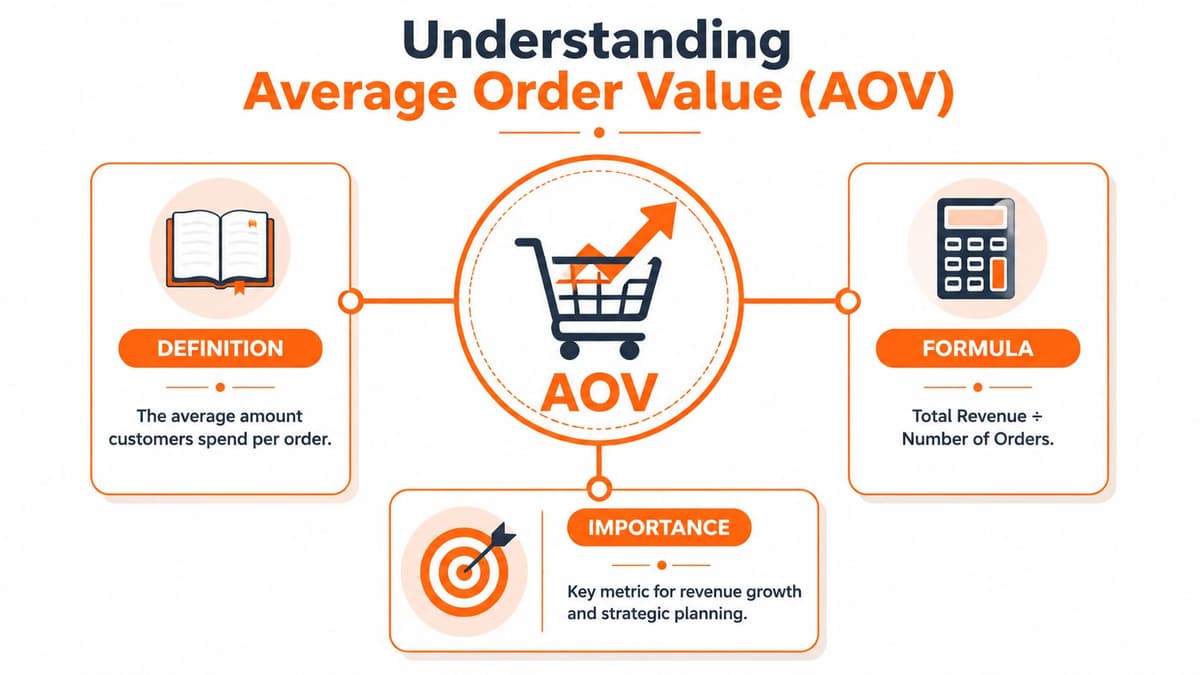
AOV stands for Average Order Value. It measures the average dollar amount per order, not the value of the customer over time.
#The formula is simple
Use this formula:
AOV = Total Revenue ÷ Number of Orders
If your store generates $2,000 from 100 orders, your AOV is $20. Raise that to $22 at the same order volume and revenue becomes $2,200. No extra traffic. No higher ad spend. Just a larger average basket.
That's why AOV matters to your bottom line. Small lifts create meaningful revenue gains fast.
If you want to place AOV in context with conversion rate, CAC, and retention, review these eCommerce KPIs that actually matter.
#A "good" AOV depends on what you sell
Stop asking whether your AOV is good in isolation. That question wastes time.
A snack brand, a skincare subscription, and a premium electronics store should not target the same order value. Category, price point, purchase frequency, and product mix all shape what healthy AOV looks like. The useful comparison is your own store over time, segmented by channel, device, customer type, and product collection.
AOV only becomes actionable when you compare it against margin and repeat purchase behavior.
#AOV is a transaction metric, not a growth strategy
Founders often get sloppy. They treat AOV like a score to maximize at all costs. That's how you end up pushing bundles, thresholds, and add-ons that raise the first order and hurt the second.
Keep the distinction clear:
- AOV measures the average value of one order
- CLV measures the value of the full customer relationship
That difference should shape your decisions. If a higher AOV comes from better product pairing or smarter merchandising, keep it. If it comes from forcing bigger carts that reduce repeat purchases, you're trading long-term growth for a short-term spike.
AOV is useful. CLV keeps it honest.
#Why a High AOV Can Be a Warning Sign
You run a promo, bundles take off, and AOV jumps. A week later, conversion softens, second orders lag, and you are left wondering whether the gain was real or whether you just trained customers to overbuy once.
That is the trap.
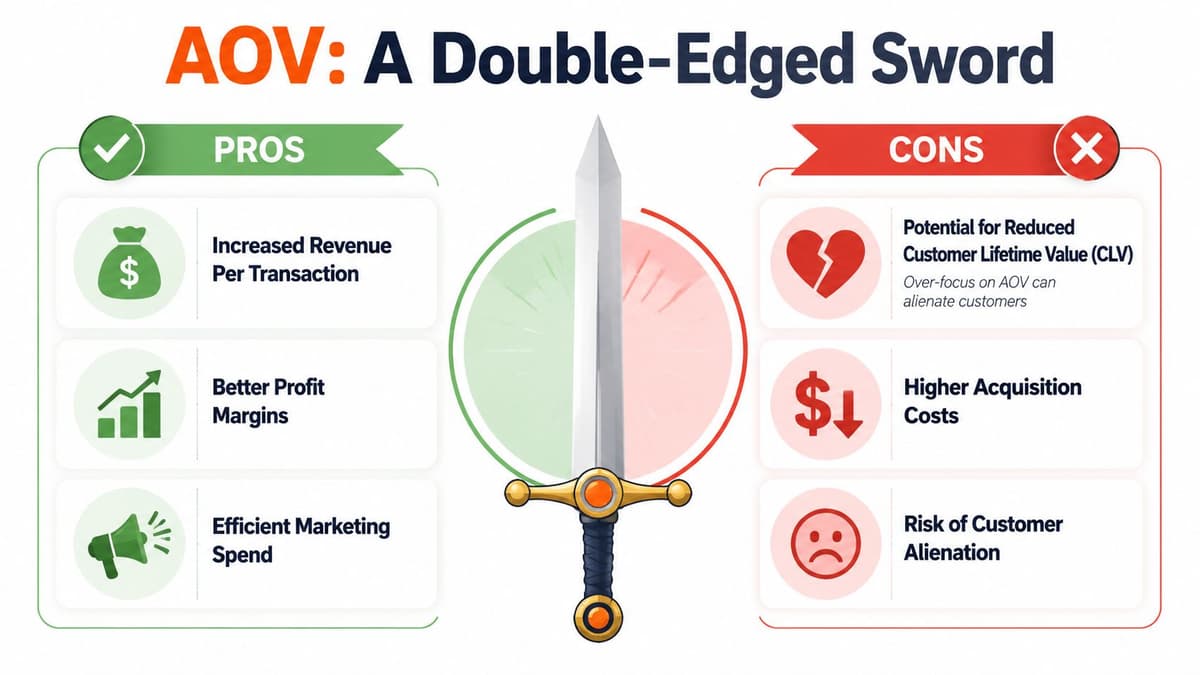
A high AOV can signal better merchandising. It can also signal that you are squeezing too much value out of the first transaction and making the next purchase less likely. For a Shopify founder, that distinction matters more than the headline number on the dashboard. Revenue pulled forward is not the same as revenue created.
#AOV and CLV can move in opposite directions
Some stores raise AOV by making the cart more useful. Others raise it by adding friction, forcing thresholds, or pushing bundles that do not match customer intent. Those are very different outcomes.
If a customer buys a larger first order because the offer is genuinely helpful, keep going. If they buy a larger first order because your cart setup pressures them into spending more than they planned, expect weaker retention. The result is simple. You get a short-term lift in order value and a weaker customer file three months later.
AOV only deserves credit when repeat purchase behavior stays healthy.
#Raw averages are easy to misread
AOV is an average. A few unusually large orders can make a test look better than it really is.
AB Tasty's analysis of misleading AOV reads explains the problem clearly. A variant can post a higher raw AOV because a small number of high-spending customers landed in that group, not because the experience improved for the broader audience. The same analysis also notes that statistical significance matters when comparing AOV test results, and that seasonality alone can create large swings in order value. Do not treat one clean-looking average as proof.
This is why smart teams segment before they celebrate. Review AOV by first-time versus returning customers, channel, product category, and offer type. If you need a starting point, use these customer segmentation examples for ecommerce brands to break apart blended performance.
#What to check before you call higher AOV a win
Use a tighter filter:
- Repeat purchase rate: Did customers who spent more come back at the same rate, or did reorders fall?
- Conversion rate: Did the AOV lift come with added cart friction?
- Margin by order type: Did discounts, shipping costs, or bundle composition eat the profit?
- Refund and support patterns: Did bigger carts create more regret, returns, or confusion?
- Cohort quality: Are new customers acquired under the higher-AOV offer as valuable as your normal cohorts?
This is the part many founders skip. They look at the cart value and ignore the customer behavior behind it.
A better approach is to raise AOV in ways that feel aligned with the buying journey. Relevant add-ons, smarter bundles, refill logic, and threshold offers that are close to current spend usually outperform heavy-handed upsells over time. If you want more examples, review these effective strategies for higher AOV, then pressure-test each one against retention, not just first-order revenue.
The rule is simple. AOV is a good signal only when it rises without damaging CLV. If it hurts repeat business, it is a warning sign, not a win.
#Five Actionable Tactics to Increase Your AOV Today
You're already paying to get people to the store. The mistake is pushing harder for a bigger first order without asking whether that customer will want a second one.
Raise AOV in ways that feel useful, easy, and consistent with why the customer came to buy. That is how you get more revenue now without dragging down CLV later.
#AOV-Boosting Tactics and Their Estimated Impact
| Tactic | How It Works | Estimated Impact per Order |
|---|---|---|
| Product bundling | Group complementary products into a more attractive package than buying items separately | Can lift order value when the bundle matches a real buying pattern |
| Tiered discounts | Reward larger carts with stronger value at higher spend levels | Can raise basket size if the threshold feels attainable |
| Strategic cross-sells | Show related items on product, cart, or checkout surfaces | Adds incremental revenue when the recommendation fits the item already in cart |
| Post-purchase upsells | Offer a one-click add-on after the initial transaction | Often captures accessory or refill revenue with low friction |
| Free shipping threshold | Set free shipping above current AOV to encourage one more item | As noted earlier, a threshold modestly above current AOV often lifts final cart value |
Here's the order I'd use.
-
Start with a free shipping threshold. It is usually the fastest test because shoppers understand it immediately. Keep the gap close enough to current spend that adding one item feels reasonable, not forced.
-
Build bundles from actual attach behavior. Pair products customers already buy together, such as a hero item with a refill, accessory, or protection add-on. Forced bundles can raise first-order revenue and still hurt retention if buyers feel they were pushed into extras they did not want.
-
Place cross-sells where purchase intent is already high. Product pages, cart drawers, and checkout-adjacent surfaces usually beat generic recommendation blocks. Relevance matters more than volume.
A practical reference for merchandising ideas is this roundup of effective strategies for higher AOV from Silver Spoon Agency. Use it as inspiration, then judge every tactic by margin, conversion rate, and repeat purchase behavior.
-
Use post-purchase upsells for simple add-ons. Accessories, samples, and consumables work well because the customer does not need to rethink the main purchase. Keep the offer narrow and easy to accept in one click.
-
Segment the offer before you show it. First-time buyers usually need confidence and simplicity. Returning customers often respond better to replenishment bundles or higher-value add-ons. This guide to a customer segmentation example for eCommerce is a good starting point if you need clearer rules for who should see which offer.
Run one test at a time. Keep it if it increases order value without hurting conversion, refund rate, or repeat purchase rate. Kill it if it makes the cart feel heavier.
That tradeoff matters. AOV tactics should increase cart value because the offer is more relevant, not because the customer feels cornered.
#How to Track AOV and Find Hidden Opportunities
Tracking AOV inside Shopify is easy. Interpreting it well is the actual job.
Start with the native metric so you have a baseline. Then break it apart by device, channel, and customer type. That's where the useful opportunities usually show up.
#Start with Shopify Analytics
In Shopify, go to your analytics area and find Average Order Value for the period you care about. Don't overcomplicate this part. Pull the number for the last month, then compare it against a prior period that makes sense for your business.
After that, stop staring at the top-line number. Start splitting it:
- By device so you can see where friction is reducing transaction size
- By channel to understand which acquisition sources bring deeper buyers
- By new versus returning customers so you can spot whether order value is being driven by acquisition or loyalty
For a practical view of how analytics should support action, not just reporting, this guide on analytics in eCommerce is a good lens.
#Look for the mobile gap and customer segments
One of the most common blind spots is device performance. Industry data shows a persistent mobile-desktop gap, where mobile AOV is typically 30% to 40% lower than desktop AOV due to checkout friction or weaker product discovery on smaller screens.
That gap matters because many Shopify stores get heavy mobile traffic. If mobile shoppers buy, but buy smaller, your store may not have a traffic problem at all. It may have a merchandising or checkout problem on small screens.
Common causes include:
- Weak cross-sell visibility because recommendations sit too far down the page
- Checkout friction from awkward form flow or distracting steps
- Poor cart design that hides the value of adding one more product
- Cluttered mobile PDPs that bury bundles and complementary items
Here's a helpful walkthrough if you want to think more visually about how teams review growth signals and store performance:
If your desktop AOV looks healthy and mobile AOV lags, don't blame traffic quality first. Audit the mobile buying path.
You should also look at AOV by cohort. A higher number from first-time buyers can be good. It can also mean your acquisition offer is pulling in one-and-done customers. A higher number from returning customers is often a stronger signal because it usually reflects trust, product fit, and easier reordering behavior.
#From Metric to Strategy Start Your AOV Plan
By now, the answer to what does AOV stand for should be clear. It's Average Order Value, and for a Shopify founder, it's one of the cleanest revenue levers available.
But the main point isn't the definition. The point is discipline.
AOV is useful when you treat it as part of a system. Raise it with better merchandising, sharper thresholds, and relevant offers. Then check whether those changes protect conversion, retention, and the customer experience. That's how you grow without creating fake progress.

Do this in the next hour:
- Calculate your last 30 days of AOV using total revenue divided by total orders.
- Choose one tactic from this article to test this week.
- Review AOV beside repeat behavior, not in isolation.
- Check mobile versus desktop before you spend more on acquisition.
If you do only that, you'll be ahead of most operators. Most stores track AOV. Fewer use it well. The founders who win are the ones who turn one dashboard number into a repeatable operating decision.
If you want help turning raw Shopify numbers into clear weekly actions, Arlo is built for that job. It gives founder-led brands a concise AI-powered marketing report that explains what changed, why it matters, and what to do next, without making you dig through multiple dashboards.