
Real Estate Ads: The 2026 Conversion Playbook
By Arthur Falcone · Founder of Arlo
The most popular advice about real estate ads is to improve the photos, widen the audience, and collect more leads. That's incomplete. A campaign that fills your CRM with people who never book, can't understand the financing assumptions, or didn't realize which property they were asking about isn't working.
Qualification and fair delivery are part of conversion, not cleanup tasks after launch. A smaller inquiry count can be the better result when appointments, preapproval, showing attendance, and closed revenue improve. The operating discipline is straightforward: define the action, make the offer clear, preserve fair access, and move money only when downstream outcomes justify it.
#Table of Contents
- Pick One Job for the Ad
- How to Build a Compliant Campaign
- Creative and Copy That Earn the Inquiry
- Budget Bidding and the Rates That Count
- Test Lead Quality Without Shutting People Out
- Move the Budget After One Window
#Pick One Job for the Ad
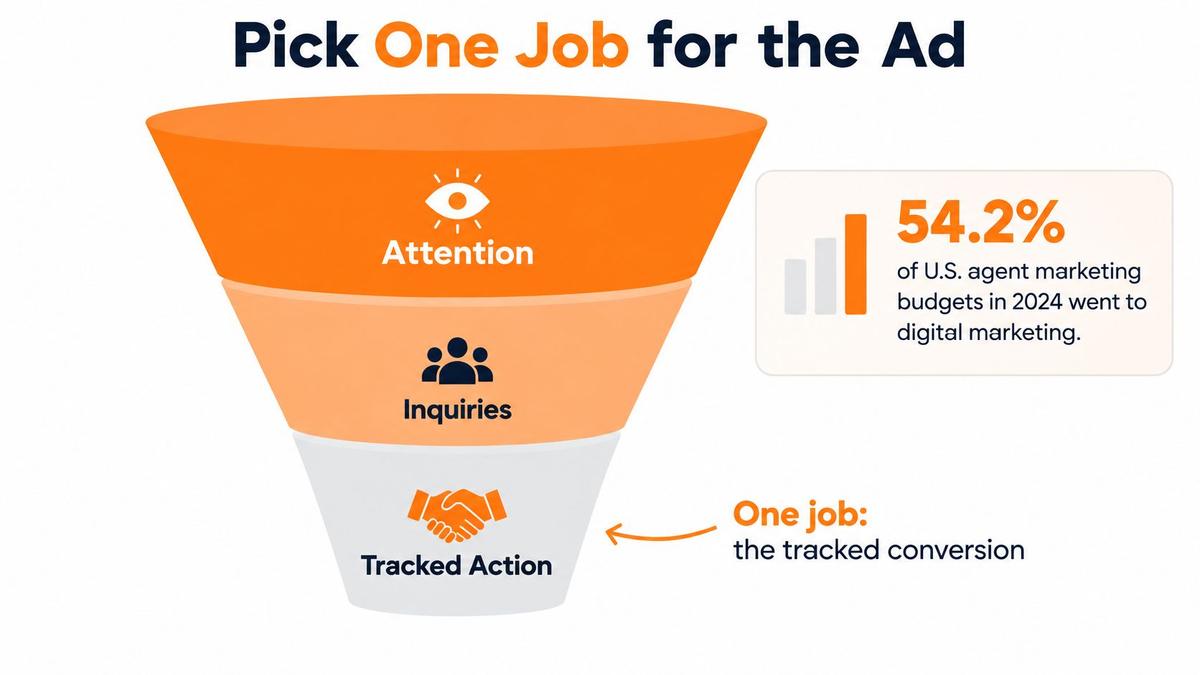
Don't optimize clicks when you need appointments. Digital marketing represented 54.2% of U.S. real estate agents' marketing budgets in 2024, according to REsimpli's industry survey compilation. That spending needs to earn a tracked action, not merely produce activity in an advertising dashboard.
Start with a completed inquiry, showing request, valuation request, or open-house RSVP. A photo click, video view, or partially completed form can help diagnose behavior, but it isn't the conversion you should buy.
#One objective, one conversion, one number
| Campaign job | Primary conversion | Judge it by | Do not optimize |
|---|---|---|---|
| Active listing | Showing request | Cost per qualified showing | Photo clicks |
| Seller lead | Valuation request | Cost per booked appointment | Form starts |
| Open house | RSVP | Show-up rate | Event responses |
| Retargeting | Appointment from prior viewers | Cost per appointment | Reach |
| Broad home search | Inquiry with budget and timing | Qualified-lead rate | Raw lead count |
An active-listing campaign should land on that property's page, with availability and a showing request prominently displayed. Count a qualified showing only after confirming genuine interest in that listing and a workable next step. Don't let repeat submissions inflate the result.
A seller campaign needs a home-value form rather than a buyer search page. The valuation request is the initial conversion, but the booked valuation appointment decides whether the campaign deserves more money.
For an open house, send visitors to an RSVP page containing the address, schedule, and attendance instructions. Event responses indicate interest. Actual attendance tells you whether the promise and reminders worked.
The funnel should narrow toward an auditable action.
#Make the destination match the job
Retargeting should invite previous listing viewers to book an appointment, where platform rules permit that audience. Broad home-search campaigns need voluntary budget and timing questions so the inquiry arrives with useful context.
Combining buyers and sellers in the same campaign creates an avoidable measurement problem. They need different pages, different follow-up, and different definitions of progress. Optimizing video views creates a different problem: you're asking the platform to find watchers rather than people willing to inquire.
Practical rule: If the sales team can't identify the next action from the campaign name, the campaign is too broad.
Ecommerce founders can copy this discipline onto a high-ticket product consultation or local service offer. Before creative work begins, name one revenue-linked event, one landing page, and one campaign UTM. Write the selected conversion into the ad account, and test that it fires only after the action is completed.
#How to Build a Compliant Campaign
Build compliance into campaign structure rather than treating it as a final copy edit. Audience settings, placements, and landing pages need the same scrutiny as the headline.
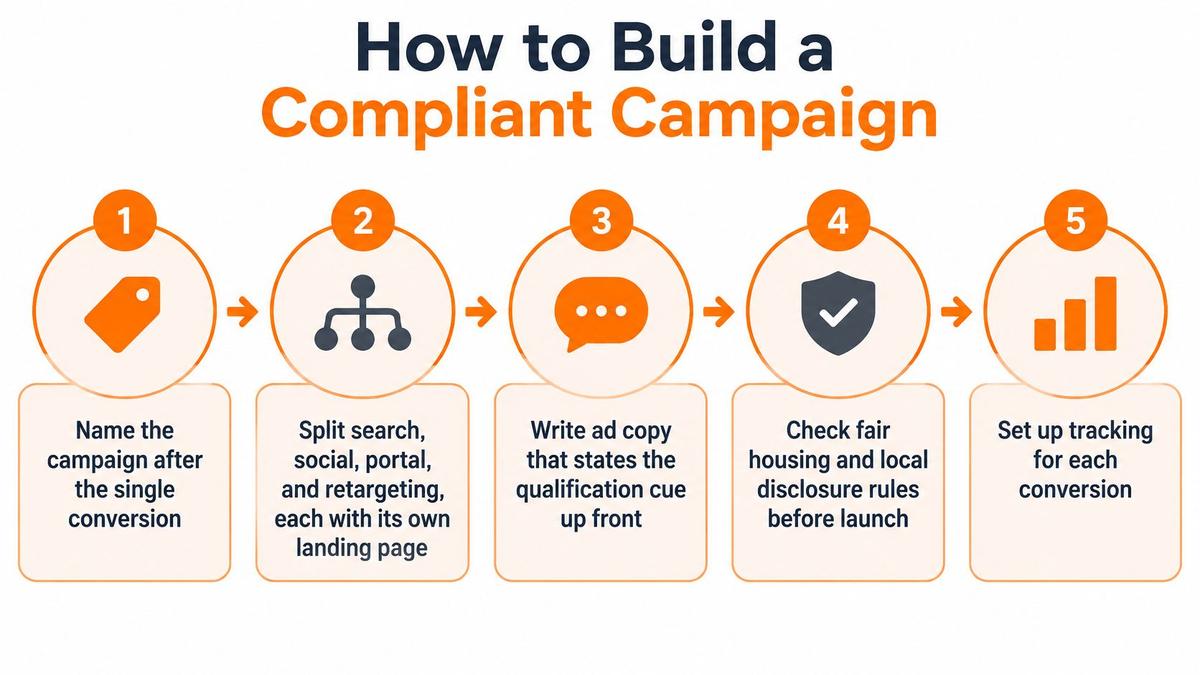
Use this launch sequence as an operating checklist.
#Set the account boundaries
- Name the campaign after its conversion. Use a name that identifies the property or offer and the completed action.
- Split search, social, portal, and retargeting traffic into distinct campaigns with dedicated landing pages and call tracking. Keep the offer consistent while preserving channel attribution.
- Remove restricted audience settings. For U.S. and Canadian housing campaigns, Google's housing-ad policy prohibits targeting by gender, age, parental status, marital status, and ZIP code, while permitting city, country, or radius targeting covering at least 1 kilometer.
Housing-ad signals you can and cannot use
| Signal | Housing ads | Use instead |
|---|---|---|
| Gender | Not allowed | Do not set |
| Age | Not allowed | Do not set |
| Parental status | Not allowed | Do not set |
| Marital status | Not allowed | Do not set |
| ZIP code | Not allowed | City, country, or radius |
| Radius under 1 km | Not allowed | Radius of at least 1 km |
| City or country | Allowed | Location of the property |
| First-party site behavior | Allowed where the platform permits | Viewed listing or started a form |
- On other platforms, use permitted property-location signals, listing interest, and first-party site behavior. Don't use protected-class proxies or lookalikes designed to narrow housing exposure.
- Limit exclusions to existing clients or people who already converted, where permitted. Record every exclusion and its operational reason.
- Match the landing page to the ad's price or payment, beds, location, and booking promise. If a Puerto Rico property raises incentive questions, let readers browse Act 60 incentive answers from Christie's International Real Estate Puerto Rico rather than compressing complex eligibility questions into an ad claim.
- Turn on tracking for the selected completed action, then submit a test inquiry before spending.
Ecommerce operators should audit restricted attributes by product category too. Shift experimentation toward broad geography, permitted first-party behavior, and creative rather than assuming every audience control is appropriate for every offer.
#Audit delivery as well as settings
Research published through ACM on Meta housing-ad delivery found racial delivery disparities above 10% in all 18 tested cases without variance reduction; mitigation brought variance below 10% in every case and below 5% in 15 cases. Correct settings alone don't establish equitable delivery.
Enable the platform's housing designation and available variance-reduction controls. Export reach, compare distribution across channels using legally appropriate diagnostics, and don't infer an individual's protected characteristics.
HUD's advertising guidance treats placement as part of housing advertising and warns against selecting media or locations unlikely to attract people because of race, color, religion, sex, disability, familial status, or national origin. Log placements beside exclusions.
Before launch, verify that the Google radius meets its minimum and no prohibited demographic filter remains. After launch, inspect who receives the opportunity.
#Creative and Copy That Earn the Inquiry
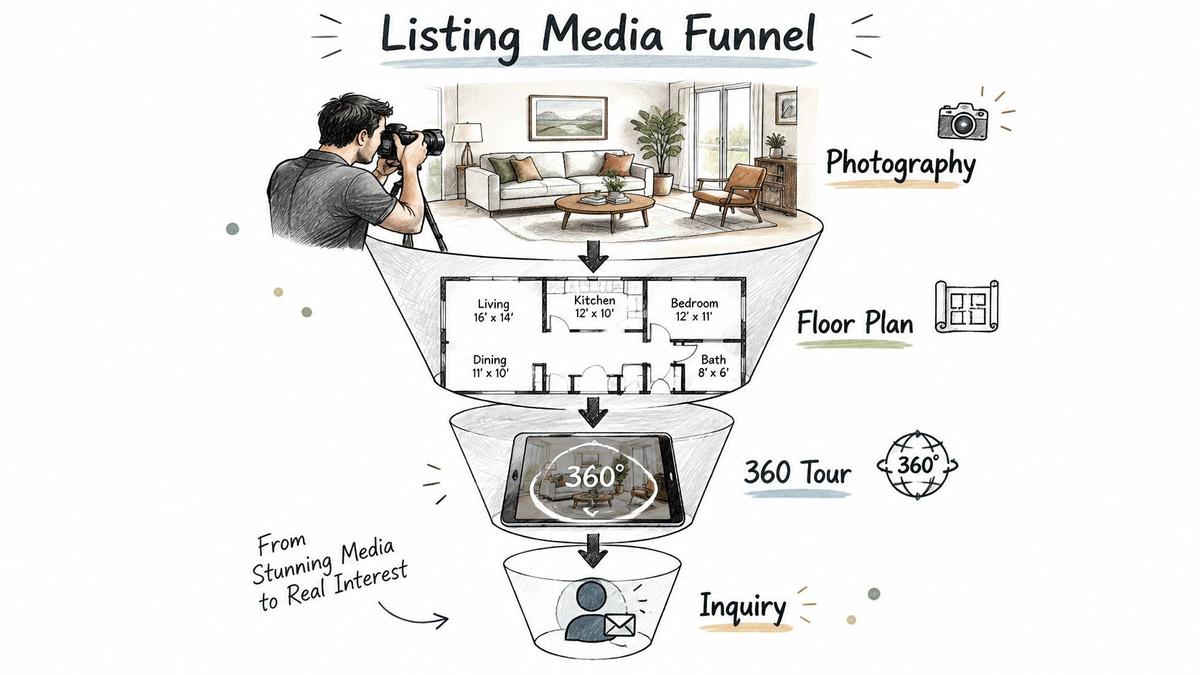
Treat listing media as a decision funnel, not decoration. Buyers need to understand the property before they can make a useful showing request. Attractive images that conceal layout or contradict the description create questions your sales team must resolve later.
Build the media package in this order.
#Fix the visual foundation first
- Photography: Commission consistent exposure, composition, and color. Sequence rooms logically so viewers can understand how the spaces connect.
- Floor plan: Add a dimensionally credible plan that agrees with the photographs and property description. Label spaces clearly rather than leaving buyers to reconstruct the layout.
- Immersive tour: Add a true panoramic walkthrough after the photos and facts are reliable. A slideshow isn't an immersive tour.
- Outcome tracking: Compare inquiries, completed showings, and offers by media package against comparable properties, accounting for price, location, and property quality.
The National Association of REALTORS' coverage of listing-media research reports that, among more than 25,000 U.S. portal listings, fewer than 30% followed professional-photography best practices, 16% included a floor plan, and 94% lacked an immersive tour; it also describes Harvard Business School research using 75,178 Los Angeles-area sales, where an apparent 1.1% tour price premium became statistically insignificant after controlling for photo and description quality.
That's a reason to improve the basics, not a promise that buying a tour increases the sale price. Evaluate the tour through qualified inquiries, showing completion, days-to-offer, and price reductions. Don't mistake time spent exploring for intent to transact.
A media upgrade earns its place when it helps someone make a better decision, not merely when it produces more views.
#Write copy that answers the next question
Use these patterns as drafting templates, replacing bracketed fields with verified listing details:
- Search headline: [Neighborhood] home | [Bed count] beds | [Asking price] | Request a showing.
- Social primary text: [Documented property feature] in [location]. View the floor plan and asking price. When would you ideally like to move? Answering is optional.
- Retargeting line: Revisit [listing name or address] and choose a showing time.
Keep retargeting language property-focused. You don't need to tell someone you tracked their visit to make the next step relevant.
Royal LePage Brookside Realty's guide to social media marketing for realtors offers useful channel-planning context. For drafting variations, apply the hook, proof, and action structure in this Facebook ad copywriting guide, while keeping property facts fixed.
Use the video as a separate creative reference, not a substitute for listing evidence.
HUD's residential advertising materials state that space advertising for residential property for sale or rent should contain an Equal Housing Opportunity logotype, statement, or slogan. Include the appropriate mark and keep the price, payment assumptions, and booking steps consistent between creative and landing page.
Ecommerce founders can reuse the pattern: hero proof, a concrete offer number, and a clear next step. Keep the material terms identical at checkout.
#Budget Bidding and the Rates That Count
Set the measurement protocol before choosing a bid strategy. Automated bidding can pursue the conversion you give it, but it can't repair a definition that counts duplicate submissions or unresponsive contacts as success.
The directional figures below are reported benchmarks, not spending promises. Pinnacle Real Estate Marketing's conversion-rate guide reports approximately 3.70% search-ad conversion, $102.51 cost per lead, and 13.61% invalid traffic; geography, conversion definitions, inventory, and attribution windows affect comparability.
Directional benchmarks for paid real estate ads
| Measure | Directional figure | How to use it | Do not |
|---|---|---|---|
| Search conversion rate | 3.70% | Compare like-for-like intent | Mix branded and generic |
| Cost per lead | $102.51 | Sanity-check spend | Treat as a success target |
| Invalid traffic | 13.61% | Filter before judging CPL | Reallocate on raw leads |
| Lead conversion | Leads ÷ clicks | Find the weak stage | Optimize CPC instead |
| Qualified-lead rate | Qualified leads ÷ leads | Decide budget shifts | Count duplicates as wins |
#Calculate the stages separately
Lock the selected conversion and record spend, impressions, clicks, leads, qualified leads, appointments, offers, and closed transactions. Preserve the campaign and landing-page identifiers in the CRM so an eventual transaction can be traced to its acquisition source.
Use stage rates to locate the actual constraint:
- Lead conversion: Leads divided by clicks reveals whether visitors complete the inquiry.
- Qualified-lead rate: Qualified leads divided by leads reveals whether the inquiry has useful intent and context.
- Appointment rate: Appointments divided by qualified leads reveals whether follow-up and scheduling work.
- Cost per qualified lead: Spend divided by qualified leads provides a more defensible budget signal than raw CPL.
Define qualification before reviewing results. Record contactability, interest in the actual offer, voluntary timing information, and the agreed next step. Don't let agents apply different standards based on how promising a person appears.
Say one hypothetical campaign produces $70 leads and another produces $140 leads. The cheaper campaign loses if its contacts never attend while the more expensive campaign produces viable appointments. Those example prices don't tell you which campaign wins without the downstream outcomes.
#Buy enough evidence before changing bids
Set a learning budget using your expected cost per qualified lead and the volume your team can follow up properly. Fund enough qualified opportunities to judge a week of activity, but don't assume that a week is always sufficient. Your minimum observation window must allow for normal response delays, booking, and attendance.
Keep the initial window fixed. Extend it when the sample is too small rather than converting uncertainty into a confident budget decision.
Budget discipline: Don't lower bids to solve a booking problem, and don't increase bids to compensate for invalid traffic.
Use fraud filtering and deduplicated CRM labels before reviewing performance. Separate unresponsive contacts, booked appointments, attended showings, offers, and closed transactions instead of leaving everything labeled as a lead.
Pause a placement when its qualified-lead rate collapses after a fair observation window. Cap retargeting frequency where supported, and isolate branded search so existing demand can't disguise weak generic-intent performance.
For ecommerce founders, the same distinction underpins cost per acquisition: an inexpensive intermediate action isn't necessarily an inexpensive customer. Compare stage efficiency with MER, total revenue divided by total ad spend, rather than relying on platform ROAS alone.
#Test Lead Quality Without Shutting People Out
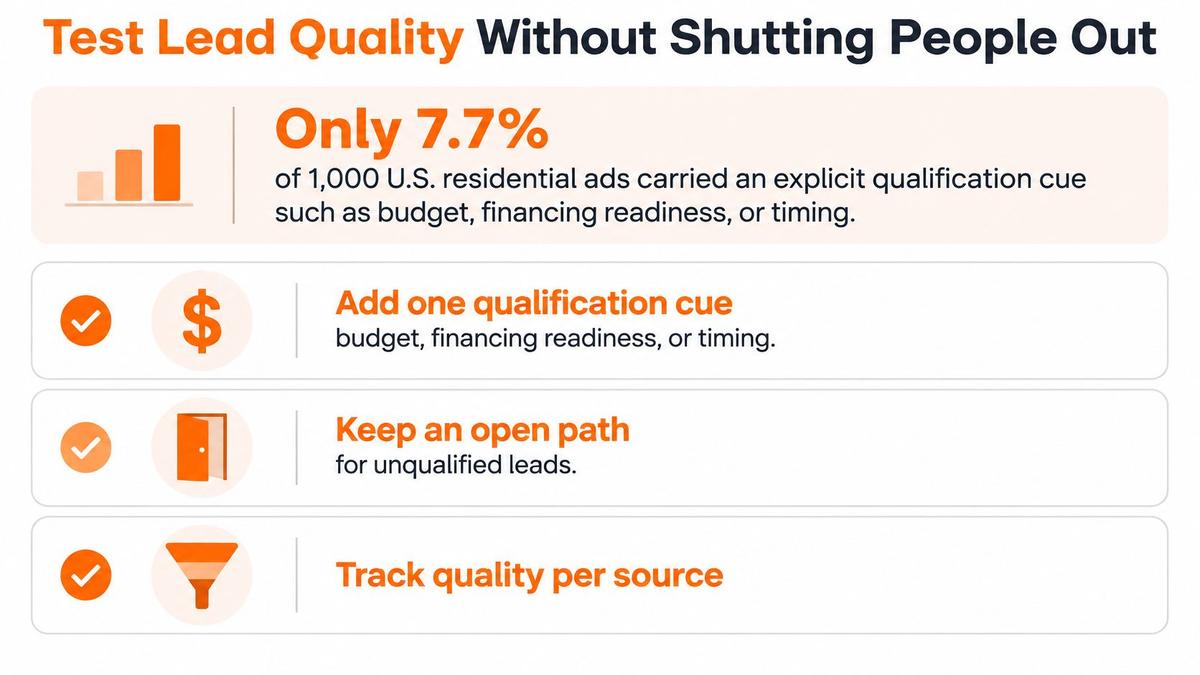
Only 7.7% of 1,000 U.S. residential ads in a 2026 review included an explicit qualification cue such as budget, financing readiness, or timing, compared with approximately 10% of instant-form ads, while price or monthly-payment information appeared in just 38% overall, according to HousingWire's coverage of buyer qualification in advertising.
That leaves a practical opening: help people understand the offer before they submit. Useful friction clarifies the decision. It doesn't require shutting out people who need financing guidance or aren't ready to move immediately.
Use this checklist to keep qualification informative rather than exclusionary.
#Test disclosure against vague aspiration
Use the current dream-home message as Variant A. Build Variant B toward a clearer offer containing the asking price or illustrative monthly payment, labeled down-payment assumptions, and an optional question about timing or financing status.
Don't change everything simultaneously. Test the price disclosure first, then the voluntary question, then additional payment context. Hold the audience, destination, and other creative elements steady enough to attribute the difference.
If you show a payment illustration, state the assumptions prominently and explain what the amount includes or excludes. Have financing claims and required disclosures reviewed before publication. A payment number without its assumptions can create false expectations rather than useful self-selection.
Compare outcomes with consistent denominators:
- Appointment rate: Do more inquiries become booked conversations?
- Preapproval rate: Do more participating buyers progress to documented financing readiness?
- Showing attendance: Do booked prospects arrive?
- Closed revenue: Does the test improve completed business after allowing for the sales cycle?
A decline in inquiries can be a win when those outcomes improve. A rise in preapproval alone isn't enough if attendance falls or follow-up capacity deteriorates.
Use statistical significance to distinguish evidence from ordinary variation. Don't declare a winner after an isolated appointment, and don't treat an immature revenue cohort as a failed campaign.
#Preserve an open path
Let visitors choose that they're still researching or would like financing information. Route those inquiries into appropriate follow-up rather than treating readiness as a judgment about who deserves access to housing.
The HUD guidance on digital housing advertising explains that the Fair Housing Act prohibits advertisements indicating preference, limitation, or discrimination based on race, color, religion, sex, national origin, disability, or familial status. The prohibition applies to making, printing, or publishing the ad, not only to the eventual transaction.
Give a named owner responsibility for publication approval:
- Review the whole experience: Check the headline, image, landing page, and audience settings for preferences or exclusions.
- Confirm disclosure consistency: Keep the Equal Housing Opportunity mark present and material terms aligned.
- Preserve the record: Save creative versions, placement records, and documented exclusions.
- Stop discriminatory tests: Never use a protected class as the experimental split or direct the media plan away from a protected group.
Ecommerce teams marketing regulated or sensitive offers should keep the same approval owner and channel records. Qualification should explain the transaction, not become an informal substitute for lawful eligibility rules.
#Move the Budget After One Window
After the minimum observation window closes, make a narrow decision rather than refreshing the entire account. Keep the sales cohort consistent when comparing outcomes. Otherwise, you'll compare mature appointments from an older campaign with incomplete follow-up from a newer one.
#Apply the decision sequence
-
Qualified-lead rate holds, but appointments stall. Rewrite the landing page's booking instructions and inspect the handoff to the calendar. Leave the bid unchanged while testing whether visitors can understand availability, choose a slot, and receive confirmation.
-
Search beats social on cost per qualified lead. Move the next budget increment toward search. Limit social acquisition spending and retain permitted retargeting for previous listing viewers, provided the delivery audit supports that decision.
-
Portal traffic produces showings but not offers. Keep the placement stable while testing the floor plan and price presentation. Review showing feedback for misunderstandings about layout, condition, or affordability before buying more traffic.
-
Cheap leads include duplicates or invalid submissions. Recompute cost per qualified lead after filtering. Don't scale a placement because its uncleaned report looks efficient, and don't penalize another placement for maintaining cleaner records.
-
Branded search appears to outperform everything. Keep it separate. Evaluate generic-intent search on its own economics rather than letting people already looking for the agency make acquisition performance look stronger.
-
Delivery shows a protected-class disparity and mitigation is off. Pause the affected campaign and investigate. Rebuild using permitted city, country, or compliant-radius geography plus first-party behavior where allowed, activate available housing safeguards, and review the subsequent delivery export before scaling.
-
Record the decision. Assign the campaign a keep, fix, or stop status, name the owner, and state what evidence would change that status. Wait another observation window before judging the adjustment unless compliance or tracking fails.
#Change the constrained stage
Don't combine a bid change, new audience, replacement creative, and landing-page rewrite into the same intervention. You might improve results, but you won't know which action to preserve or reverse.
Move money after you identify the constraint, not after you get tired of waiting.
Ecommerce founders can apply this sequence to high-ticket offers by substituting consultations, purchases, and fulfilled revenue for showings and offers. Confirm the move with MER and operating margin, not platform ROAS alone. A campaign deserves more budget when it improves business outcomes without concealing poor lead quality or narrowing fair access.
Arlo offers an AI marketing analyst for Shopify stores, with Meta Ads reporting covering spend, impressions, reach, clicks, CTR, CPC, CPM, conversions, ROAS, and other standard performance metrics from connected accounts. Visit Arlo to turn store and marketing signals into prioritized actions, and try our free Should I Kill This Ad? tool when reviewing whether an ad deserves more budget. Pair that reporting with qualified-lead and revenue outcomes so your next decision isn't based on cheap clicks alone.